Peterboro in Madison County, New York — The American Northeast (Mid-Atlantic)
To Work In The Abolition Movement

Photographed by Susan A. Dalaba, April 25, 2022
1. To Work In The Abolition Movement Marker
Black abolitionists came to Peterboro to work with Gerrit Smith in the abolition movement
1817 or 1818 Douglass born a slave in Maryland
1838 Douglass escaped from slavery and worked as a strip caulker in New Bedford, MA
1841 William Lloyd Garrison heard Douglass speak and invited him to join the American Anti-Slavery Society
1845 Published Narrative of the Life of Frederick Douglass, an American Slave
1847 Moved to Rochester, NY
1848 Attended First Women’s Rights Convention, Seneca Falls, NY
1852 Delivered “What to the Slave is the Fourth of July?”
1855 Published My Bondage and My Freedom
1872 First African American nominated for Vice President
1877 Appointed as United States Marshal
1881 Published Life and Times of Frederick Douglass
1889 Appointed minister - resident to Republic of Haiti
1895 Died Washington, DC
1895 Buried Mt. Hope Cemetery, Rochester, NY
Douglass spoke at anti-slavery conventions in Peterboro and in the Free Church of Peterboro which Gerrit Smith had established. Douglass worked
this page online
Jermain Loguen visited Peterboro, where he shared property ownership with Garnet and Ward. He worked with Gerrit Smith on abolition activities. Both were Underground Railroad station masters.
1813 Born into slavery in Tennessee
1834 Escaped to Canada
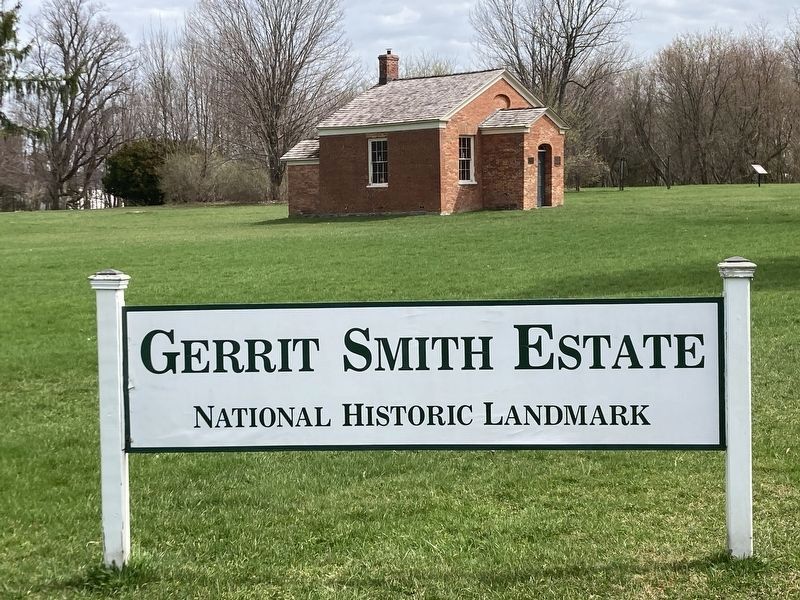
1839 Student at OneidaInstitute in Whitesboro, NY and started school in Utica, NY for black childrenPhotographed by Susan A. Dalaba, April 25, 20222. Entrance to the Gerrit Smtih Estate National Historic Landmark
1844 Frederick Douglass introduced Loguen to Smith
1846 Smith deeded Peterboro property to Loguen
1851 Loguen sold his Peterboro property
1851 Fled to Canada following his indictment for the Jerry Rescue
1852 Returned to his Syracuse, NY Underground Railroad Station
1859 Published The Rev. J.W. Loguen, as a Slave and as a Freeman: A Narrative of Real Life
Perhaps the best known conductor for the Underground Railroad, Nurse, Military Scout, Union spy in Civil War, and Women’s rights advocate.
Called “General Tubman” by John Brown
“Moses of her People”
1822 Tubman born Araminte Ross as a slave in Maryland
1849 Tubman escaped to freedom
1850 First return trip South to bring more slaves to freedom
1859 Abolitionist U.S. Senator William H. Seward sold Tubman property in Auburn, NY
1861 Cook, nurse, scout, spy during Civil War
1863 Led Combahee River Raid SC liberating 100 slaves
1865 Moved to Auburn, NY
1869 Sarah H. Bradford wrote biography Scenes in the Life of Harriet Tubman
1913 Died and buried in Auburn, NY
Tubman’s

Photographed by Susan A. Dalaba, April 25, 2022
3. To Work In The Abolition Movement Marker - Land Office On The Estate
1815 Garnet born on Maryland slave plantation
1824 Garnet family escaped
1836 Garnet entered Oneida Institute in Whitesboro, NY
1842 Pastor Liberty Street Presbyterian Church Troy, NY
1843 “Address to the Slaves” advocated physical resistance
1850 Delegate to World Peace Congress Frankfurt, Germany
1856 Pastor of Shiloh Presbyterian Church in New York City, NY
1858 Met with John Borden in Philadelphia
1864 Pastor 15th St. Presbyterian Church Washington, D.C.
1865 First African American to deliver sermon in House of Representatives
1881 Appointed members minister to Liberia
1882 Died and buried in Liberia
In 1846, Garnet was chosen by Gerrit Smith as one of the trustees for Smith’s gift of 120,000 acres of land to 3000 African American New Yorkers. All the deeds bore the date September 1, 1846, including an indenture for a price of property in Peterboro, NY, that was deeded to H.H. Garnet, Samuel R. Ward, and J.W. Loguen. Garnet lived in Peterboro 1848-1849 witnessing the local success at implementing his inter-racial harmony, and wrote to Frederick Douglass, “There are yet two places where slaveholders cannot come, Heaven and Peterboro.”
1797 Truth born as slave Isabella Baumfree in Ulster County NY
1826 Years called away from slave owner with her infant daughter
1828 Won court case to get her son back, who had been sold illegally
1843 Isabella changed her name to Sojourner Truth
1844 Joined Association of Education & Industry, Northampton, MA
1850 Narrative of Sojourner Truth: A Bondswomen of Older Times published by Garrison
1850 Purchased home in Northampton, MA
1861 Recruited black males and gathered supplies for Civil War service
1864 Worked with National Freedmen’s Relief Association
1883 Died in Battle Creek, MI
Sojourner Truth visited in Peterboro in 1851 and 1871. Truth wrote to Gerrit Smith March 23, 1871. “I would like to come out to Peterboro and have a meeting there and see you… I would like to stay a day or two and have a meeting.”
1817 Ward born in Maryland slavery
1820 Ward family fled to freedom
1826 Ward family settled in New York City
1832 Ward worked in black abolitionist David Ruggles’ grocery store
1839 Licensed to preach in Congregational churches
1839 Appointed agent of American Anti-Slavery Society
1843 Entered medical studies in Geneva, Switzerland
1846 Appointed pastor of Congregational Church in Cortland, NY
1851 Moved to Syracuse, NY
1851 Fled to Toronto after participating in Jerry Rescue in Syracuse; NY
1853 Campaigned in England to support Anti-Slavery of Canada
1855 Published Autobiography of a Fugitive Negro: His Anti-Slavery Labours in the United States, Canada & England
1855 Moved Jamaica
1866 Died in Jamaica
Ward first heard Gerrit Smith speak in May of 1838. When Ward was a boy his mother brought Samuel to Peterboro and Samuel “enjoyed the advantages of a thorough education” in the family of Gerrit Smith. (Charles Blackson.) Ward played a prominent role in the August 1843 black convention at Buffalo, NY where the Liberty Party was strongly endorsed by the attendees. In 1846, Ward sent freedom seekers from his station in Cortland to Peterboro. Ward was the recipient of a Peterboro land parcel from Smith which he sold in 1851 when he moved to Syracuse.
Topics. This historical marker is listed in these topic lists: Abolition & Underground RR • African Americans • War, US Civil. A significant historical year for this entry is 1817.
Location. 42° 58.101′ N, 75° 41.213′ W. Marker is in Peterboro, New York, in Madison County. It can be reached from the intersection of Pleasant Valley Road and Peterboro Road (County Road 32), on the right when traveling north. The marker stands on the grounds of the Gerrit Smith Estate National Historic Landmark. Touch for map. Marker is at or near this postal address: 5304 Oxbow Road, Cazenovia NY 13035, United States of America. Touch for directions.

Regionally, this marker is in Upstate New York, specifically in Central New York, and in the Syracuse Metropolitan Area. It is also in the American Northeast and in the Mid-Atlantic. Globally, it is in North America, the Western Hemisphere, the Western World, and the Anglosphere. Historically, it finds itself in what was once the Haudenosaunee (Iroquois) Confederacy, New Netherland, and one of the original Thirteen Colonies.
Other nearby markers. At least 8 other markers are within walking distance of this marker: Heaven & Peterboro (here, next to this marker); African American Soldier of the Civil War Buried at Peterboro (here, next to this marker); Purchased From Slavery (here, next to this marker); The Laundry (a few steps from this marker); The Birdhouse (a few steps from this marker); Greene Smith (within shouting distance of this marker); The Barn (within shouting distance of this marker); Designations (within shouting distance of this marker). Touch for a list and map of all markers in Peterboro.
Credits. This page was last revised on July 20, 2026. It was originally submitted on July 19, 2026, by Susan A. Dalaba of Cortland, New York. This page has been viewed 10 times since then. Photos: 1, 2, 3. submitted on July 19, 2026, by Susan A. Dalaba of Cortland, New York. • Devry Becker Jones was the editor who published this page.
Editor’s want-list for this marker. A wide shot of the marker in context. • Can you help?
