Pikeville in Pike County, Kentucky — The American South (East South Central)
Pikeville History Moments
visitpikeville.com
| — | Scan the code below to watch videos of Pikesville's most famous people and places in history. | — |
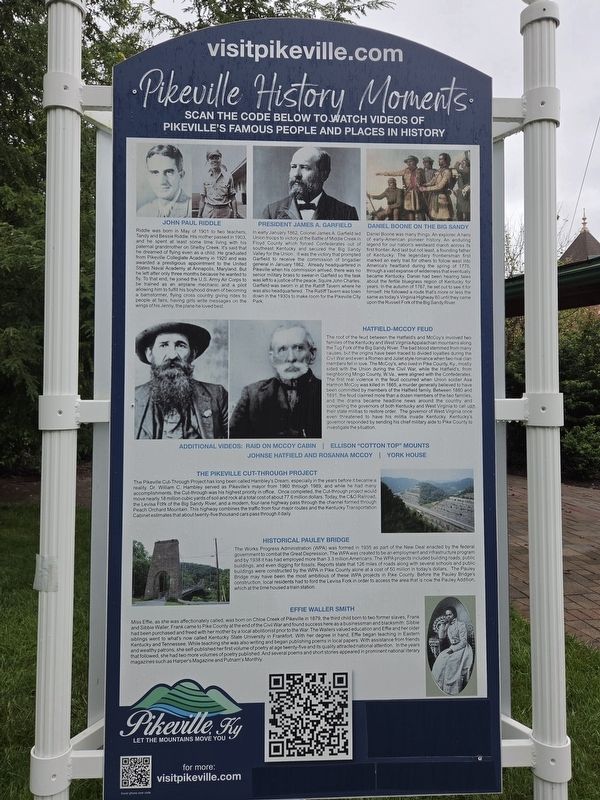
Photographed by Mark Parker, July 12, 2026
1. Pikeville History Moments Marker
John Paul Riddle
Riddle was born May of 1901 to two teachers, Tandy and Bessie Riddle. His mother passed in 1903, and he spent at least some time living with his paternal grandmother on Shelby Creek. It's said that he dreamed of flying even as a child. He araduated from Pikeville Colleaiate Academy in 1920 and was awarded a prestigious appointment to the United States Naval Academy at Annapolis, Maryland. But he left after only three months because he wanted to fly. To that end, he joined the U.S. Army Air Corps to be trained as ar airplane mechanic and a pilot allowing him to fulfill his boyhood dream of becoming a barnstormer, flying cross country giving rides to people at fairs, having girls write messages on the wings of his Jenny, the plane he loved best.
President James A. Garfield
In early January 1862, Colonel James A. Garfield led Union troops to victory at the Battle of Middle Creek in Floyd County which forced Confederates out of southeast Kentucky and secured the Big Sandy Valley for the Union. It was the victory that prompted Garfield to receive the commission of brigadier general in January 1862. Already
this page online
Daniel Boone on the Big Sandy Daniel Boone was many things. An explorer. A hero of early-American pioneer history. An enduring leaend for our nation's westward march across its first frontier. And last but not least, a founding father of Kentucky. The legendary frontiersman first marked an early trail for others to follow west into America's heartland during the spring of 1775, through a vast expanse of wilderness that eventually became Kentucky. Daniel had been hearing tales about the fertile bluegrass region of Kentucky for years. In the autumn of 1767, he set out to see it for himself. He followed a route that's more or less the same as today's Virginia Highway 80 until they came upon the Russell Fork of the Big Sandy River.
The Hatfield McCoy Feud
The root of the feud between the Hatfield's
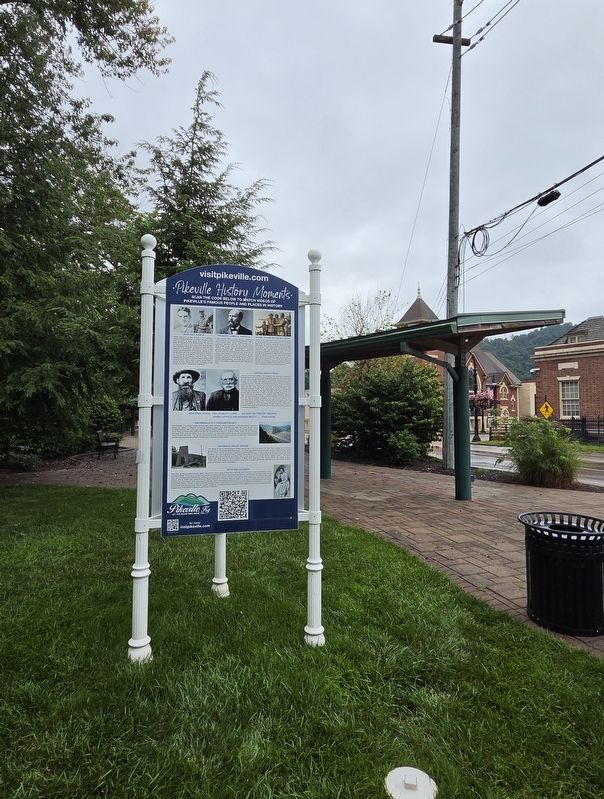
Photographed by Mark Parker, July 12, 2026
2. Wide wiew Pikeville History Moments Marker
Located at Pikeville City Park. Pikeville United Methodist Church is in the background across Hoffman Ave.
Additional Videos: Raid on McCoy Cabin • Ellison "Cotton Top" Mounts • Johnse Hatfield and Rosanna McCoy • York House
The Pikeville Cut-Through Project
The Pikeville Cut-Through Project has long been called Hambley's Dream, especially in the years before it became a reality. Dr. William C. Hambley served as Pikeville's mayor from 1960 through 1989, and while he had many accomplishments, the Cut-through was his hiqhest priority in office. Once completed, the Cut-through would move nearly 18 million cubic yards of soil and rock at a total cost of about 77.6 million dollars. Today, the C&O Railroad, the Levisa Fork of the Big Sandy River, and a modern, four-lane highway pass through the channel formed through Peach Orchard Mountain. This highway combines the traffic from four major routes and the Kentucky Transportation Cabinet estimates that about twenty-five thousand cars pass through it daily.
Historic Pauley Bridge
The Works Progress Administration (WPA) was formed in 1935 as part of the New Deal enacted by the federal government to combat the Great Depression. The WPA was created to be an employment and an infrastructure program and by 1938 it had employed more than 3.3 million Americans. The WPA projects included building roads, public buildings, and even digging for fossils. Reports state that 126 miles of road along with several schools and public buildings work structured by the WPA and Pike County alone at a cost of 50 million in today's dollars. The Pauley Bridge may have been the most ambitious of these WPA projects in Pike county. Before the Pauley Bridge's construction, local residents had to forward the Levisa Fork in order to access the area that is now the Pauley addition, which at the time housed a train station.
Effie Waller Smith
Miss Effie, as she was affectionately called, was born on Chloe Creek of Pikeville in 1879, the third child born to two former slaves, Frank and Sibbie Waller. Frank came to Pike County at the end of the Civil War and found success here as a businessman and blacksmith. Sibbie had been purchased and freed with her mother by a local abolitionist prior to the War. The Wallers valued education and Effie and her older siblings went to what's now called Kentucky State University in Frankfort. With her degree in hand, Effie began teaching in Eastern Kentucky and Tennessee. While teaching she was also writing and began publishing poems in local papers. With assistance from friends and wealthy patrons, she self-published her first volume of poetry at age twenty-five and its quality attracted national attention. In the years that followed, she had two more volumes of poetry published. And several poems and short stories appeared in prominent national literary magazines such as Harper's Magazine and Putnam's Monthly.
Topics. This historical marker is listed in these topic lists: African Americans • Exploration • War, US Civil • Waterways & Vessels. A significant historical month for this entry is January 1862.
Location. 37° 28.644′ N, 82° 31.101′ W. Marker is in Pikeville, Kentucky, in Pike County. It is on Huffman Avenue east of Main Street, on the right when traveling east. The marker is located at Pikeville City Park. Touch for map. Marker is at or near this postal address: 101 Cumberland Ct, Pikeville KY 41501, United States of America. Touch for directions.

Regionally, this marker is in Eastern Kentucky. It is also in the American South, specifically in the Upper South, in Appalachia, and specifically in Southern Appalachia. Globally, it is in North America, the Western Hemisphere, the Western World, and the Anglosphere. Historically, it finds itself in what was once the territory of the Mississippian Culture and also the Antebellum South.
Other nearby markers. At least 8 other markers are within walking distance of this marker: Garfield at Piketon (a few steps from this marker); Educator, Soldier, Congressman, President (a few steps from this marker); James A. Garfield (a few steps from this marker); Shady Grady Kinney • 1925 - 2001 (within shouting distance of this marker); “Spirit of the American Doughboy” (about 700 feet away, measured in a direct line); To the Memory of the Revolutionary Soldiers (about 700 feet away); 250 Years of American Freedom (about 700 feet away); Paul E. Patton (about 700 feet away). Touch for a list and map of all markers in Pikeville.
Related markers. Click here for a list of markers that are related to this marker.
Credits. This page was last revised on August 3, 2026. It was originally submitted on July 23, 2026, by Mark Parker of Hickory, North Carolina. This page has been viewed 19 times since then. Photos: 1, 2. submitted on July 23, 2026, by Mark Parker of Hickory, North Carolina. • Devry Becker Jones was the editor who published this page.
