Julesburg in Sedgwick County, Colorado — The American Mountains (Southwest)
Last Days of the Buffalo
Photographed by Beverly Pfingsten, June 13, 2011
1. Last Days of the Buffalo Marker
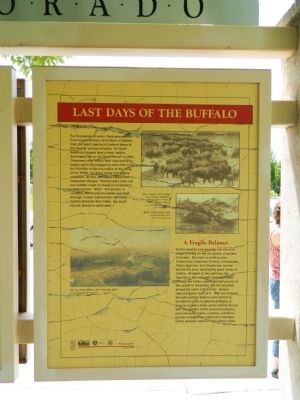
For thousands of years, these grasslands have supported tens of millions of buffalo, from the giant species of ancient times to the smaller version of today. As North America's largest land animal, buffalo dominated life on the Great Plains. In 1851, Cheyenne chief Yellow Wolf reported to an Indian agent the staggering news that from the foothills of the mountains to the forks of the Platte, the great herds had largely vanished. In fact, starvation stalked the Cheyenne villages. Twenty years later, not one buffalo could be found on Colorado's eastern plains. Why? The answer is complex, but mostly the herds vanished through human intervention: too many buffalo killed for their hides, too much habitat altered or destroyed.
A Fragile Balance
Native peoples successfully met the challenge of living on the dry plains of eastern Colorado. Mounted on swift ponies, Cheyennes, Arapahos, Kiowas, Comanches, Plains Apaches, and Shoshones moved across the land, hunting the great herds of buffalo. Brought to the plains by the Spanish in the sixteenth century; horses allowed the tribes unprecedented access to the wealth of the plains,
this page online
Erected 1999 by Colorado Historical Society. (Marker Number 223.)
Topics and series. This historical marker is listed in these topic lists: Animals • Environment • Indigenous Peoples and Communities. In addition, it is included in the History Colorado series list. A significant historical year for this entry is 1851.
Location. Marker has been permanently removed. It was located near 40° 57.976′ N, 102° 15.095′ W. Marker was in Julesburg, Colorado, in Sedgwick County. It was at the intersection of Interstate 76 and U.S. 385, on the right when traveling north on Interstate 76. Marker is at the Colorado Welcome Center. Touch for map. Marker was in this post office area: Julesburg CO 80737, United States of America.
We have been informed that this marker is no longer there and will not be replaced. This page is an archival view of what was.
Regionally, this marker was in the Eastern Plains. It was also in the American Mountain West, on the Great Plains, and specifically on the High Plains. Globally, it was in North America, the Western Hemisphere, the Western World, and the Anglosphere. Historically, it found itself in what was once the Louisiana Purchase.

Other nearby markers. At least 8 other markers are within 2 miles of this location, measured as the crow flies: The Pony Express Trail (here, next to this marker); Pony Express, Telegraph and Railroad (within shouting distance of this marker); Water - Lifeblood of the West (within shouting distance of this marker); A Moving Experience (within shouting distance of this marker); Overland City (Julesburg) Pony Express Riders (within shouting distance of this marker); Prairie Home Companions (approx. 0.6 miles away); Devil’s Dive (approx. 0.9 miles away); The Town that Wouldn't Die (approx. 1½ miles away). Touch for a list and map of all markers in Julesburg.
Other markers no longer nearby. Colorado's Wildlife Story (was here, next to this marker but has been permanently removed); Welcome to Colorado (was here, next to this marker but has been permanently removed).
More about this marker. This was one of four panels outside the Welcome Center. According to the lady at the Welcome Center a camper struck the markers and History Colorado could not afford to replace them so the 4 panels have all been removed.
Credits. This page was last revised on July 24, 2026. It was originally submitted on September 18, 2011, by Bill Pfingsten of Bel Air, Maryland. This page has been viewed 1,574 times since then and 117 times this year. Last updated on July 23, 2026, by Susan Van Den Bosch of Almond, Wisconsin. Photo 1. submitted on September 18, 2011, by Bill Pfingsten of Bel Air, Maryland. • Devry Becker Jones was the editor who published this page.
