Charlestown in Washington County, Rhode Island — The American Northeast (New England)
Fort Ninigret
Photographed by Dwight C. Brown Jr.
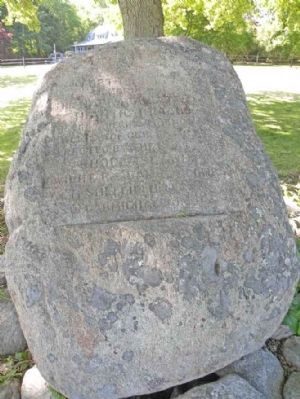
1. Fort Ninigret Marker
Memorial of the Narragansett and Niantic Indians the unwavering friends and allies of our fathers
Erected 1883 by The State of Rhode Island; Dwight R. Adams Cmrs; Wm. P. Sheffield; Geo. Carmichael Jr.
Topics. This memorial is listed in these topic lists: Colonial Era • Forts and Castles • Indigenous Peoples and Communities.
Location. 41° 22.868′ N, 71° 38.872′ W. Memorial is in Charlestown, Rhode Island, in Washington County. It is on Fort Ninigret Road 0.2 miles south of Old Post Road (State Route 1A), on the right when traveling south. This site is located at the end of Fort Ninigret Road, which is approximately 1000 ft. from Rhode Island Route 1A. Marker (a boulder) is visible in the middle of the enclosure. Touch for map. Memorial is at or near this postal address: 73 Fort Ninigret Rd, Charlestown RI 02813, United States of America. Touch for directions.

Regionally, this memorial is on Narragansett Bay and in South County. It is also in the American Northeast, in New England, and on the Eastern Seaboard. Globally, it is in the North Atlantic Region,
this page online
Other nearby markers. At least 8 other markers are within 7 miles of this marker, measured as the crow flies: Fort Ninigret Marker (approx. ¼ mile away); Charlestown Naval Auxiliary Landing Field Memorial (approx. 1.1 miles away); Grumman F6F-5N Hellcat Crash (approx. 1.1 miles away); Liberty Tree Memorial (approx. 1.1 miles away); Ninigret Park History (approx. 1.1 miles away); Ninigret National Wildlife Refuge (approx. 1.6 miles away); General Joseph Stanton Monument (approx. 3.8 miles away); The Great Swamp Fight (approx. 6.6 miles away). Touch for a list and map of all markers in Charlestown.
More about this memorial. This marker was 'unearthed' from the vicinity and the inscription was accomplished by Joseph Ledward of Westerly, Rhode Island, and supervisor of a local granite company in Westerly. Note that the text is barely readable, but with the aid of the newspaper article from The Narragansett Weekly (published in Westerly, R.I.) dated Sept. 6, 1883
Photographed by G.W.Bartlett, July 19, 2026
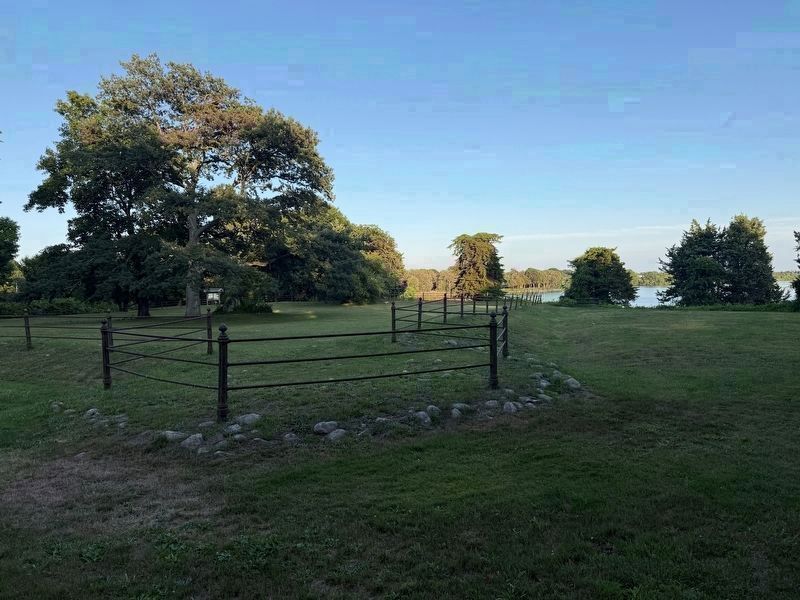
2. Fort Ninigret Marker (wide)
The marker/boulder is in the center under the tree. It is no longer legible. In the foreground the perimeter fence marking the outline of the palisade is visible from behind the northwest bastion. In the distance to the left of the boulder a kiosk with additional information (white) is visible. Ninigret Pond is visible beyond the treeline.
Fort Ninigret - Charlestown Historical Society
The outline of this ancient fort is still visible at this site. At the highest elevation on this pond, its location provided safety and visibility for this seasonal dwelling of the Niantic Tribe, a subsidiary of the great Narragansett nation, which encompassed much of present-day Rhode Island. The surrounding wall of stone and earth outlines the original palisade, which contains approximately three quarters of an acre and appears in the form of a square.
There were three bastions, twenty feet square, one on each side of the three angles or corners, which completely covered the ditches and walls of the fort. It appears that the main entrance to the fort was reached at the southeast corner, closest to the water and the only corner without a bastion.
There have been many archaeological excavations performed at this location over the past 150 years, which is considered to be an extremely significant Native American
Photographed by G.W.Bartlett, July 19, 2026
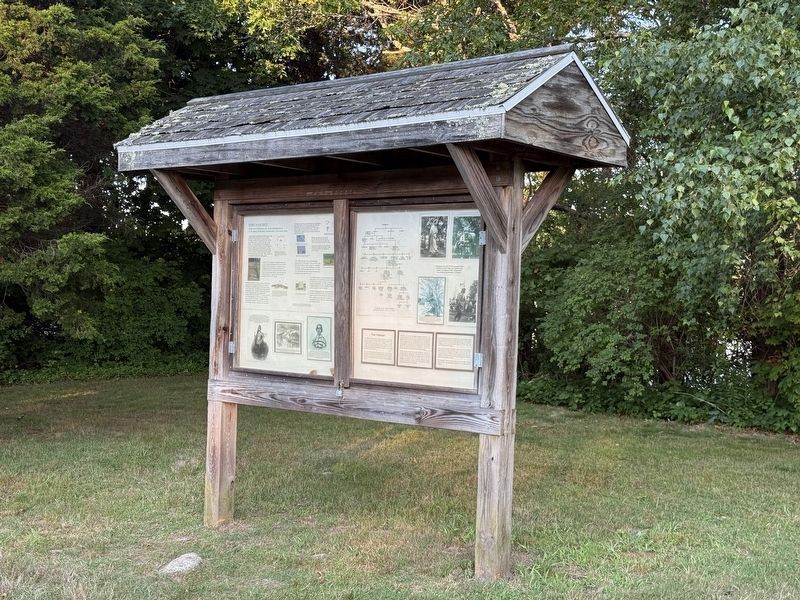
3. Additional Information
The information kiosk located on this site contains additional educational information.
As Mason proceeded on his journey, he was reinforced by a large party of Narragansett sent on by Miantinomo [aka Miantonimo]. Mason and his men arrived at the fort in the evening for an overnight stay. It was garrisoned by a large body of Niantic who would not allow him and his troops to enter this fortification. Undoubtedly, it was a strong and well-fortified position. Here then is one particular instance on early record where the condition of the Niantic fort was known to the English.
At this site the Dutch traded with the Niantic Tribe and many Dutch artifacts have been found within the fort and within the burial sites. It is believed the European contact here may go back as far as the late 1500s as a Spanish or Portuguese cannon
Photographed by G.W.Bartlett, July 19, 2026
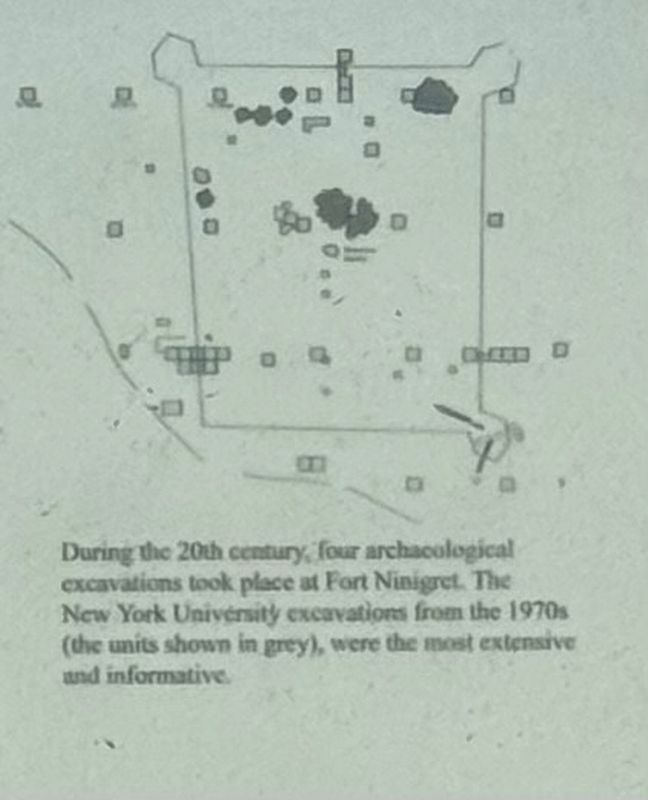
4. Fort Ninigret Archaeology Map
After numerous excavations and studies, we know that the Royal Ninigrets dwelled here and some were buried here as well. In 1912, a very large study was conducted by archaeologist H.H. Wilder. The burying plots were disrupted and analyzed. Many of the items, including human remains, were exhumed and sent to other locations for analysis, destroying what was once a sacred location of the Niantic people.
The Charlestown Historical Society retains a copy of the Wilder research along with other historically-related information on the history of Fort Ninigret.
Related markers. Click here for a list of markers that are related to this marker. Other memorials or markers to Niantic and Miantonimo / Miantinomo
Also see . . .
1. Fort Ninigret - Charlestown Historical Society.
Welcome to Fort Ninigret!
At this site in Charlestown, RI, are the embankments of a 17th-century fort, outlined by a 19th-century fence.
Archaeological investigations and Narragansett oral tradition tell that long before the arrival of the Europeans, people lived here on Fort Neck during the summer months. Around 1620, many of the Niantic, who were members of the Narragansett Nation under the Royal Family of the Narragansett Sachems, settled here more permanently, making wampum (shell beads), growing corn, and trading with the Europeans. (Submitted on July 23, 2026, by G.W.Bartlett of Hingham, Massachusetts.)
2. Fort Ninigret - Wikipedia.
Fort Ninigret is a historic fort and trading post site at Fort Neck Road in Charlestown, Rhode Island, built and occupied by European settlers in the seventeenth century. At its 1883 dedication, Commissioner George Carmichael, Jr. referred to it as "the oldest military post on the Atlantic coast."(Submitted on July 23, 2026, by G.W.Bartlett of Hingham, Massachusetts.)
3. Historical sketch of the town of Charlestown in Rhode Island 1636-1876, pub. 1877, pg.49.
The Royal Headsof the Niantic Tribe Ninigret was the Sachem or Sagamore of the Nyantics, or the Westerly Tribe, and since the division of that town, now styled the Charlestown Tribe. Ninigret was tributary to Canonicus, Miantinomo, and his successors.(Submitted on July 23, 2026, by G.W.Bartlett of Hingham, Massachusetts.)
Credits. This page was last revised on July 27, 2026. It was originally submitted on June 1, 2010, by Dwight C. Brown Jr. of Bradford, Rhode Island. This page has been viewed 2,037 times since then and 49 times this year. Last updated on July 24, 2026, by G.W.Bartlett of Hingham, Massachusetts. Photos: 1. submitted on June 1, 2010, by Dwight C. Brown Jr. of Bradford, Rhode Island. 2. submitted on July 19, 2026, by G.W.Bartlett of Hingham, Massachusetts. 3, 4. submitted on July 23, 2026, by G.W.Bartlett of Hingham, Massachusetts. • Devry Becker Jones was the editor who published this page.
