
Kilmainham in Dublin in County Dublin, Leinster, Ireland — Mid-East (and Dublin)
Kilmainham Gaol & Courthouse
⎯⎯⎯
Príosún & Teach Cúirte Chill Mhaighneann
| — | The Dubline / Dublin Discovery Trail | — |

Photographed by Ian Lefkowitz, May 18, 2026
1. Kilmainham Gaol & Courthouse side of marker

Kilmainham Gaol & Courthouse
Opened as the county gaol for Dublin in 1796, Kilmainham Gaol soon held a surge of Irish revolutionaries. From its first political prisoner, United Irishman Henry Joy McCracken, to its last, Éamon de Valera (later president of Ireland) in 1924, the gaol would house many who fought for Irish independence from Britain.
Fourteen leaders of the 1916 Easter Rising were shot in the gaol’s Stonebreakers’ Yard. One of the largest unused prisons in these islands, it has also been used as a location for a number of films, including Michael Collins and In The Name Of The Father. Kilmainham Courthouse, which was built in 1820 alongside the gaol, has recently been refurbished as a visitor centre.
Trial of the Invincibles
Kilmainham Courthouse hosted one of the most famous Irish trials of the 19th century. A group of Irish republicans known as the ‘Invincibles’ were tried here for the murder of Chief Secretary for Ireland Lord Frederick Cavendish and Under Secretary Thomas Henry Burke in the Phoenix Park in 1882. Five men were found guilty and hanged in Kilmainham Gaol.
Richmond Barracks
Built in 1814, British soldiers stationed here left for the Crimean War, Boer War and First World War among other campaigns. Over 3,000 suspected rebels were held here after the Easter Rising. Their number included six of the signatories of the Proclamation of the Irish Republic who were taken to Kilmainham Gaol to be executed. It was renamed Keogh Barracks after independence from Britain.
(Captions)
Courtesy of Kilmainham Gaol Museum
Courtesy of the National Library of Ireland
Príosún & Teach Cúirte Chill Mhaighneann
Ba sa bhliain 1796 a osclaíodh Príosún Chill Mhaighneann mar phríosún contae do Bhaile Átha Cliath, ach ní gearr go raibh sé lán go doras le réabhlóidithe Éireannacha. Ón gcéad
this page online
Caitheadh urchar le 14 ceannaire a bhí páirteach san Éirí Amach 1916 i gClós Briste Cloch an phríosúin. Áirítear é ar cheann de na príosúin is mó ach is lú úsáid ar an oileán, agus is ann a rinneadh roinnt scannán freisin, lena n-áirítear Michael Collins agus In The Name Of The Father. Ba sa bhliain 1820 a tógadh Teach Cúirte Chill Mhaighneann taobh leis an bpríosún, agus tógadh ionad cuairteoirí ann le gairid.
Triail na hInvincibles
Ba i dTeach Cúirte Chill Mhaighneann a reáchtáladh ceann de na trialacha is mó cáil in Éirinn sa 19ú haois. Cuireadh grúpa de phoblachtaigh Éireannacha ar a dtugtar “na hInvincibles” chun trialach anseo maidir le dúnmharú Phríomh-Rúnaí na hÉireann an Tiarna Frederick Cavendish, agus Fho-Rúnaí Thomas Henry Burke, i bPáirc an Fhionnuisce sa bhliain 1882. Fuarthas cúigear ciontach agus crochadh i bPríosún Chill

Photographed by Ian Lefkowitz, May 18, 2026
2. Príosún & Teach Cúirte Chill Mhaighneann side of marker
Dún Richmond
Ba sa bhliain 1814 a tógadh Dún Richmond, agus ba ón áit sin a thug saighdiúirí ón mBreatain aghaidh ar an gCogadh Criméach, Cogadh na mBórach, an Chéad Chogadh Domhanda, agus cogaí eile nach iad. Coinníodh breis is 3,000 reibilíúnach a bhí faoi amhras anseo i ndiaidh Éirí Amach na Cásca. Ina measc bhí seisear den seachtar a shínigh Forógra Phoblacht na hÉireann agus a tógadh chomh fada le Príosún Chill Mhaighneann chun iad a chur chun báis. I ndiaidh neamhspleáchas ar an mBreatain tugadh ainm nua ar an Dún – Dún Keogh.
(Captions)
Le caoinchead ó Mhúsaem Phríosún Chill Mhaighneann
Le caoinchead ó Leabharlann Náisiúnta na hÉireann
Topics. This historical marker is listed in these topic lists: Law Enforcement • Patriots & Patriotism • Wars, Non-US. A significant historical year for this entry is 1796.
Location. 53° 20.52′ N, 6° 18.514′ W. Marker is in Dublin, Leinster, in County Dublin. It is in Kilmainham. It is on Inchicore Road west of South Circular Road, on the left when traveling west. Touch for map. Marker is at or near this postal address: 5 Inchicore Road, Dublin, Leinster, Ireland. Touch for
Photographed by Ian Lefkowitz, May 18, 2026
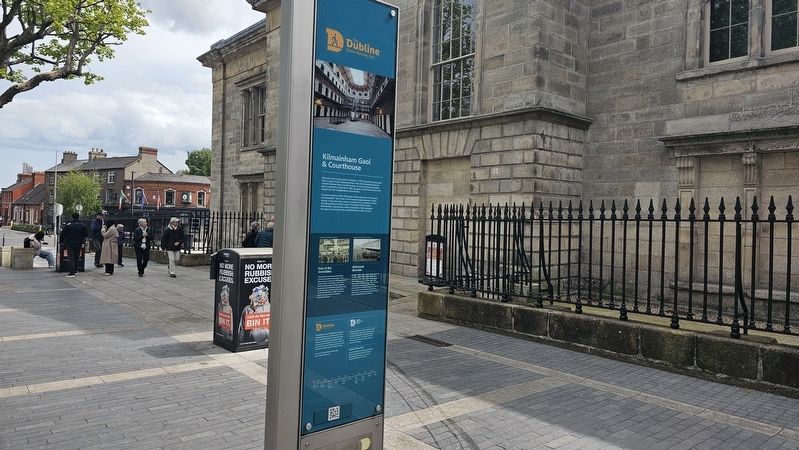
3. Kilmainham Gaol & Courthouse Marker
A full view of the English language side of the marker, in front of Kilmainham Gaol.

Regionally, this marker is in the Ancient East. Globally, it is on the Atlantic Ocean, in the North Atlantic Region, in Europe, on the Island of Ireland, on the Celtic Fringe, in the European Union, in Atlantic Europe, on one of the British Isles, in the Western World, and in the Anglosphere.
Other nearby markers. At least 8 other markers are within walking distance of this marker: 1916 Easter Rising Memorial (about 90 meters away, measured in a direct line); Irish Civil War Memorial (about 90 meters away); Wellington (approx. 0.9 kilometers away); The People's Flower Gardens / Gaírdíní Bláthanna an Phobaíl (approx. one kilometer away); Droichead Seán Heuston Bridge (approx. 1.3 kilometers away); Ludwig Wittgenstein (approx. 1.4 kilometers away); Last sailing of a Guinness Barge (approx. 1.4 kilometers away); The Croppy's Acre (approx. 1.5 kilometers away). Touch for a list and map of all markers in Dublin.
Also see . . . Kilmainham Gaol Museum. (Submitted on July 27, 2026, by Ian Lefkowitz of New York, New York.)

Photographed by Ian Lefkowitz, May 18, 2026
4. Kilmainham Gaol & Courthouse / Príosún & Teach Cúirte Chill Mhaighneann Marker
A full view of the Irish side of the marker.
Photographed by Ian Lefkowitz, May 18, 2026
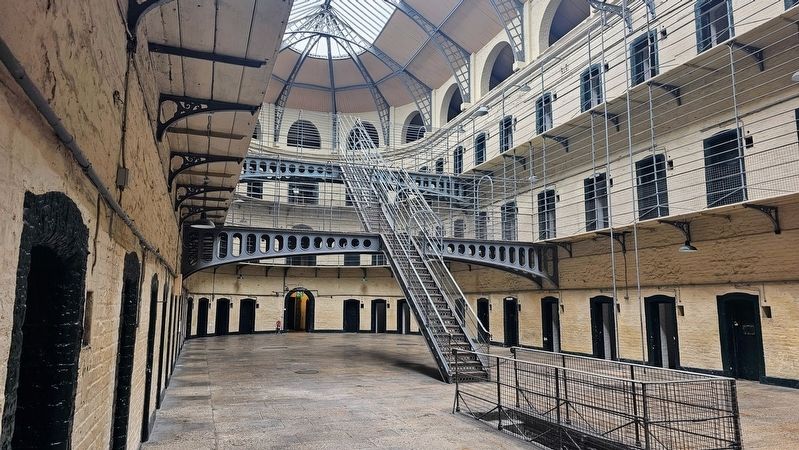
5. Kilmainham Gaol
Inside Kilmainham Gaol, a national landmark of Ireland.
Credits. This page was last revised on July 27, 2026. It was originally submitted on July 27, 2026, by Ian Lefkowitz of New York, New York. This page has been viewed 10 times since then. Photos: 1, 2, 3, 4, 5. submitted on July 27, 2026, by Ian Lefkowitz of New York, New York. • Andrew Ruppenstein was the editor who published this page.
