William Penn Annex East in Philadelphia in Philadelphia County, Pennsylvania — The American Northeast (Mid-Atlantic)
William Howe
1729 - 1814
| — | British Occupation of Philadelphia 1777-1778 | — |
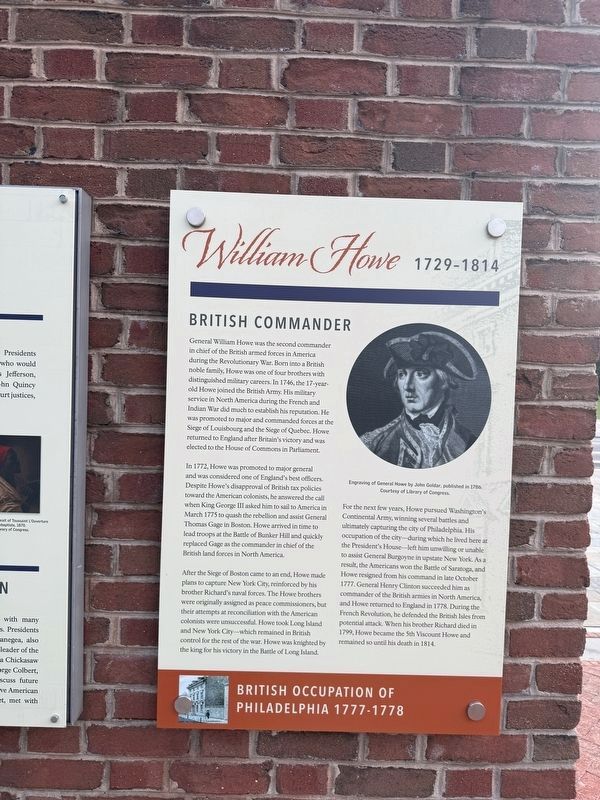
British Commander
General William Howe was the second commander in chief of the British amed forces in America during the Revolutionary War. Born into a British noble family, Howe was one of four brothers with distinguished military careers. In 1746, the 17-year-old Howe joined the British Army. His military service in North America during the French and Indian War did much to establish his reputation. He was promoted to major and commanded forces at the Siege of Louisbourg and the Siege of Quebec. Howe returned to England after Britain's victory and was elected to the House of Commons in Parliament.
In 1772, Howe was promoted to major general and was considered one of England's best officers. Despite Howe's disapproval of British tax policies toward the American colonists, he answered the call when King George III asked him to sail to America in March 1775 to quash the rebellion and assist General Thomas Gage in Boston. Howe arrived in time to lead troops at the Battle of Bunker Hill and quickly replaced Gage at the commander in chief of the British land forces in North America.
After the Siege of Boston came
this page online
For the next few years, Howe pursuied Washington's Continental Army, winning several battles and ultimately capturing the city of Philadelphia. His occupation of the city—during which he lived here at the President's House—left him unwilling or unable to assist General Burgoyne in upstate New York. As a result, the Americans won the Battle of Saratoga, and Howe resigned from his command in late October 1777. General Henry Clinton succeeded him as commander of the British armies in North America, and Howe returned to England in 1778. During the French Revolution, he defended the British Isles from potential attack. When his brother Richard died in 1799, Howe became the 5th Viscount Howe and remained so until his
Photographed by Devry Becker Jones (CC0), July 25, 2026
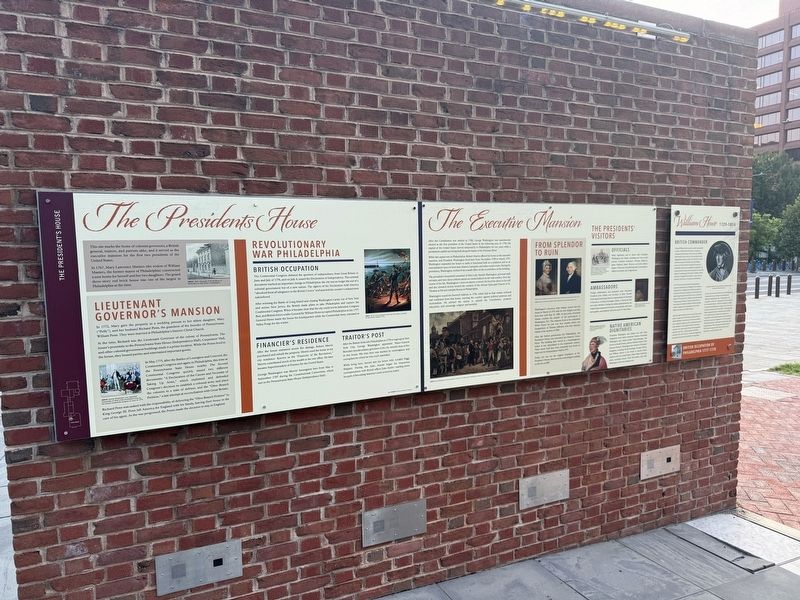
2. Several markers on display on the grounds of Independence National Historical Park
[Caption:]
Engraving of General Howe by John Goldar, published in 1786. Courtesy of Library of Congress.
Erected 2026 by National Park Service, U.S. Department of the Interior.
Topics. This historical marker is listed in these topic lists: War, French and Indian • War, US Revolutionary • Wars, Non-US. A significant historical month for this entry is March 1775.
Location. 39° 57.029′ N, 75° 9.001′ W. Marker is in Philadelphia, Pennsylvania, in Philadelphia County. It is in William Penn Annex East. It is at the intersection of South 6th Street (County Road 2005) and Market Street (County Road 2004), on the left when traveling south on South 6th Street. Touch for map. Marker is at or near this postal address: 598 Market St, Philadelphia PA 19106, United States of America. Touch for directions.

Regionally, this marker is in Southeast Pennsylvania. It is also in the American Northeast and in the Mid-Atlantic. Globally, it is in North America, the Western Hemisphere, the Western World, and the Anglosphere. Historically, it finds itself in what was once the Haudenosaunee (Iroquois) Confederacy, New Netherland, and one of the original Thirteen Colonies.
Other nearby markers. At least 6 other markers are within walking distance of this marker: Commander in Chief (here, next to this marker); The Executive Mansion (here, next to this marker); Selecting a President (here, next to this marker); Treaties and Appointments (here, next to this marker); The President's House (here, next to this marker); What is Executive Power? (here, next to this marker). Touch for a list and map of all markers in Philadelphia.
Other markers no longer nearby. "I will fear no Evil" (was here, next to this marker but has been replaced with another marker now near it); Suppressing the Opposition (was here, next to this marker but has been replaced with another marker now near it); The House & the People Who Worked & Lived In It (was here, next to this marker but has been permanently removed); "An Act respecting fugitives from Justice" (was here, next to this marker but has been replaced with another marker now near it); The Keeper of the House (was here, next to this marker but has been replaced with another marker now near it); "We shall come to a civil war" (was here, next to this marker but has been permanently removed); "Burn this treaty to Hell!" (was here, next to this marker but has been replaced with another marker now near it); "I am free now" (was here, next to this marker but has been permanently removed); The Dirty Business of Slavery (was here, next to this marker but has been permanently removed); The opener of the Way (was here, next to this marker but has been replaced with another marker now near it).
Credits. This page was last revised on July 27, 2026. It was originally submitted on July 27, 2026, by Devry Becker Jones of Washington, District of Columbia. This page has been viewed 16 times since then. Photos: 1, 2. submitted on July 27, 2026, by Devry Becker Jones of Washington, District of Columbia.
