Little Compton in Newport County, Rhode Island — The American Northeast (New England)
Three Sisters: A Symbiotic Garden
Living things grow best in relationship with others.
| — | Awashonks Garden | — |
Photographed by G.W.Bartlett, July 26, 2026
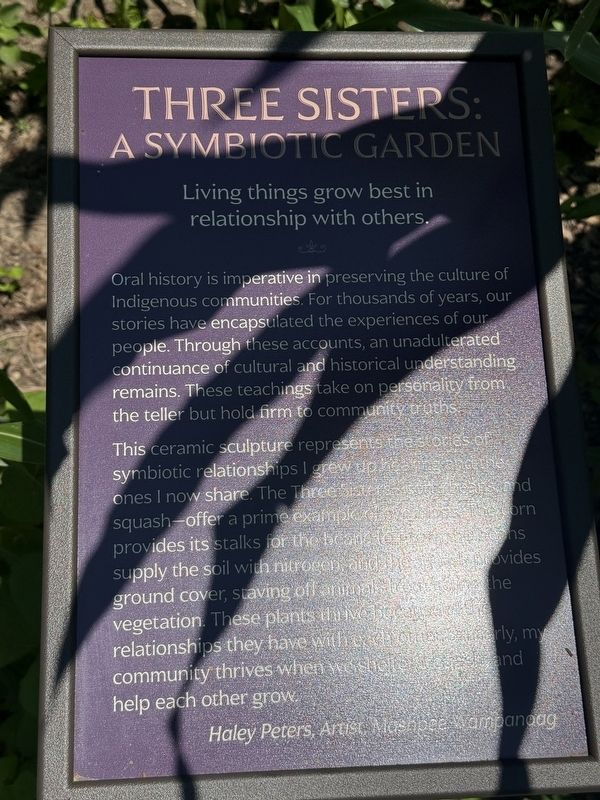
1. Three Sisters: A Symbiotic Garden Marker
Living things grow best in relationship with others.
Oral history is imperative in preserving the culture of Indigenous communities. For thousands of years, our stories have encapsulated the experiences of our people. Through these accounts, an unadulterated continuance of cultural and historical understanding remains. These teachings take on personality from the teller but hold firm to community truths.
This ceramic sculpture represents the stories of symbiotic relationships I grew up hearing and the ones I now share. The Three Sisters - corn, beans and squash - offer a prime example of symbiosis. The corn provides its stalks for the beans to grow; beans supply the soil with nitrogen; and the squash provides ground cover, staving off animals from eating the vegetation. These plants thrive because of the relationships they have with each other. Similarly, my community thrives when we shelter, nourish and help each other grow.
Haley Peters, Artist, Mashpee Wampanoag
Erected 2025 by Little Compton Historical Society. (Marker Number 102.)
Topics and series.
this page online
Location. 41° 29.594′ N, 71° 11.068′ W. Marker is in Little Compton, Rhode Island, in Newport County. It can be reached from West Main Road (Route 77) just south of Fairfields Drive, on the left when traveling south. Touch for map. Marker is at or near this postal address: 548 West Main Road, Little Compton RI 02837, United States of America. Touch for directions.

Regionally, this marker is on Narragansett Bay. It is also in the American Northeast, in New England, and on the Eastern Seaboard. Globally, it is in the North Atlantic Region, North America, the Western Hemisphere, the Western World, and the Anglosphere. Historically, it finds itself in what was once one of the original Thirteen Colonies.
Other nearby markers. At least 8 other markers are within walking distance of this marker: Honoring Awashonks (here, next to this marker); Summer Weeku Frame
Photographed by G.W.Bartlett, July 26, 2026
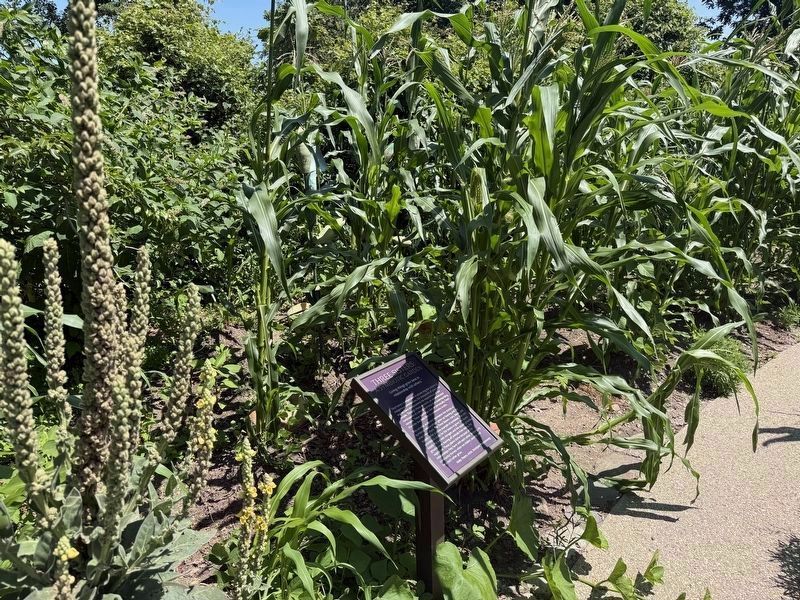
2. Three Sisters: A Symbiotic Garden Marker
Regarding Three Sisters: A Symbiotic Garden. The corn, squash and beans planted in this garden are planted in ground native to the Sakonnet trive and once set aside as a reservation for the Sakonnet people before being appropriated by colonists after King Philip's war.
Also see . . .
1. Three Sisters (agriculture) (Wikipedia).
The Three Sisters (Spanish: tres hermanas) are the three main agricultural crops of various indigenous peoples of Central and North America. The crops are squash, maize, and climbing beans (typically tepary beans or common beans).(Submitted on July 28, 2026, by G.W.Bartlett of Hingham, Massachusetts.)
2. Awashonks Garden Exhibit #102.
Photographed by G.W.Bartlett, July 26, 2026
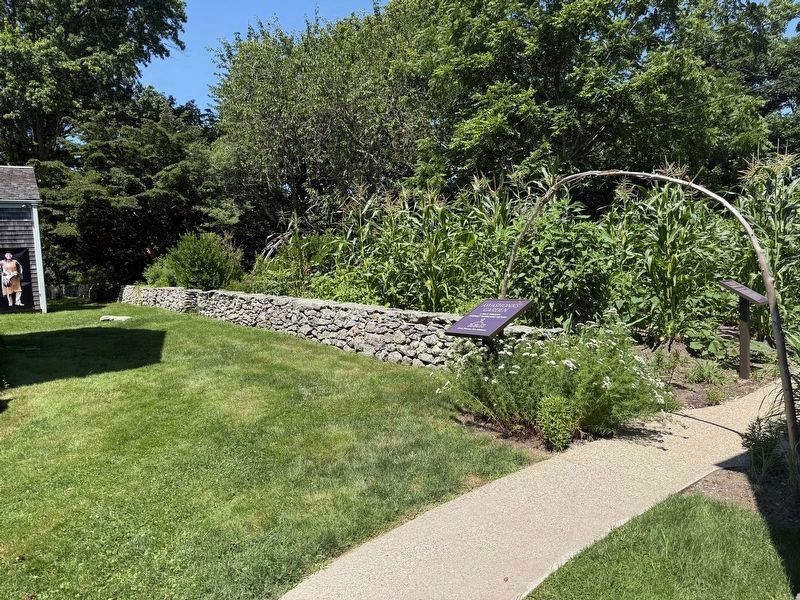
3. Awashonks Garden Entrance
Located behind the Wilbor House on the grounds of the Little Compton Historical Society.
Three Sisters: A Symbiotic Garden(Submitted on July 29, 2026, by G.W.Bartlett of Hingham, Massachusetts.)
Credits. This page was last revised on July 29, 2026. It was originally submitted on July 28, 2026, by G.W.Bartlett of Hingham, Massachusetts. This page has been viewed 14 times since then. Photos: 1, 2, 3. submitted on July 28, 2026, by G.W.Bartlett of Hingham, Massachusetts. • Michael Herrick was the editor who published this page.
