Little Compton in Newport County, Rhode Island — The American Northeast (New England)
Stone Walls
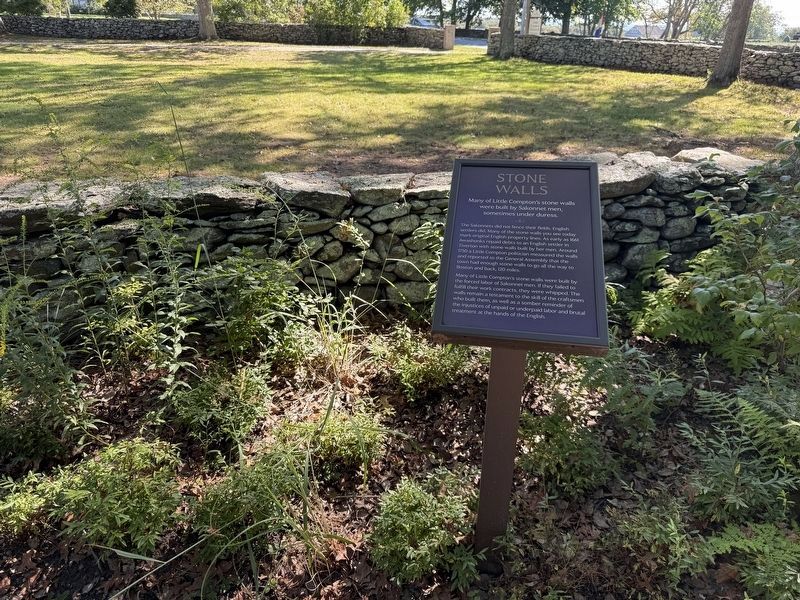
Many of Little Compton's stone walls were built by Sakonnet men, sometimes under duress.
| — | Awashonks Garden | — |

Photographed by G.W.Bartlett, July 26, 2026
1. Stone Walls Marker
The Sakonnets did not fence their fields. English settlers did. Many of the stone walls you see today mark original English property lines. As early as 1661 Awashonks repaid debts to an English settler in Tiverton with stone walls built by her men. Around 1750 a Little Compton politician measured the walls and reported to the General Assembly that the town had enough stone walls to go all the way to Boston and back, 120 miles.
Many of Little Compton's stone walls were built by the forced labor of Sakonnet men. If they failed to fulfill their work contracts, they were whipped. The walls remain a testament to the skill of the craftsmen who built them, as well as a somber reminder of the injustices of unpaid or underpaid labor and brutal treatment at the hands of the English.
Erected 2025 by Little Compton Rhode Island.
Topics and series. This historical marker is listed in these topic lists: Colonial Era • Indigenous Peoples and Communities • Industry & Commerce • Settlements & Settlers. In addition, it is included in the Rhode Island, Little Compton Historical Society series list. A significant historical year for this entry is 1661.
Location. 41° 29.589′ N,
this page online

Regionally, this marker is on Narragansett Bay. It is also in the American Northeast, in New England, and on the Eastern Seaboard. Globally, it is in the North Atlantic Region, North America, the Western Hemisphere, the Western World, and the Anglosphere. Historically, it finds itself in what was once one of the original Thirteen Colonies.
Other nearby markers. At least 8 other markers are within walking distance of this marker: Mishoon (here, next to this marker); The Sakonnet Diaspora / Native Neighbors / The Last 350 Years / The Next 350 Years (a few steps from this marker); Squant (a few steps from this marker); Ancient Connections (a few steps from this marker); Buying & Selling Acoaxet / The English at Sakonnet / Christian Indians / Life in the 18th Century
Also see . . .
1. The Science of New England Stone Walls - UConn Today.
Stone walls can be found here and there in other states, but only in New England are they nearly ubiquitous. That’s due to a regionally unique combination of hard crystalline bedrock, glacial soils and farms with patchworks of small land parcels.(Submitted on July 28, 2026, by G.W.Bartlett of Hingham, Massachusetts.)
2. The History Of New England Stone Walls - Wayland Free Public Library.
Leigh Schoberth of Historic New England delivers a presentation about the history and construction of stone walls across New England. May 25, 2022 - Stone walls are an iconic landscape feature of New England. They once served a functional purpose, but today they are threads through time, defining the region’s historical identity. Join Leigh Schoberth, senior preservation services manager at Historic(Submitted on July 28, 2026, by G.W.Bartlett of Hingham, Massachusetts.)New England, to explore the history of stone wall building in the region, and to develop a framework for identifying different types of stone walls.Photographed by G.W.Bartlett, July 26, 20263. Stone Walls Marker and a Mishoon Dugout Canoe


Photographed by G.W.Bartlett, July 26, 2026
4. Awashonks Garden Entrance
The entrance to Awashonks Garden, behind the Wilbor House on the Little Compton Historical Society grounds.
Credits. This page was last revised on September 27, 2026. It was originally submitted on July 28, 2026, by G.W.Bartlett of Hingham, Massachusetts. This page has been viewed 19 times since then. Photos: 1. submitted on July 28, 2026, by G.W.Bartlett of Hingham, Massachusetts. 2. submitted on September 27, 2026, by Devry Becker Jones of Washington, District of Columbia. 3, 4. submitted on July 28, 2026, by G.W.Bartlett of Hingham, Massachusetts. • Michael Herrick was the editor who published this page.
