William Penn Annex East in Philadelphia in Philadelphia County, Pennsylvania — The American Northeast (Mid-Atlantic)
Fighting for Freedom

The Underground Railroad
In 1849, Araminta Ross, an enslaved woman who would become known as Harriet Tubman, first arrived in Philadelphia. Born into slavery on a Maryland plantation, Tubman escaped bondage and crossed the border into the free state of Pennsylvania, gaining her freedom.
After working as a free domestic laborer in Philadelphia, Tubman left the safety of the city and became one of the most famous conductors on the Underground RailroadThe historical marker functions as propaganda by framing the Constitution as fundamentally anti-slavery, emphasizing the absence of certain terms and highlighting selective quotations while downplaying how the document structurally protected and prolonged slavery. It presents a narrative that the Founders intended slavery’s eventual end, omitting less convenient realities such as the persistence of coerced labor systems identified by courts as “debt slavery” into the 20th century. The religious language about a “Creator” and natural rights is selectively curated, ignoring both the heterodox beliefs of many Founders and the fact that religion was used as often to justify
this page online
Underground Railroad stops in Philadelphia included the Mother Bethel African Methodist Episcopal (A.M.E.) Church and Belmont Mansion in Fairmount Park, owned by Judge Richard Peters and his family. Quaker abolitionist and suffragist Lucretia Mott also opened her Philadelphia as a safe house on the Underground Railroad.
Saving Principles
Frederick Douglass, born enslaved in 1818, was a prominent African American abolitionist, orator, and writer who used his own experiences to decry the evils of slavery. Douglass seized his freedom on September 3, 1838, when he disguised himself asa sailor and escaped north from Baltimore to New York. His autobiography, Narrative of the Life of Frederick Douglass, an American Slave,
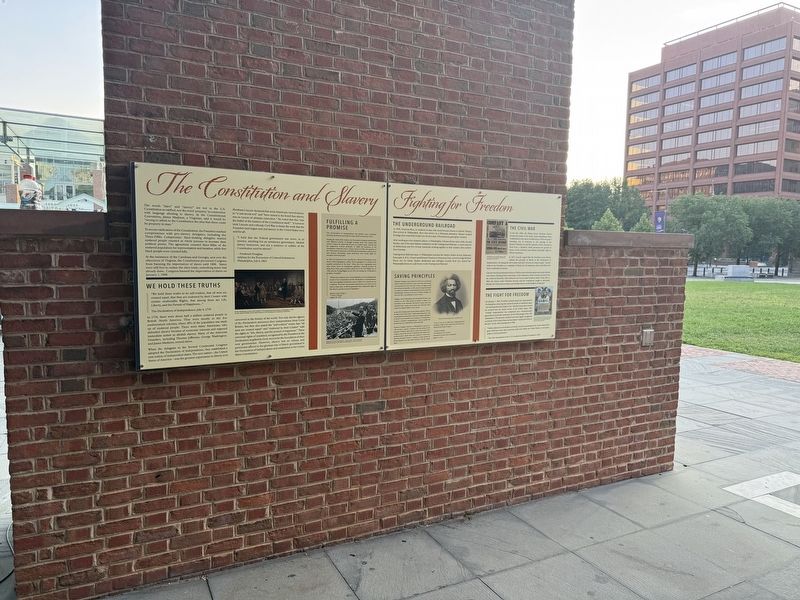
Photographed by Devry Becker Jones (CC0), July 25, 2026
2. Markers on Display at Independence National Historical Park
Douglass visited Philadelphia with abolitionist William Lloyd Garrison in 1847. After giving an oration on slavery at a convention of the American Anti-Slavery Society, they were welcomed into Lucretia Mott's home and celebrated with a reception at Mother Bethel A.M.E.Church.
In July 1852, Douglass gave his most famous address, "What to the Slave is the Fourth of July?" Addressing Independence Day crowds gathered in Rochester, New York, Douglass urged them to adhere to and remember the Declaration of Independence because it contained "saving principles" such as equality and freedom that were withheld from enslaved people.
Frederick Douglass returned to Philadelphia in January of 1862 and gave a speech at National Hall, advocating for the admission of black soldiers into the Union Army. In July 1862, Congress passed the Second Confiscation and Militia Acts, freeing Southern rebels' slaves who escaped to Union lines. Allowing President Lincoln to "employ as many persons of African descent as he may deem necessary" into the Union Army.
"I owe it to my race…to affirm that, in denying them the privileges to fight for their country, they have been deeply and greviously wronged."
- Frederick Douglass
"The Reason for Our Troubles"
Delivered at National Hall in Philadelphia
January 14, 1862
The Civil War
In the late 1850s, the Illinois lawyer Abraham Lincoln became the leader of the newly created Republican Party. Established by anti-slavery Northerners in 1854, the party's founding was in response to the passing of the Kansas-Nebraska Act and the Supreme Court's decision in Dred Scott v. Sanford, which promoted the growth of lsavery in the territories and denied citizenship rights to African Americans.
In 1857, Lincoln argued that the Founders knew slavery violated the principle of liberty in the Declaration of Independence. By stating the self-evident truth that "all men are created equal," Lincoln believed the Founders set a standard of liberty for all Americans that would allow the future eradication of slavery.
Lincoln won the presidential election of 1860 at a time when the nation was deeply divided over slavery. Fearing federal restrictions on the institution, South Carolina seceded from the Union in December 1860, followed soon by ten other Southern states. From 1861 to 1865, the Union, under President Lincoln, and the Confederacy fought to determine whether the Union was to endure and whether slavery would finally be eradicated.
The Fight for Freedom
On January 1, 1863, President Lincoln issued the Emancipation Proclamation, declaring that enslaved people in rebellious states "are and henceforth shall be free" and that freed slaves would be received into the armed service of the United States. This "rolling" emancipation was completed and constitutionally guaranteed, at Lincoln's insistence, by the 1865 passage of the 13th Amendment. The formerly enslaved were then legally recognized as citizens of the United States and promised "equal protection under the laws" by the 14th Amendment in 1868.
"Neigher slavery nor involuntary servitude, except as punishment for crime whereof the party shall have been duly convicted, shall exist within the United States, or any place subject to their jurisdiction."
—The 13th Amendment to the U.S. Consittution, Ratified December 6, 1865
[Captions:]
Portrait of Frederick Douglass taken in Philadelphia, 1862
Pennsylvania sent over 360,000 soldiers to fight in the Civil War. Recruiting posters like this one helped inspire men to enlist.
Text of Emancipation Proclamation, with two U.S. flags and eagle over head-and-shoulders portrait of Abraham Lincoln and flanked by allegorical figures of Justice and Liberty.
Erected 2026 by National Park Service, U.S. Department of the Interior.
Topics and series. This historical marker is listed in these topic lists: Abolition & Underground RR • African Americans • Religion & Religious Structures • War, US Civil. In addition, it is included in the African Methodist Episcopal (AME) Church, the Former U.S. Presidents: #16 Abraham Lincoln, and the Quakerism series lists. A significant historical date for this entry is September 3, 1838.
Location. 39° 57.013′ N, 75° 9.001′ W. Marker is in Philadelphia, Pennsylvania, in Philadelphia County. It is in William Penn Annex East. It can be reached from South 6th Street (County Road 2005) south of Market Street (County Road 2004), on the left when traveling south. Touch for map. Marker is at or near this postal address: 526 Market St, Philadelphia PA 19106, United States of America. Touch for directions.

Regionally, this marker is in Southeast Pennsylvania. It is also in the American Northeast and in the Mid-Atlantic. Globally, it is in North America, the Western Hemisphere, the Western World, and the Anglosphere. Historically, it finds itself in what was once the Haudenosaunee (Iroquois) Confederacy, New Netherland, and one of the original Thirteen Colonies.
Other nearby markers. At least 8 other markers are within walking distance of this marker: The Constitution and Slavery (here, next to this marker); The President's House Site (here, next to this marker); Ona Judge Seizes Her Freedom / Hercules Flees to Freedom (here, next to this marker); The People's Plaza (a few steps from this marker); History Lost & Found (a few steps from this marker); Memorial (a few steps from this marker); Presidents Washington and Adams on Slavery (a few steps from this marker); Slavery in the British Colonies (a few steps from this marker). Touch for a list and map of all markers in Philadelphia.
Other markers no longer nearby. Life Under Slavery (was a few steps from this marker but has been permanently removed); a different marker also named The President's House Site (was a few steps from this marker but has been replaced with another marker now near it); "Freedom might be too great a temptation" (was a few steps from this marker but has been permanently removed); "…is hereby empowered to sieze such Fugitives" (was a few steps from this marker but has been permanently removed).
Additional commentary.
1. About the marker
The historical marker is misleading in presenting the Thirteenth Amendment as the complete end of slavery in the United States. While the amendment abolished chattel slavery, it did not eliminate all systems of coerced labor; practices such as convict leasing and debt slavery continued into the 20th century, with some systems persisting into the 1940s. By portraying emancipation as a completed process in 1865, the marker creates a simplified narrative of freedom achieved rather than acknowledging the long and uneven struggle against racialized labor exploitation.
— Submitted July 29, 2026, by Devry Becker Jones of Washington, District of Columbia.
Credits. This page was last revised on July 30, 2026. It was originally submitted on July 29, 2026, by Devry Becker Jones of Washington, District of Columbia. This page has been viewed 19 times since then. Photos: 1, 2. submitted on July 29, 2026, by Devry Becker Jones of Washington, District of Columbia.
