Saint Kevin's in Dublin in County Dublin, Leinster, Ireland — Mid-East (and Dublin)
Trinsí/Baracáidí
⎯⎯⎯
Trenches and Barricades
| — | Éirí Amach 1916 i bhFaiche Stiabhna / The 1916 Rising in St Stephen’s Green | — |
Photographed by Ian Lefkowitz, May 18, 2026
1. Trinsí/Baracáidí / Trenches and Barricades Marker

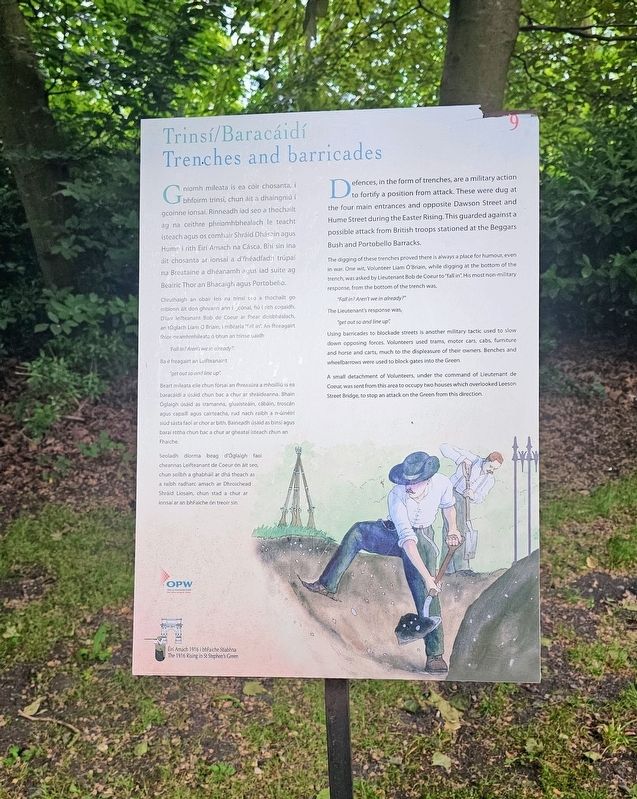
Gníomh míleata is ea cóir chosanta, i bhfoirm trinsí, chun áit a dhaingniú i gcoinne ionsaí. Rinneadh iad seo a thochailt ag na ceithre phríomhbhealach le teacht isteach agus os comhair Shráid Dhásain agus Hume i rith Éirí Amach na Cásca. Bhí sin ina áit chosanta ar ionsaí a d’fhéadfadh trúpaí na Breataine a dhéanamh agus iad suite ag Beairic Thor an Bhacaigh agus Portobello.
Chruthaigh an obair leis na trinsí seo a thochailt go mbíonn áit don ghreann ann i gcónaí, fiú i rith cogaidh. D’iarr leifteanant Bob de Coeur ar fhear deisbhéalach, an tÓglach Liam Ó Briain, i mBéarla “fall in”. An fhreagairt fhíor-neamhmhíleata ó bhun an trinse uaidh
“Fall in? Aren’t we in already?”
Ba é freagairt an Leifteanaint
“get out so and line up”.
Beart míleata eile chun fórsaí an fhreasúra a mhoilliú is ea baracáidí a úsáid chun bac a chur ar shráideanna. Bhain Óglaigh úsáid as tramanna, gluaisteáin, cábáin, troscán agus capaill agus cairteacha, rud nach raibh a n-úinéirí siúd sásta faoi ar chor ar bith. Baineadh úsáid as binsí agus baraí rotha chun bac a chur ar gheataí isteach chun an Fhaiche.
Seoladh díorma beag d’Óglaigh faoi
this page online
Defences, in the form of trenches, are a military action to fortify a position from attack. These were dug at the four main entrances and opposite Dawson Street and Hume Street during the Easter Rising. This guarded against a possible attack from British troops stationed at the Beggars Bush and Portobello Barracks.
The digging of these trenches proved there is always a place for humour, even in war. One wit, Volunteer Liam Ó’Briain, while digging at the bottom of the trench, was asked by Lieutenant Bob de Coeur to “fall in”. His most non-military response, from the bottom of the trench was,
“Fall in? Aren’t we in already?”
The Lieutenant’s response was,
“get out so and line up”.
Using barricades to blockade streets is another military tactic used to slow down opposing forces. Volunteers used trams, motor cars, cabs, furniture and horse and carts, much to the displeasure of their owners. Benches and wheelbarrows were used to block gates into
Photographed by Ian Lefkowitz, May 18, 2026
2. Trinsí/Baracáidí / Trenches and Barricades Marker
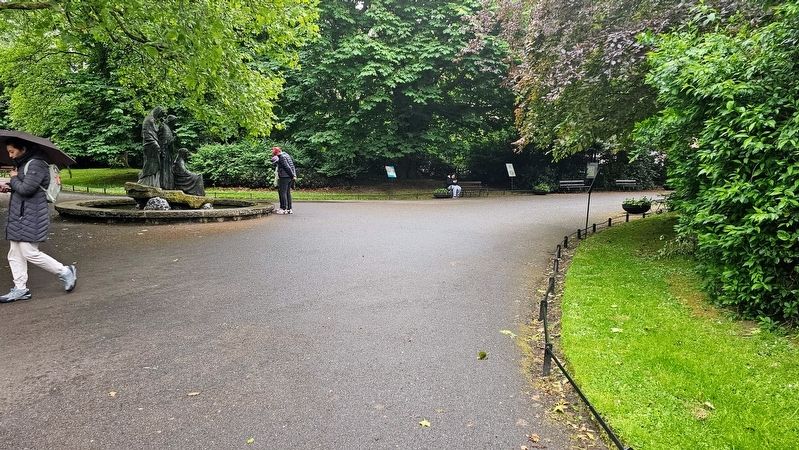
This marker is located across from the Three Fates fountain. Marker number 10, which includes a map of the 1916 Easter Rising route, is seen in the distance at the park entrance.
A small detachment of Volunteers, under the command of Lieutenant de Coeur, was sent from this area to occupy two houses which overlooked Leeson Street Bridge, to stop an attack on the Green from this direction.
Erected 2016 by The Office of Public Works. (Marker Number 9.)
Topics and series. This historical marker is listed in these topic lists: Parks & Recreational Areas • Patriots & Patriotism • Wars, Non-US. In addition, it is included in the Ireland, Dublin: The 1916 Rising in St Stephen’s Green / Éirí Amach 1916 i bhFaiche Stiabhna series list. A significant historical date for this entry is April 24, 1916.
Location. 53° 20.205′ N, 6° 15.473′ W. Marker is in Dublin, Leinster, in County Dublin. It is in Saint Kevin's. It can be reached from the intersection of Saint Stephen's Green and Leeson Street, on the left when traveling east. Touch for map. Marker is at or near this postal address: 78 St Stephen's Green, Dublin, Leinster, Ireland. Touch for directions.

Regionally, this marker is in the Ancient East. Globally, it is on the Atlantic Ocean, in the North Atlantic Region, in Europe, on the Island of Ireland, on the Celtic Fringe, in the European Union, in Atlantic Europe, on one of the British Isles, in the Western World, and in the Anglosphere.
Other nearby markers. At least 8 other markers are within walking distance of this marker: The "Three Fates" (a few steps from this marker); Éirí Amach na Cásca 1916: Páirc Fhaiche Stiabhna / 1916 Easter Rising in St Stephen's Green Park (a few steps from this marker); Páirc Fhaiche Stiabhna / Saint Stephen's Green Park (within shouting distance of this marker); Foireann Pháirc Fhaiche Stiabhna / Staff of St Stephen's Green Park (about 90 meters away, measured in a direct line); Ról na mBan — san Éirí Amach / The Role of Women — in the Rising (about 90 meters away); Eaglais na hOllscoile / University Church (about 120 meters away); Countess Constance Markievicz (about 150 meters away); Stáisiúin Garchabhrach / First Aid Stations (about 150 meters away). Touch for a list and map of all markers in Dublin.
Also see . . . 1916 Exhibition (St. Stephen's Green Park). (Submitted on July 31, 2026, by Ian Lefkowitz of New York, New York.)
Credits. This page was last revised on July 31, 2026. It was originally submitted on July 31, 2026, by Ian Lefkowitz of New York, New York. This page has been viewed 10 times since then. Photos: 1, 2. submitted on July 31, 2026, by Ian Lefkowitz of New York, New York. • Andrew Ruppenstein was the editor who published this page.
