Dublin in County Dublin, Leinster, Ireland — Mid-East (and Dublin)
An Ceannfort Michael Mallin
⎯⎯⎯
Commandant Michael Mallin
(1874–1916)
| — | Éirí Amach 1916 i bhFaiche Stiabhna / The 1916 Rising in St Stephen’s Green | — |
Photographed by Ian Lefkowitz, May 18, 2026
1. An Ceannfort Michael Mallin / Commandant Michael Mallin Marker
 [Gaeilge:]
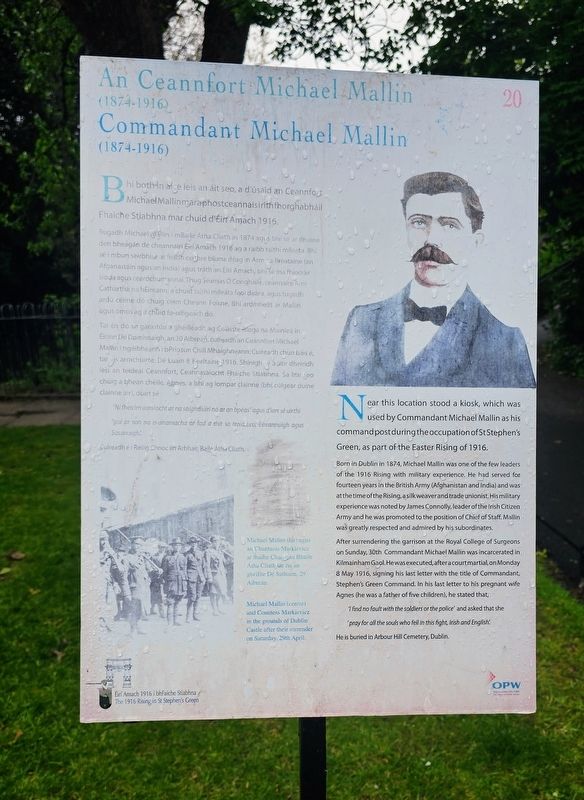
Bhí both in aice leis an áit seo, a d’úsáid an Ceannfort Michael Mallin mar a phost ceannais i rith fhorghabháil Fhaiche Stiabhna mar chuid d’Éirí Amach 1916.
Rugadh Michael Mallin i mBaile Átha Cliath in 1874 agus bhí sé ar dhuine den bheagán de cheannairí Éirí Amach 1916 ag a raibh taithí míleata. Bhí sé i mbun seirbhíse ar feadh ceithre bliana déag in Arm na Breataine (an Afganastáin agus an India) agus tráth an Éirí Amach, bhí sé ina fhíodóir síoda agus ceardchumannaí. Thug Séamas Ó Conghaile, ceannaire Arm Cathartha na hÉireann, a chuid taithí míleata faoi deara, agus tugadh ardú céime dó chuig céim Cheann Foirne. Bhí ardmheas ar Mallin agus ómós ag a chuid fo-oifigheach dó.
Tar éis dó an garastún a ghéilleadh ag Coláiste Ríoga na Máinleá in Éirinn Dé Domhnaigh, an 30 Aibreán, cuireadh an Ceannfort Michael Mallin i ngéibheann i bPríosún Chill Mhaighneann. Cuireadh chun báis é, tar éis armchúirte, Dé Luain 8 Bealtaine 1916. Shínigh sé a litir dheiridh leis an teideal Ceannfort, Ceannasaíocht Fhaiche Stiabhna. Sa litir seo chuig a bhean chéile, Agnes, a bhí ag iompar clainne (bhí cúigear duíne clainne
this page online
“Ní fheicim aon locht ar na saighdiúirí nó ar an bpéas” agus d’iarr sé uirthi
“guí ar son na n-anamacha ar fad a thit sa troid seo, Éireannaigh agus Sasanaigh”.
Cuireadh é i Reilig Chnoc an Arbhair, Baile Átha Cliath.
Near this location stood a kiosk, which was used by Commandant Michael Mallin as his command post during the occupation of St Stephen’s Green, as part of the Easter Rising of 1916.
Born in Dublin in 1874, Michael Mallin was one of the few leaders of the 1916 Rising with military experience. He had served for fourteen years in the British Army (Afghanistan and India) and was at the time of the Rising, a silk weaver and trade unionist. His military experience was noted by James Connolly, leader of the Irish Citizen Army and he was promoted to the position of Chief of Staff. Mallin was greatly respected and admired by his subordinates.
After surrendering the garrison at the Royal College of Surgeons on Sunday, 30th Commandant Michael Mallin was incarcerated in Kilmainham Gaol. He was executed, after a court martial, on Monday 8 May 1916, signing his last letter with the title of Commandant, Stephen’s Green
Photographed by Ian Lefkowitz, May 18, 2026
2. An Ceannfort Michael Mallin / Commandant Michael Mallin Marker
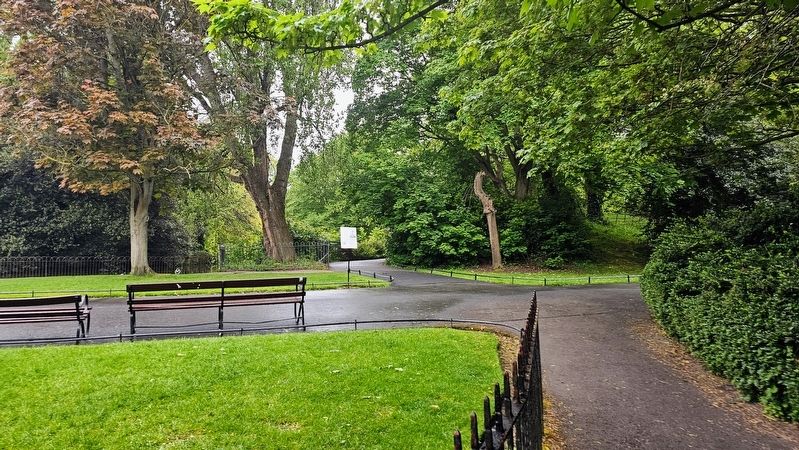
The marker is located in the northwest corner of St. Stephen's Green, near the site of the surrender.
‘I find no fault with the soldiers or the police’ and asked that she
‘pray for all the souls who fell in this fight, Irish and English’.
He is buried in Arbour Hill Cemetery, Dublin.
(Captions)
Michael Mallin (lár) agus an Chuntaois Markievicz ar thailte Chaisleán Bhaile Átha Cliath tar éis an ghéillte Dé Sathairn, 29 Aibreán. / Michael Mallin (centre) and Countess Markievicz in the grounds of Dublin Castle after their surrender on Saturday, 29th April.
Erected 2016. (Marker Number 20.)
Topics and series. This historical marker is listed in these topic lists: Parks & Recreational Areas • Patriots & Patriotism • Wars, Non-US. In addition, it is included in the Ireland, Dublin: The 1916 Rising in St Stephen’s Green / Éirí Amach 1916 i bhFaiche Stiabhna series list. A significant historical date for this entry is April 29, 1916.
Location. 53° 20.353′ N, 6° 15.637′ W. Marker is in Dublin, Leinster, in County Dublin. It can be reached from Saint Stephen's Green south of King Street, on the left when traveling south. The marker is located
By National Library of Ireland on The Commons
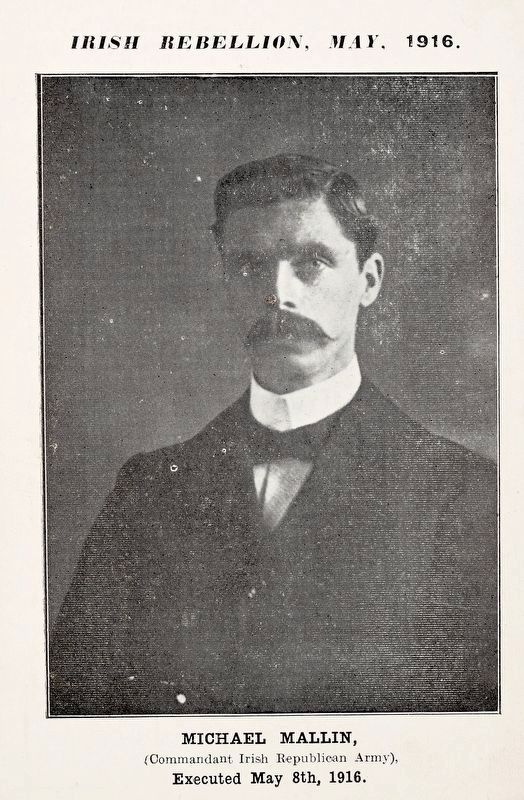
3. Michael Mallin : (Commandant Irish Republican Army) Executed May 8th, 1916.

Regionally, this marker is in the Ancient East. Globally, it is on the Atlantic Ocean, in the North Atlantic Region, in Europe, on the Island of Ireland, on the Celtic Fringe, in the European Union, in Atlantic Europe, on one of the British Isles, in the Western World, and in the Anglosphere.
Other nearby markers. At least 8 other markers are within walking distance of this marker: Robert Emmet (within shouting distance of this marker); An Chuntaois Constance Markievicz / Countess Constance Markievicz (within shouting distance of this marker); The United Service Club (within shouting distance of this marker); Éirí Amach na Cásca 1916: Páirc Fhaiche Stiabhna / 1916 Easter Rising in St Stephen's Green Park (within shouting distance of this marker); Jeremiah O'Donovan Rossa / Ó Donnabháin Rosa (within shouting distance of this marker); Fusiliers’ Arch (within shouting distance of this marker); Páirc Fhaiche Stiabhna / Saint Stephen's Green Park (within shouting distance of this marker); Ag Cosaint Pháirc Fhaiche Stiabhna / Defending St Stephen's Green Park (within shouting distance of this marker). Touch for a list and map of all markers in Dublin.
Also see . . .
1. 1916 Exhibition (St. Stephen's Green Park). (Submitted on August 1, 2026, by Ian Lefkowitz of New York, New York.)
2. Mallin, Michael Thomas (Dictionary of Irish Biography).
As dawn broke on Tuesday they came under fire from a machine gun on the roof of the Shelbourne hotel, suffering several casualties. Mallin himself had to drag a wounded man to safety and had a close shave when a bullet went through the brim of his hat. He was forced to withdraw to the College of Surgeons on the west side of the Green, a safer position but one of little strategic value. The decision to occupy a park overlooked on all sides by high buildings was a serious mistake, as was the failure to seize the Shelbourne, which dominated the area.(Submitted on August 1, 2026, by Ian Lefkowitz of New York, New York.)
Credits. This page was last revised on August 2, 2026. It was originally submitted on August 1, 2026, by Ian Lefkowitz of New York, New York. This page has been viewed 17 times since then. Photos: 1, 2, 3. submitted on August 1, 2026, by Ian Lefkowitz of New York, New York. • Andrew Ruppenstein was the editor who published this page.
