Edgewater in Anne Arundel County, Maryland — The American Northeast (Mid-Atlantic)
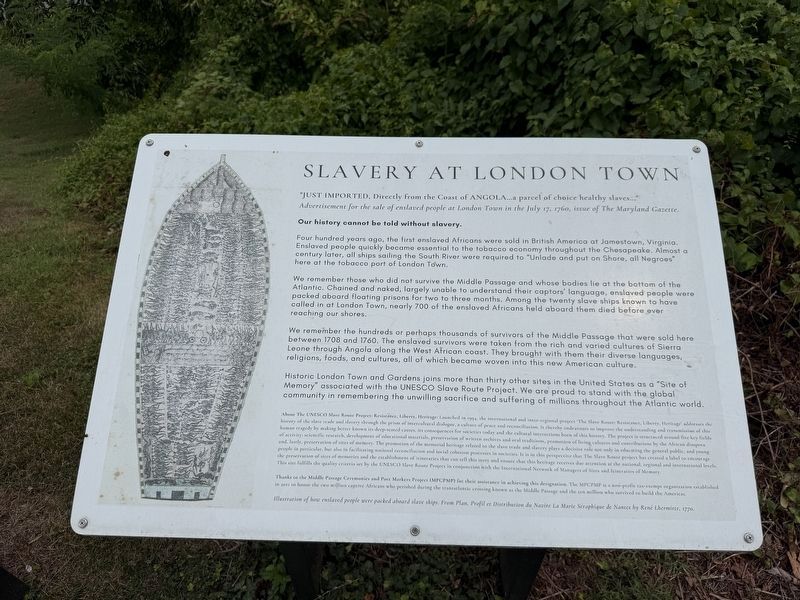
Slavery at London Town
“JUST IMPORTED, Directly from the Coast of ANGOLA…a parcel of choice healthy slaves…”
Advertisement for the sale of enslaved people at London Town in the July 17, 1760, issue of The Maryland Gazette.
Our history cannot be told without slavery.
Four hundred years ago, the first enslaved Africans were sold in British America at Jamestown, Virginia. Enslaved people quickly became essential to the tobacco economy throughout the Chesapeake. Almost a century later, all ships sailing the South River were required to “Unload and put on Shore, all Negroes” here at the tobacco port of London Town.
We remember those who did not survive the Middle Passage and whose bodies lie at the bottom of the Atlantic. Chained and naked, largely unable to understand their captors’ language, enslaved people were packed aboard floating prisons for two to three months. Among the twenty slave ships known to have called in at London Town, nearly 700 of the enslaved Africans held aboard them died before ever reaching our shores.
We remember the hundreds or perhaps thousands of survivors of the Middle Passage that were sold here between
this page online
Historic London Town and Gardens joins more than thirty other sites in the United States as a “Site of Memory” associated with the UNESCO Slave Route Project. We are proud to stand with the global community in remembering the unwilling sacrifice and suffering of millions throughout the Atlantic world.
About The UNESCO Slave Route Project: Resistance, Liberty, Heritage: Launched in 1994, the international and inter-regional project “The Slave Route: Resistance, Liberty, Heritage” addresses the history of the slave trade and slavery through the prism of intercultural dialogue, a culture of peace and reconciliation. It thereby endeavors to improve the understanding and transmission of the causes and modalities of the slave trade and slavery, as well as the issues and consequences of interactions among the peoples and cultures involved in these processes. The project is structured around five fields of action: scientific research, development of educational materials, preservation of sources and oral traditions, promotion of living cultures and contributions by the African diaspora, and, lastly, preservation of sites of memory. The promotion of the memorial heritage related to the slave trade and slavery plays a decisive role not only in understanding the general public, and young people in particular, but also in facilitating national reconciliation and social cohesion processes in societies. It is in this perspective that the Slave Route project has created a label to encourage the preservation of sites of memory and the establishment of itineraries that can tell this story and ensure that this heritage receives due attention at the national, regional and international levels. This site fulfills the quality criteria set by the UNESCO Slave Route Project in conjunction with the International Network of Managers of Sites and Itineraries of Memory.
Thanks to the Middle Passage Ceremonies and Port Markers Project (MPCPMP) for their assistance in achieving this designation. The MPCPMP is a non-profit tax-exempt organization established in 2011 to honor the two million captive Africans who perished during the transatlantic crossing known as the Middle Passage and the ten million who survived to build the Americas.
[Caption:]
Illustration of how enslaved people were packed aboard slave ships. From Plan, Profil et Distribution du Navire La Marie Séraphique de Nantes by René Lhermitte, 1770.
Erected by Historic

Topics and series. This historical marker is listed in these topic lists: African Americans • Colonial Era • Industry & Commerce • Waterways & Vessels. In addition, it is included in the UNESCO Slave Route Project series list. A significant historical date for this entry is July 17, 1760.
Location. 38° 56.491′ N, 76° 32.375′ W. Marker is in Edgewater, Maryland, in Anne Arundel County. It can be reached from Londontown Road west of Londontown Court, on the right when traveling west. Touch for map. Marker is at or near this postal address: 839 Londontown Rd, Edgewater MD 21037, United States of America. Touch for directions.

Regionally, this marker is in Central Maryland. It is also in the American Mid-Atlantic, in the Chesapeake Bay Region, and on the Eastern Seaboard. Globally, it is in the North Atlantic Region, North America, the Western Hemisphere, the Western World, and the Anglosphere. Historically, it finds itself in what was once one of the original Thirteen Colonies and also the Antebellum South.
Other nearby markers. At least 8 other markers are within walking distance of this marker: The South River (here, next to this marker); The Almshouse (within shouting distance of this marker); London Town Ferry (within shouting distance of this marker); a different marker also named William Brown House (within shouting distance of this marker); Scott Street (within shouting distance of this marker); The Carpenter's Shop (within shouting distance of this marker); Tobacco Barn (about 300 feet away); The Tenement (about 300 feet away). Touch for a list and map of all markers in Edgewater.
Other markers no longer nearby. The Ferry at London Town (was here, next to this marker but has been replaced with another marker now near it); William Brown House (was a few steps from this marker but has been replaced with another marker now near it); Dr. Hill's Medicinal Plants (was within shouting distance of this marker but has been replaced with another marker now near it); Archaeology at London Town (was within shouting distance of this marker but has been replaced with another marker now near it); Establishing a Colonial Town (was within shouting distance of this marker but has been replaced with another marker now near it); The Lord Mayor's Tenement (was within shouting distance of this marker but has been replaced with another marker now near it); Historic London Town and Gardens (was about 300 feet away, measured in a direct line but has been replaced with another marker now near it).
Additional keywords. Transatlantic Slave Trade; Human trafficking
Credits. This page was last revised on August 1, 2026. It was originally submitted on August 1, 2026, by Devry Becker Jones of Washington, District of Columbia. This page has been viewed 10 times since then. Photos: 1, 2. submitted on August 1, 2026, by Devry Becker Jones of Washington, District of Columbia.
