Edgewater in Anne Arundel County, Maryland — The American Northeast (Mid-Atlantic)
The South River
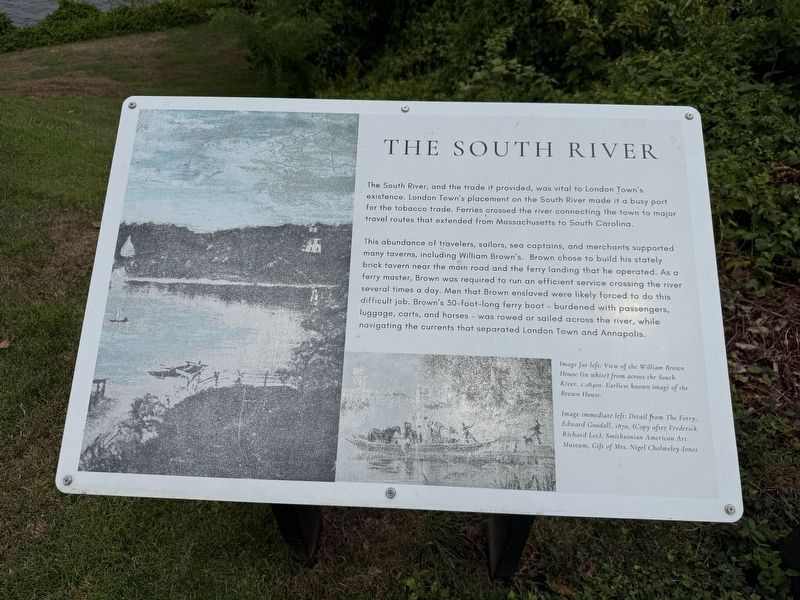
The South River, and the trade it provided, was vital to London Town's existence. London Town's placement on the South River made it a busy port for the tobacco trade. Ferries crossed the river connecting the town to major travel routes that extended from Massachusetts to South Carolina.
This abundance of travelers, sailors, sea captains, and merchants supported many taverns, including William Brown's. Brown chose to build his stately brick tavern near the main road and the ferry landing that he operated. As a ferry master, Brown was required to run an efficient service crossing the river several times a day. Men that Brown enslaved were likely forced to do this difficult job. Brown's 30-foot-long ferry boat - burdened with passengers, luggage, carts, and horses - was rowed or sailed across the river, while navigating the currents that separated London Town and Annapolis.
[Captions:]
Image far left: View of the William Brown House (in white) from across the Savanna River, c. 1840s. Earliest known image of the Brown House.
> Image immediate left: Detail from The Ferry, Edward Goodall, 1870, (Copy after Frederick Richard Lee), Smithsonian Art Museum, Gift of Mrs. Nigel Colmeley-Jones
Erected by Historic
this page online
Topics. This historical marker is listed in these topic lists: Colonial Era • Industry & Commerce • Waterways & Vessels. A significant historical year for this entry is 1870.
Location. 38° 56.492′ N, 76° 32.375′ W. Marker is in Edgewater, Maryland, in Anne Arundel County. It can be reached from Londontown Road west of Londontown Court, on the right when traveling west. Touch for map. Marker is at or near this postal address: 839 Londontown Rd, Edgewater MD 21037, United States of America. Touch for directions.

Regionally, this marker is in Central Maryland. It is also in the American Mid-Atlantic, in the Chesapeake Bay Region, and on the Eastern Seaboard. Globally, it is in the North Atlantic Region, North America, the Western Hemisphere, the Western World, and the Anglosphere. Historically, it finds itself in what was once one of the original Thirteen Colonies and also the Antebellum South.
Other nearby markers. At least 8 other markers are within walking distance of this marker: Slavery at London Town (here, next to this marker); The Almshouse (within shouting distance of this marker);

Other markers no longer nearby. The Ferry at London Town (was here, next to this marker but has been replaced with another marker now near it); William Brown House (was a few steps from this marker but has been replaced with another marker now near it); Dr. Hill's Medicinal Plants (was within shouting distance of this marker but has been replaced with another marker now near it); Archaeology at London Town (was within shouting distance of this marker but has been replaced with another marker now near it); Establishing a Colonial Town (was within shouting distance of this marker but has been replaced with another marker now near it); The Lord Mayor's Tenement (was within shouting distance of this marker but has been replaced with another marker now near it); Historic London Town and Gardens (was about 300 feet away, measured in a direct line but has been replaced with another marker now near it).
Credits. This page was last revised on August 1, 2026. It was originally submitted on August 1, 2026, by Devry Becker Jones of Washington, District of Columbia. This page has been viewed 8 times since then. Photos: 1, 2. submitted on August 1, 2026, by Devry Becker Jones of Washington, District of Columbia.
