Dayton's Bluff in Saint Paul in Ramsey County, Minnesota — The American Midwest (Upper Plains)
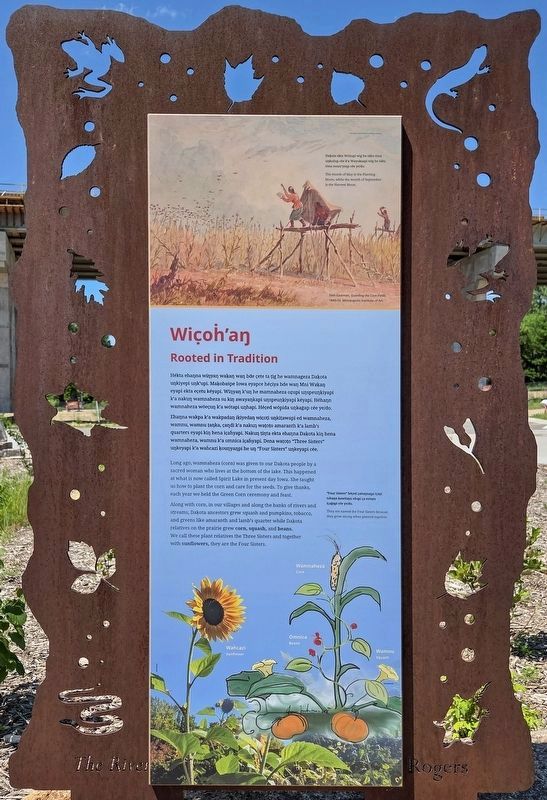
Wic̣oḣ'aŋ
Rooted in Tradition
Photographed by McGhiever, June 13, 2026
1. Wic̣oḣ'aŋ Marker

Seth Eastman, Guarding the Corn Fields, 1849-55. Minneapolis Institute of Art.
Ehaŋna wakpa k'a wakpadaŋ iḳiyedaŋ wic̣oṭi uŋkiṭawapi ed wamnaheza, wamnu, wamnu ṭaŋka, c̣aŋdi k'a nakuŋ waṭoṭo amaranth k'a lamb's quarters eyapi kiŋ hena ic̣aḣyapi. Nakuŋ ṭíŋta ekta ehaŋna Daḳota kiŋ hena wamnaheza, wamnu k'a omnica ic̣aḣyapi. Dena waṭoṭo "Three Sisters" uŋkeyapi k'a waḣcazi ḳouŋyaŋpi he uŋ "Four Sisters" uŋkeyapi cée.
Along with corn, in our villages and along the banks of rivers and streams, Daḳota ancestors grew squash and pumpkins,
this page online
"Four Sisters"
Wamnaheza
Corn
Waḣcazi
Sunflower
Omnica
Beans
Wamnu
Squash
Erected by Waḳaŋ Ṭípi Awaŋyaŋkapi.
Topics. This historical marker is listed in these topic lists: Agriculture • Indigenous Peoples and Communities.
Location. 44° 57.142′ N, 93° 4.453′ W. Marker is in Saint Paul, Minnesota, in Ramsey County. It is in Dayton's Bluff. It is at the intersection of Commercial Street and 4th Street E. on Commercial Street. The marker is next to the Waḳaŋ Ṭípi Center. Touch for map. Marker is at or near this postal address: 590 4th Street
Photographed by McGhiever, June 13, 2026
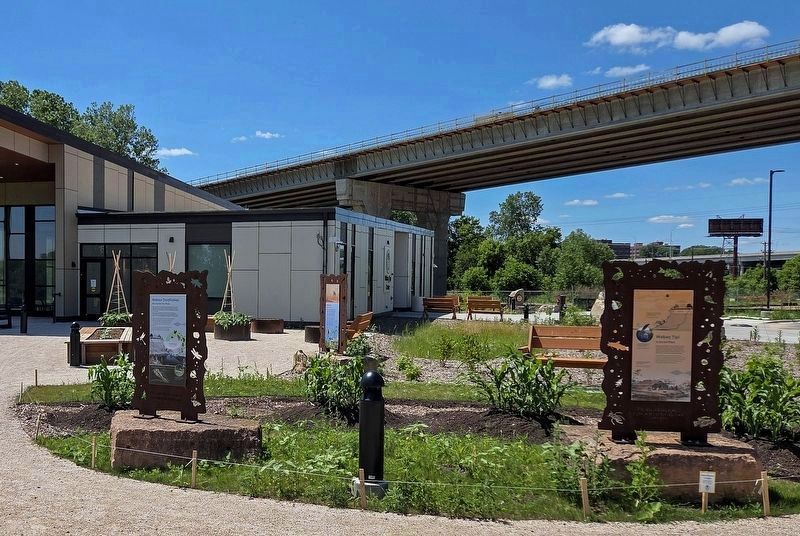
2. Wic̣oḣ'aŋ Marker (center background) in front of the Waḳaŋ Ṭípi Center

Regionally, this marker is in the Twin Cities Metropolitan Area. It is also in the American Midwest, in the Corn Belt, and in the Great River Road Region. Globally, it is in North America, the Western Hemisphere, the Western World, and the Anglosphere. Historically, it finds itself in what was once Rupert’s Land, the territory of the Mississippian Culture, and the Louisiana Purchase.
Other nearby markers. At least 8 other markers are within walking distance of this marker: Maḳoc̣e Ṭueŋḣiŋdapi (here, next to this marker); Waḳaŋ Ṭípi (a few steps from this marker); Uŋhdihuŋnipi (a few steps from this marker); Nature and history in the Phalen Creek valley (within shouting distance of this marker); Remnants of a Former Rail Yard (approx. 0.2 miles away); Northern Pacific Railway Warehouse (approx. half a mile away); Al Avila (approx. half a mile away); Marty Scott (approx. half a mile away). Touch for a list and map of all markers in Saint Paul.
Other markers no longer nearby. A time of environmental and cultural change (was within shouting distance of this marker but has been permanently removed); Preserving history on the land (was within shouting distance of this marker but has been permanently removed); Dakota life along Wakpa Tanka (was within shouting distance of this marker but has been permanently removed).
Credits. This page was last revised on August 2, 2026. It was originally submitted on August 2, 2026, by McGhiever of Minneapolis, Minnesota. This page has been viewed 12 times since then. Photos: 1, 2. submitted on August 2, 2026, by McGhiever of Minneapolis, Minnesota.
