Glass Point in Jamestown in James City County, Virginia — The American South (Mid-Atlantic)
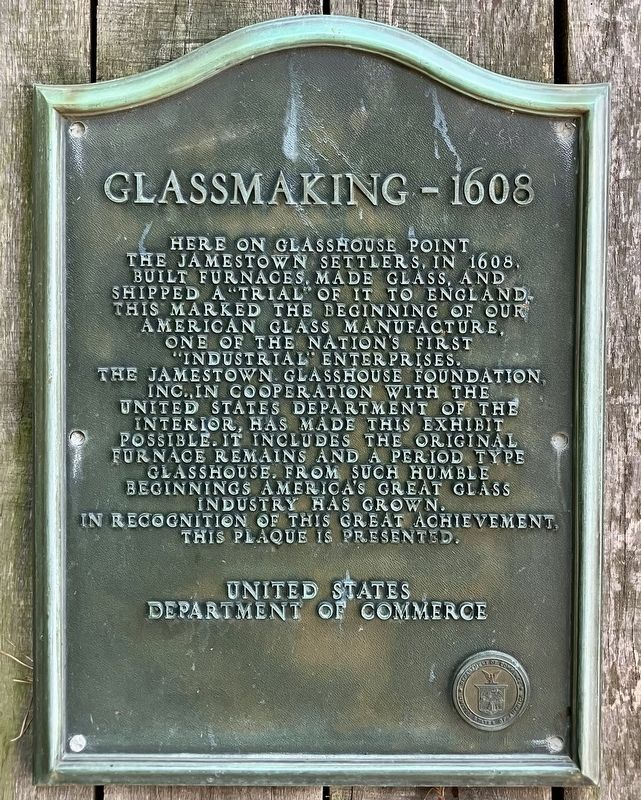
Glassmaking - 1608
Photographed by Tracy Andersen Roberts, July 3, 2026
1. Glassmaking - 1608 Marker
Erected by United States Department of Commerce.
Topics. This historical marker is listed in these topic lists: Anthropology & Archaeology • Colonial Era • Industry & Commerce • Settlements & Settlers. A significant historical year for this entry is 1608.
Location. 37° 13.214′ N, 76° 47.112′ W. Marker is in Jamestown, Virginia, in James City County. It is in Glass Point. It can be reached from no nearby street. Touch for map. Marker is in this post office area: Jamestown VA 23081, United States of America. Touch for directions.

Regionally,
this page online
Other nearby markers. At least 8 other markers are within walking distance of this marker: The Glasshouse (within shouting distance of this marker); An Ancient Road (within shouting distance of this marker); Original Glasshouse, 1608 (within shouting distance of this marker); Glasshouse Ruins (about 300 feet away, measured in a direct line); Interpreting the Glasshouse (about 300 feet away); Boatbuilding (approx. 0.2 miles away); Fishing (approx. 0.2 miles away); James Fort (approx. 0.2 miles away). Touch for a list and map of all markers in Jamestown.
Also see . . .
1. US National Park Service entry.
Photographed by Tracy Andersen Roberts, July 3, 2026
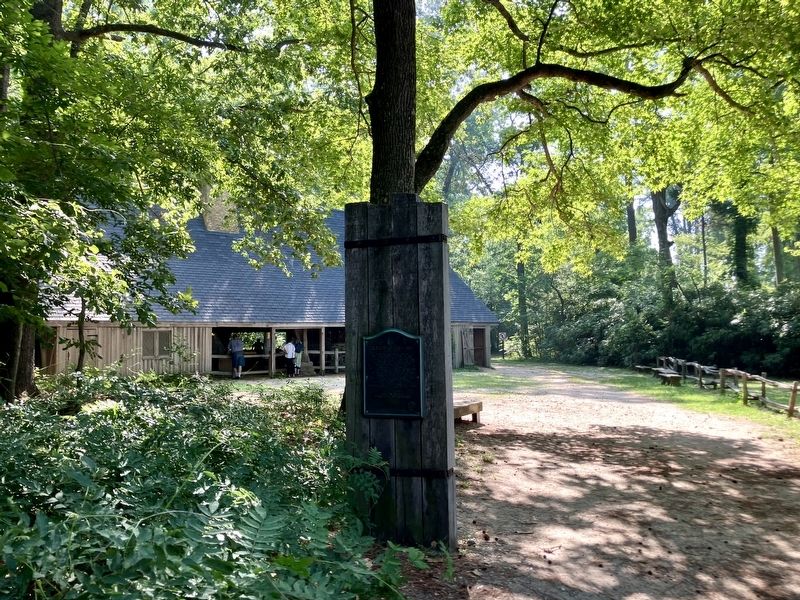
2. marker shown mid-range in front of reproduction Glasshouse
At "glass point" near Jamestown, the glass furnaces were re-discovered and excavated in 1948. Today, in a reconstructed, interpretive facility, glassblowing is again performed at Jamestown.(Submitted on July 7, 2026, by Tracy Andersen Roberts of Atlanta, Georgia.)
2. Historic Jamestowne entry.
Just off Jamestown Island is a popular re-creation of a colonial glasshouse. Artisans and interpreters are at work every day producing glass by hand in a similar manner to what the Jamestown colonists did 400 years ago.(Submitted on July 7, 2026, by Tracy Andersen Roberts of Atlanta, Georgia.)
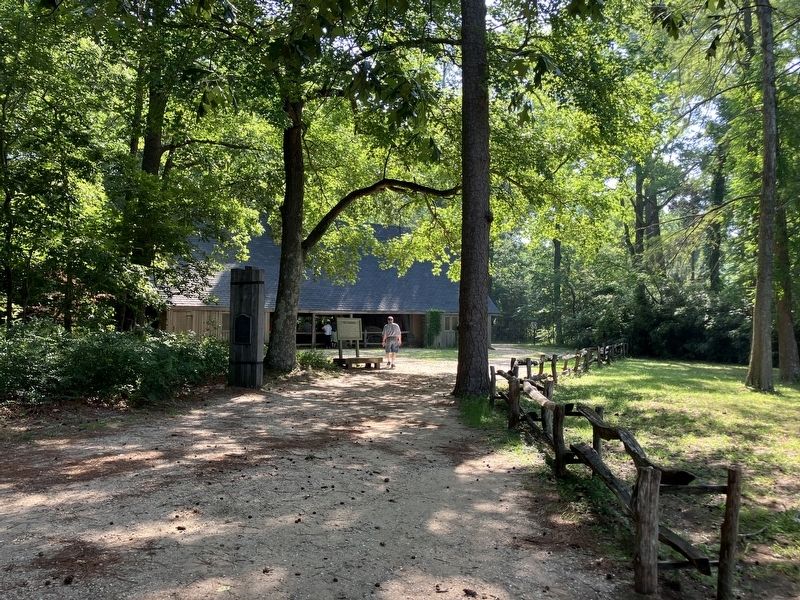
Craftsmen brought special tools with them to find riches in North America. Beyond gold and silver, a decent glass window could also make the Virginia Company money because glass was in short supply in London. Window glass had to be imported from the continent at great cost because English glassmakers could not make window glass profitably using coal furnaces (which they were required to use by English law). The Virginia Company hoped a window glass factory in Virginia was worth the breakage that would occur during the weeks of sailing the windows back across the Atlantic. There was plenty of sand on the JamesRiver beaches to provide the needed silica and a limitless supply of wood for fueling the furnaces and producing the needed potash.Photographed by Tracy Andersen Roberts, July 3, 20263. marker shown on path from beach in front of reproduction Glasshouse
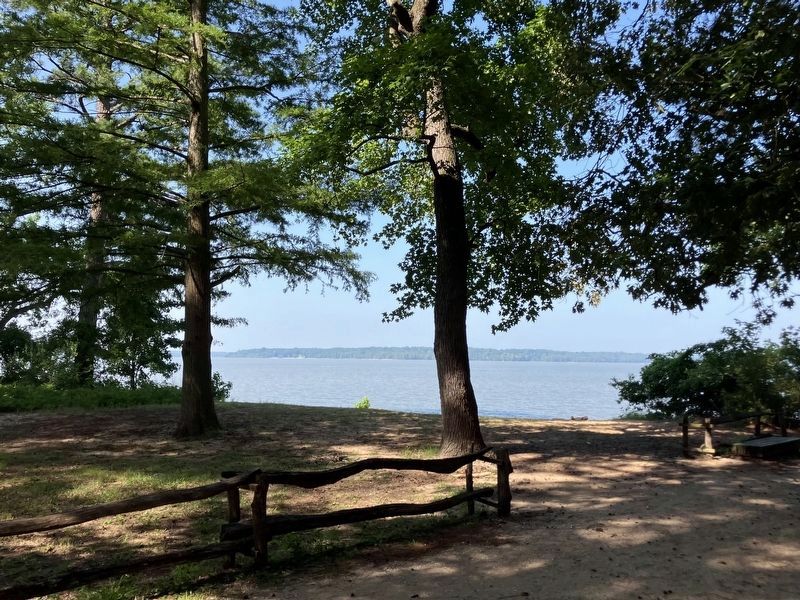
Three German glassmakers arrived at the colony in September 1608. Captain John Smith gave a nod to their industriousness when he wrote that most of the “labourers” in the fort “never did know what a dayes worke was, except the Dutch-men [Deutschmänner or German] and Poles, and some dozen other.” Archaeologists have found glass crucibles and cullet at James Fort. A crucible is a ceramic container made of refractory clay that can withstand the high temperatures used to melt the contents within. Cullet is glass waste that is recycled and used in the production of new glass.” The evidence indicates the glassmakers labored two months inside James Fort to produce a “tryal of glasse” that was returned to England at the end of 1608. The test glass was probably no more than an ingot to prove Virginia’s resources could make glass. With all the glassmaking items found inside James Fort and the later efforts made on Glasshouse Point just off the island, there is yet no evidence the Germans ever made any glass beyondtheir trial. The struggle for survival was too intense. Later attempts would be made at this location, likely with mixed success.Photographed by Tracy Andersen Roberts, July 3, 20264. View of the James River
Credits. This page was last revised on August 4, 2026. It was originally submitted on July 7, 2026, by Tracy Andersen Roberts of Atlanta, Georgia. This page has been viewed 43 times since then. Last updated on August 4, 2026, by Tracy Andersen Roberts of Atlanta, Georgia. Photos: 1, 2, 3, 4. submitted on July 7, 2026, by Tracy Andersen Roberts of Atlanta, Georgia. • Devry Becker Jones was the editor who published this page.
