Middle Township in Stone Harbor in Cape May County, New Jersey — The American Northeast (Mid-Atlantic)
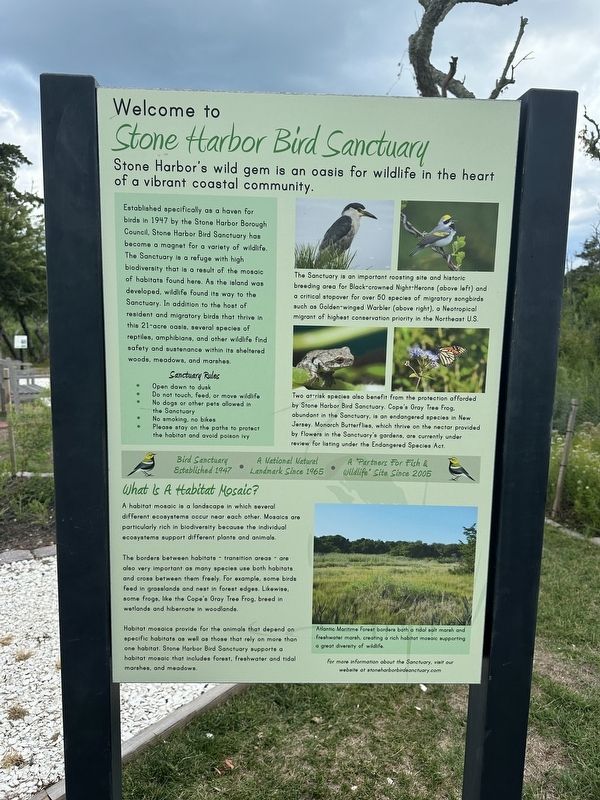
Welcome to Stone Harbor Bird Sanctuary
Stone Harbor's wild gem is an oasis for wildlife in the heart of a vibrant coastal community.
Photographed by Pete Skillman, July 30, 2026
1. Welcome to Stone Harbor Bird Sanctuary Marker
Sanctuary Rules
- Open dawn to dusk
- Do not touch, feed, or move wildlife
- No dogs or other pets allowed in the Sanctuary
- No smoking, no bikes
- Please stay on the paths to protect the habitat and avoid poison ivy
Two at-risk species also benefit from the
this page online
Bird Sanctuary Established 1947 • A National Natural Landmark Since 1965 • A "Partners For Fish & Wildlife" Site Since 2005
What is a Habitat Mosaic?
A habitat mosaic is a landscape in which several different ecosystems occur near each other. Mosaics are particularly rich in biodiversity because the individual ecosystems support different plants and animals.
The borders between habitats - transition areas - are also very important as many species use both habitats and cross between them freely. For example, some birds feed in grasslands and nest in forest edges. Likewise, some frogs, like the Cope's Gray Tree Frog, breed in wetlands and hibernate in woodlands.
Habitat mosaics provide for the animals that depend on specific habitats as well as those that rely on more than one habitat. Stone Harbor Bird Sanctuary supports
Photographed by Pete Skillman, July 30, 2026
2. Welcome to Stone Harbor Bird Sanctuary Marker - reverse side
Atlantic Maritime Forest borders both a tidal salt marsh and freshwater marsh, creating a rich habitat mosaic supporting a great diversity of wildlife.
For more information about the Sanctuary, visit our website at stoneharborbirdsanctuary.com
[Reverse Side]
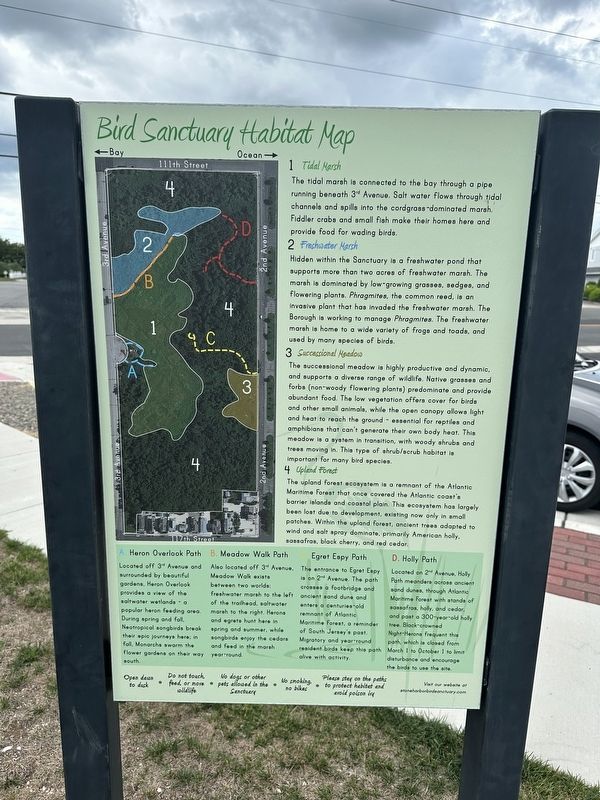
Bird Sanctuary Habitat Map
- Tidal Marsh
The tidal marsh is connected to the bay through a pipe running beneath 3rd Avenue. Salt water flows through tidal channels and spills into the cordgrass-dominated marsh. Fiddler crabs and small fish make their homes here and provide food for wading birds. - Freshwater Marsh
Hidden within the Sanctuary is a freshwater pond that supports more than two acres of freshwater marsh. The marsh is dominated by low-growing grasses, sedges, and flowering plants. Phragmites, the common reed, is an invasive plant that has invaded the freshwater marsh. The Borough is working to manage Phragmites. The freshwater marsh is home to a wide variety of frogs and toads, and used by many species of birds. - Successional Meadow
The successional meadow is highly productiveand dynamic, and supports a diverse range of wildlife. Native grasses and forbs (non-woody flowering plants) predominate and provide abundant food. The low vegetation offers cover for birds and other small animals, while the open canopy allows light and heat to reach the ground - essential for reptiles and amphibians that can't generate their own body heat. This meadow is a system in transition, with woody shrubs and trees moving in. This type of shrub/scrub habitat is important for many bird species. Photographed by Pete Skillman, July 30, 20263. Welcome to Stone Harbor Bird Sanctuary Marker - wide view
 - Upland Forest
The upland forest ecosystem is a remnant of the Atlantic Maritime Forest that once covered the Atlantic coast's barrier islands and coastal plain. This ecosystem has largely been lost due to development, existing now only in small patches. Within the upland forest, ancient trees adapted to wind and salt spray dominate, primarily American holly, sassafras, black cherry, and red cedar.
- Heron Overlook Path
Located off 3rd Avenue and surrounded by beautiful gardens, Heron Overlook provides a view of the saltwater wetlands - a popular heron feeding area. During spring and fall, Neotropical songbirds break their epic journeys here; in fall Monarchs swarm the flower gardens on their way south. - Meadow Walk Path
Also located off 3rd Avenue, Meadow Walk exists between two worlds: freshwater marsh to the left of the trailhead, saltwater marsh to the right. Herons and egrets hunt here in spring and summer, while songbirds enjoy the cedars and feed in the marsh year-round. - Egret Espy Path
The entrance to Egrey Espy in on 2ndAvenue. The path crosses a footbridge and ancient sand dune and enters a centuries-old remnant of Atlantic Maritime Forest, a reminder of South Jersey's past. Migratory and year-round resident birds keep this path alive with activity. - Holly Path
Located on 2nd Avenue, Holly Path meanders across ancient sand dunes, through Atlantic Maritime Forest with stands of sassafras, holly, and cedar, and past a 300-year-old holly tree. Black-crowned Night-Herons frequent this path, which is closed from March 1 to October 1 to limit disturbance and encourage the birds to use the site.
Visit our website at stoneharborbirdsanctuary.com
Topics. This historical marker is listed in these topic lists: Animals • Environment • Horticulture & Forestry • Parks & Recreational Areas. A significant historical year for this entry is 1947.
Location. 39° 2.523′ N, 74° 46.183′ W. Marker is in Stone Harbor, New Jersey, in Cape May County. It is in Middle Township. It is on 3rd Avenue, on the right when traveling north. Touch for map. Marker is at or near this postal address: 11400 3rd Ave, Stone Harbor NJ 08247, United States of America. Touch for directions.

Regionally, this marker is on the Jersey Shore. It is also in the American Northeast, in the Mid-Atlantic, and on the Eastern Seaboard. Globally, it is in the North Atlantic Region, North America, the Western Hemisphere, the Western World, and the Anglosphere. Historically, it finds itself in what was once New Netherland and also one of the original Thirteen Colonies.
Other nearby markers. At least 8 other markers are within walking distance of this marker: Egret Espy (about 600 feet away, measured in a direct line); Welcome to Holly Path at Stone Harbor Bird Sanctuary (about 700 feet away); In Honor of our Veterans (approx. 0.2 miles away); Avalon Home and Land Owner Assoc. Honors All Veterans (approx. 0.2 miles away); U.S. Life Saving Station (approx. 0.2 miles away); U.S. Life Saving Station No.35 (Tatham Life Saving Station) (approx. 0.2 miles away); God Bless America (approx. 0.2 miles away); Stephen C. Ludlam Post 331 (approx. 0.2 miles away). Touch for a list and map of all markers in Stone Harbor.
More about this marker. While primarily a nature-oriented marker, this counts as historical because it discusses the history of the environment in this area, the impact that human development has had, and the history of the founding of the sanctuary itself.
Also see . . . Stone Harbor Bird Sanctuary.
The Stone Harbor Bird Sanctuary is a wonderfully preserved microcosm of what the barrier islands of New Jersey looked like hundreds of years ago. As you walk along Sanctuary paths, it is easy to imagine the Lenni-Lenape Indians wandering through the maritime forest, crossing wind swept sand dunes, past groves of white cedar, birch, pine, holly and sassafras trees, taking time to drink water from a spring fed freshwater pond and then, fishing in the salt water meadows surrounded by herons and songbirds.(Submitted on August 13, 2026, by Pete Skillman of Wilmington, Delaware.)
Credits. This page was last revised on August 13, 2026. It was originally submitted on August 5, 2026, by Pete Skillman of Wilmington, Delaware. This page has been viewed 14 times since then. Photos: 1, 2, 3. submitted on August 5, 2026, by Pete Skillman of Wilmington, Delaware.
