Near Fort Peck in McCone County, Montana — The American West (Mountains)
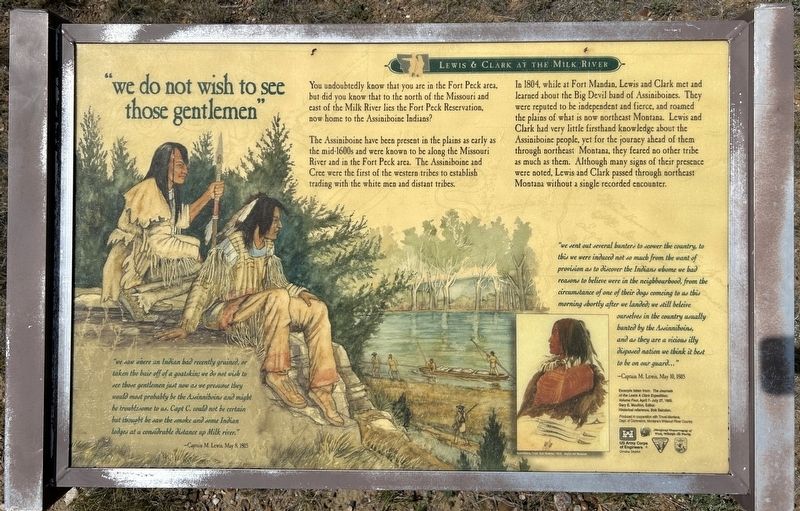
"we do not wish to see those gentlemen"
Lewis & Clark at the Milk River
June 21, 2026
1. "we do not wish to see those gentlemen" Marker
The Assiniboine have been present in the plains as early as the mid-1600s and were known to be along the Missouri River and in the Fort Peck area. The Assiniboine and Cree were the first of the western tribes to establish trading with the white men and distant tribes.
In 1804, while at Fort Mandan, Lewis and Clark met and learned about the Big Devil band of Assiniboines. They were reputed to be independent and fierce, and roamed the plains of what is now northeast Montana. Lewis and Clark had very little firsthand knowledge about the Assiniboine people, yet for the journey ahead of them through northeast Montana, they feared no other tribe as much as them. Although many signs of their presence were noted, Lewis and Clark passed through northeast Montana without a single recorded encounter.
"we saw where an Indian had recently grained, or taken the hair off of a goatskin; we do not wish to see those gentlemen just now as we presume they would most probably be the Assinniboins and might be troublesome to us. Capt C. could not be certain but thought he saw the smoke and some Indian lodges at a considerable distance up Milk river."
—Captain M. Lewis, May 8, 1805
"we sent out several hunters to scower the country, to this we were induced not so much from the want of provision as to discover the Indians whome we had reasons to believe were in the neighbourhood, from the circumstance of one of their dogs comeing to us this morning shortly after we landed; we still believe ourselves in the country usually hunted by the Assinniboins, and as they are a vicious illy disposed nation we think it best to be on our guard..."
—Captain M. Lewis, May 10, 1805
Assiniboine Chief, Karl Bodmer, 1833; Joclyn Art Museum
Excerpts taken from: The Journals of the Lewis & Clark Expedition: Volume Four, April 7- July 27, 1805. Gary E. Moulton, Editor. Historical reference, Bob Saindon.
Erected by US
this page online
Topics and series. This historical marker is listed in these topic lists: Exploration • Indigenous Peoples and Communities • Waterways & Vessels. In addition, it is included in the Lewis & Clark Expedition series list. A significant historical date for this entry is May 8, 1804.
Location. 48° 1.745′ N, 106° 19.167′ W. Marker is near Fort Peck, Montana, in McCone County. It can be reached from L and C Observation Road 0.2 miles north of Fort Peck Tower Hill Road. Located at the Lewis & Clark Milk River Observation Point. Touch for map. Marker is in this post office area: Nashua MT 59248, United States of America. Touch for directions.

Regionally, this marker is in the American Mountain West, in the Lewis & Clark Corridor, on the prairies, on the Great Plains, and specifically on the Northern Plains. Globally, it is in North America, the Western Hemisphere, the Western World, and the Anglosphere. Historically, it finds itself in what was once Rupert’s
June 21, 2026
2. "we do not wish to see those gentlemen" Marker
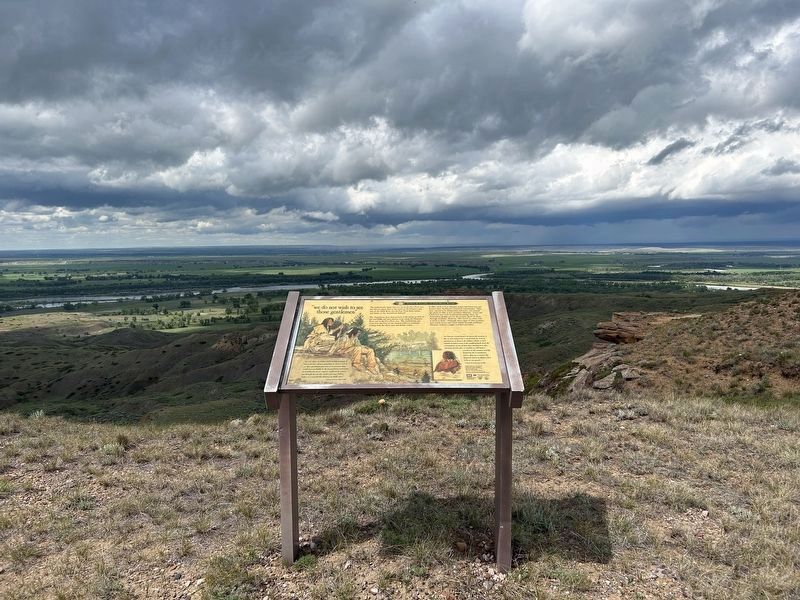
The Missouri River and its confluence with the Milk River can be seen in the distance.
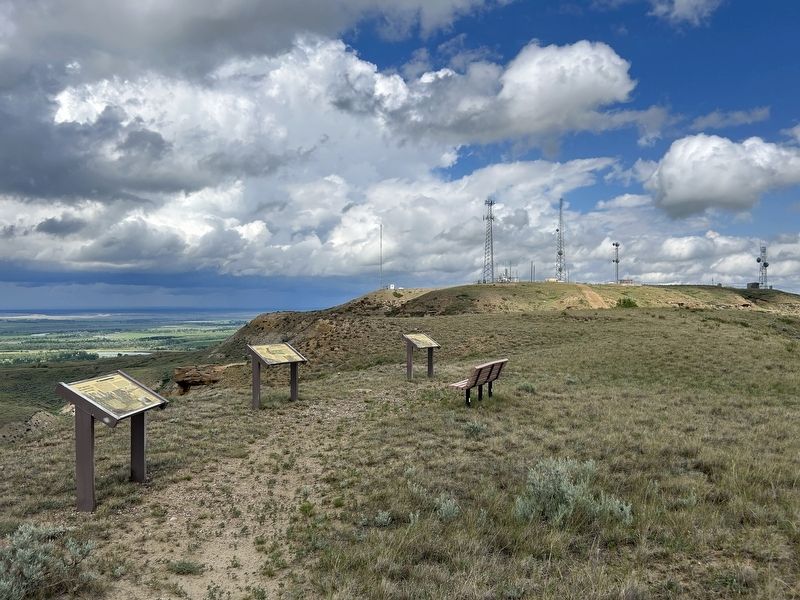
Other nearby markers. At least 8 other markers are within 4 miles of this marker, measured as the crow flies: Welcome to the Milk River Observation Point (here, next to this marker); "these appearances of cottonwood were quite reviving" (a few steps from this marker); "...much broken grannite...scattered...in a confused manner" (a few steps from this marker); a different marker also named Welcome to the Milk River Observation Point (about 500 feet away, measured in a direct line); Fort Peck Spillway (approx. 1.6 miles away); Peculiar White Water Named the Milk River (approx. 3½ miles away); With No Running Water, the Stream was called Big Dry River (approx. 3½ miles away); Summits of High Hills Were Covered with Pine (approx. 3½ miles away). Touch for a list and map of all markers in Fort Peck.
June 21, 2026
3. "we do not wish to see those gentlemen" Marker (right)
Credits. This page was last revised on August 8, 2026. It was originally submitted on August 8, 2026. This page has been viewed 21 times since then. Photos: 1, 2, 3. submitted on August 8, 2026.
