Fort Snelling in Hennepin County, Minnesota — The American Midwest (Upper Plains)
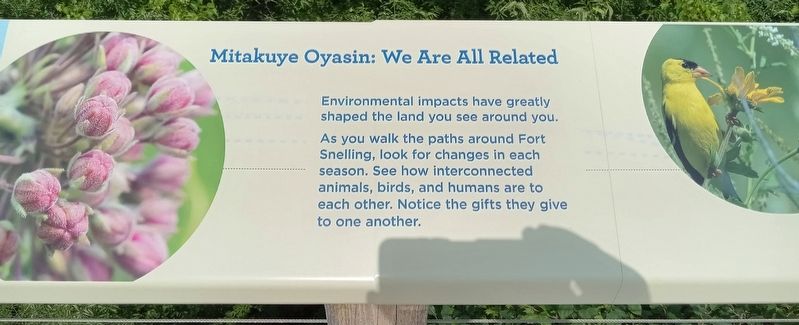
Mitakuye Oyasin: We Are All Related
Photographed by McGhiever, June 30, 2023
1. Mitakuye Oyasin: We Are All Related Marker
Mitakuye Oyasin: We Are All Related
Environmental impacts have greatly shaped the land you see around you.
As you walk the paths around Fort Snelling, look for changes in each season. See how interconnected animals, birds, and humans are to each other. Notice the gifts they give to one another.
This imagery uses the Dakota artistic form to reflect relationships between plants and animals. These connections are significant to the riverine site of Bdote.
In Dakota philosophy, there is a concept called Mitakuye Oyasin. This is a way of life based upon the interconnectedness of all life. Animals, plants, water, and earth are not viewed as lesser than human beings. Instead, we understand them as our equals. Each has an essential contribution to make in the world. As such, we treat them as relatives, with respect and reciprocity.
–Erin Genia
Erin Genia (Sissiton-Wahpeton Oyate/Odawa) created the five concrete stencils along the trail. A multidisciplinary artist, educator, and community organizer, Erin specializes in Native American and Indigenous arts and culture.
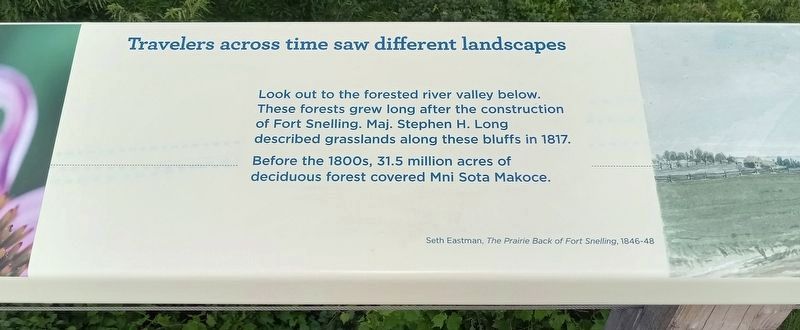
Travelers across time saw different landscapes
Look
this page online
Before the 1800s, 31.5 million acres of deciduous forest covered Mni Sota Makoce.
Seth Eastman, The Prairie Back of Fort Snelling, 1846-48
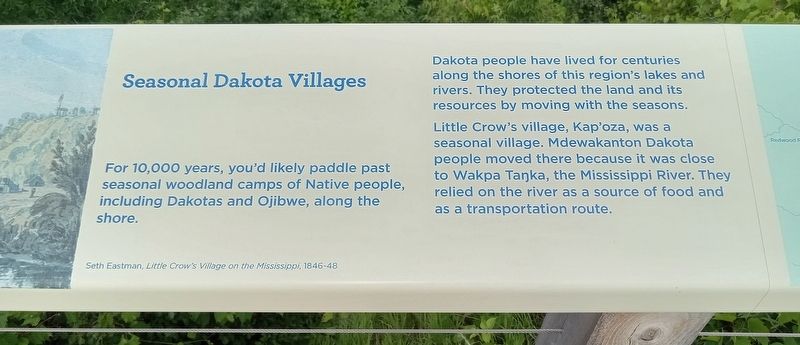
Seasonal Dakota Villages
For 10,000 years, you'd likely paddle past seasonal woodland camps of Native people, including Dakotas and Ojibwe, along the shore.
Seth Eastman, Little Crow's Village on the Mississippi, 1846-48
Dakota people have lived for centuries along the shores of this region's lakes and rivers. They protected the land and its resources by moving with the seasons.
Little Crow's village, Kap'oza, was a seasonal village. Mdewakanton Dakota people moved there because it was close to Wakpa Taŋka, the Mississippi River. They relied on the river as a source of food and as a transportation route.
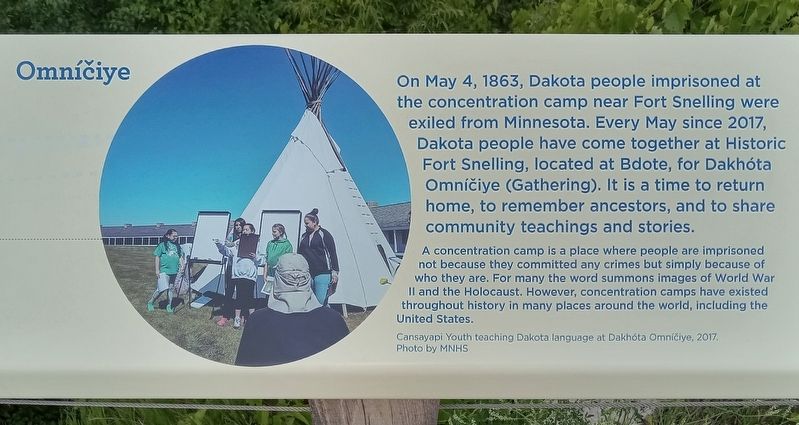
Omníčiye
On May 4, 1863, Dakota people imprisoned at the concentration camp near Fort Snelling were exiled from Minnesota. Every May since 2017, Dakota people have come together at Historic
Photographed by McGhiever, June 30, 2023
2. Travelers across time saw different landscapes
A concentration camp is a place were people are imprisoned not because they committed any crimes but simply because of who they are. For many the word summons images of World War II and the Holocaust. However, concentration camps have existed throughout history in many places around the world, including the United States.
Cansayapi Youth teaching Dakota language at Dakhóta Omníčiye, 2017. Photo by MNHS
Topics. This historical marker is listed in these topic lists: Environment • Forts and Castles • Indigenous Peoples and Communities.
Location. 44° 53.626′ N, 93° 11.196′ W. Marker is in Fort Snelling, Minnesota, in Hennepin County. It can be reached from Tower Avenue east of Bloomington Road, on the left when traveling east. The marker is at Historic Fort Snelling, on the east railing of the overlook north of the pay parking lot. Touch for map. Marker is in this post office area: Saint Paul MN 55111,
Photographed by McGhiever, June 30, 2023
3. Seasonal Dakota Villages

Regionally, this marker is in the Twin Cities Metropolitan Area. It is also in the American Midwest, in the Corn Belt, and in the Great River Road Region. Globally, it is in North America, the Western Hemisphere, the Western World, and the Anglosphere. Historically, it finds itself in what was once Rupert’s Land, the territory of the Mississippian Culture, and the Louisiana Purchase.
Other nearby markers. At least 8 other markers are within walking distance of this marker: Travel through 10,000 years of human history (a few steps from this marker); The Treaty of 1805 (about 300 feet away, measured in a direct line); The Smartest Horse in the US Army (about 300 feet away); Hope (about 300 feet away); Identity (about 400 feet away); Service (about 400 feet away); Giacomo Constantino Beltrami (about 800 feet away); An Appreciation: Colonel Josiah Snelling (approx. 0.2 miles away). Touch for a list and map of all markers in Fort Snelling.
Photographed by McGhiever, June 30, 2023
4. Omníčiye

Photographed by McGhiever, June 30, 2023
5. Marker on an overlook railing at Historic Fort Snelling
Credits. This page was last revised on August 8, 2026. It was originally submitted on August 8, 2026, by McGhiever of Minneapolis, Minnesota. This page has been viewed 11 times since then. Photos: 1, 2, 3, 4, 5. submitted on August 8, 2026, by McGhiever of Minneapolis, Minnesota.
