Eltham in Nillumbik Shire, Victoria, Australia — Oceania
The Barak Bushlands
Photographed by Dean Barton-Ancliffe, July 7, 2026
1. The Barak Bushlands Marker
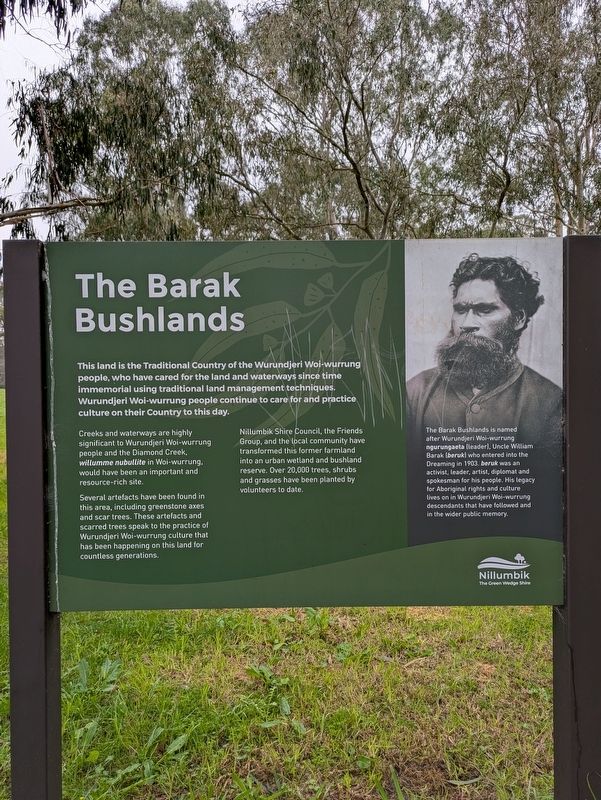
Wurundjeri Woi-wurrung people continue to care for and practice culture on their Country to this day.
Creeks and waterways are highly significant to Wurundjeri Woi-wurrung people and the Diamond Creek, willumme nubullite in Woi-wurrung, would have been an important and resource-rich site.
Several artefacts have been found in this area, including greenstone axes and scar trees. These artefacts and scarred trees speak to the practice of Wurundjeri Woi-wurrung culture that has been happening on this land for countless generations.
Nillumbik Shire Council, the Friends Group, and the local community have transformed this former farmland into an urban wetland and bushland reserve. Over 20,000 trees, shrubs and grasses have been planted by volunteers to date.
The Barak Bushlands is named after Wurundjeri Wol-wurung ngurungaeta [leader], Uncle William Barak (beruk) who entered into the Dreaming in 1903. beruk was an activist, leader,
this page online
Erected by Nillumbik The Green Wedge Shire.
Topics. This historical marker is listed in these topic lists: Indigenous Peoples and Communities • Parks & Recreational Areas. A significant historical year for this entry is 1903.
Location. 37° 43.831′ S, 145° 8.579′ E. Marker is in Eltham, Victoria, in Nillumbik Shire. It is on Main Road (Victoria Route 44) near Antoinette Boulevard. Touch for map. Marker is at or near this postal address: Main Road, Eltham VIC 3095, Australia. Touch for directions.

Regionally, it is in Oceania, in Australasia, in the Pacific Ocean, in South Pacific, on the Pacific Rim, in the Western World, and in the Anglosphere. Historically, it finds itself in what was once a British colony.
Other nearby markers. At least 8 other markers are within 6 kilometers of this marker, measured as the crow flies: Eltham Avenue of Honour (South) (approx. half a kilometer away); Eltham Avenue of Honour (North) (approx. 1.1
Photographed by Dean Barton-Ancliffe, July 7, 2026
2. The Barak Bushlands Marker
Also see . . . Barak Bushlands Reserve. Nillumbik Reconciliation Group
The Bushlands are named for William Barak (1823 – 15 August 1903), son of Tooterrie and Bebejan, and the last traditional ngurungaeta of the Wurundjeri-willam clan, the pre-colonial inhabitants of present-day Melbourne.(Submitted on August 8, 2026, by Dean Barton-Ancliffe of Rowville, Victoria.)
Barak was said to have been present as a boy when John Batman met with the tribal elders to “purchase” the Melbourne area in 1835. He became an influential spokesman for Aboriginal social justice and an important source of Wurundjeri cultural lore. He was instrumental in petitioning for and setting up the Aboriginal farming community known as Coranderrk, near Healesville, Victoria. Barak and other elders walked from Coranderrk to Parliament House, Melbourne to approach parliamentarians directly several times, as well as using newspapers to further their cause.
In his later life Barak painted and drew Wurundjeri ceremonies and carved weapons and tools, becoming widely known both at home and abroad for his art and maintenance of culture as well as a singer and storyteller. He is now considered a significant Aboriginal artist of the nineteenth century.
Credits. This page was last revised on August 8, 2026. It was originally submitted on August 8, 2026, by Dean Barton-Ancliffe of Rowville, Victoria. This page has been viewed 12 times since then. Photos: 1, 2. submitted on August 8, 2026, by Dean Barton-Ancliffe of Rowville, Victoria. • Andrew Ruppenstein was the editor who published this page.
