Falcon Heights in Ramsey County, Minnesota — The American Midwest (Upper Plains)
Agricultural Experiment Station
Photographed by McGhiever, July 11, 2025
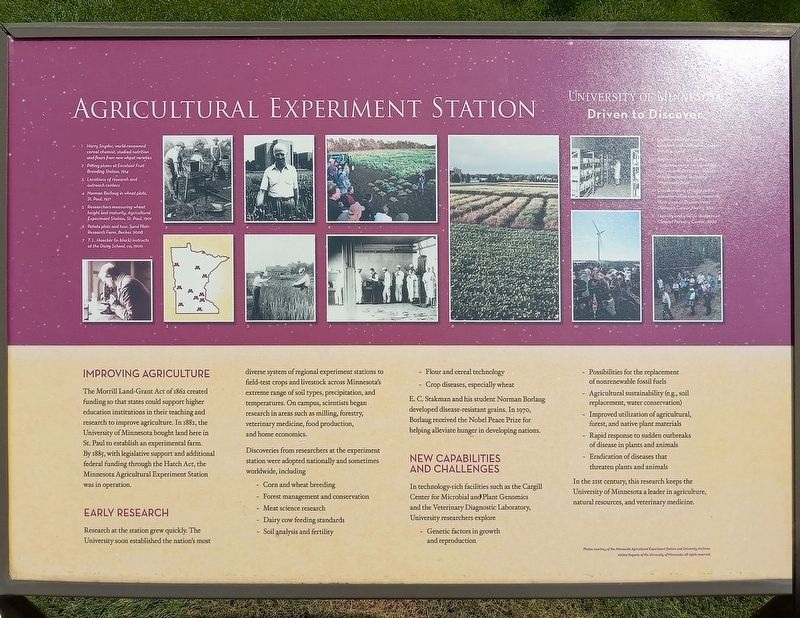
1. Agricultural Experiment Station Marker
1. Harry Snyder, world-renowned cereal chemist, studied nutrition and flours from new wheat varieties
2. Pitting plums at Excelsior Fruit Breeding Station, 1914
3. Locations of research and outreach centers
4. Norman Borlaug in wheat plots, St. Paul, 1971
5. Researchers measuring wheat height and maturity, Agricultural Experiment Station, St. Paul, 1901
6. Potato plots and tour, Sand Plain Research Farm, Becker, 2008
7. T.L. Haecker (in black) instructs at the Dairy School, ca. 1900
8. [illegible]
9. [illegible]
10. Crossbreeding of dairy cattle and alternative energy research, West Central Research and Outreach Center, Morris, 2007
11. Forestry and wildlife students at Cloquet Forestry Center, 2002
Improving Agriculture
The Morrill Land-Grand Act of 1862 created funding so that states could support higher education institutions in their teaching and research to improve agriculture. In 1882, the University of Minnesota bought land here in St. Paul to establish an experimental farm. By 1885, with legislative support and additional federal funding through the Hatch Act, the Minnesota Agricultural Experiment
this page online
Early Research
Research at the station grew quickly. The University soon established the nation's most diverse system of regional experiment stations to field-test crops and livestock across Minnesota's extreme range of soil types, precipitation, and temperatures. On campus, scientists began research in areas such as milling, forestry, veterinary medicine, food production, and home economics.
Discoveries from researchers at the experiment station were adopted nationally and sometimes worldwide, including
- Corn and wheat breeding
- Forest management and conservation
- Meat science research
- Dairy cow feeding standards
- Soil analysis and fertility
- Flour and cereal technology
- Crop diseases, especially wheat
E. C. Stakman and his student Norman Borlaug developed disease-resistant grains. In 1970, Borlaug received the Nobel Peace Prize for helping alleviate hunger in developing nations.
New Capabilities and Challenges
In technology-rich facilities such as the Cargill Center for Microbial and Plant Genomics and the Veterinary Diagnostic Laboratory, University researchers explore
-
Photographed by McGhiever, July 11, 2025
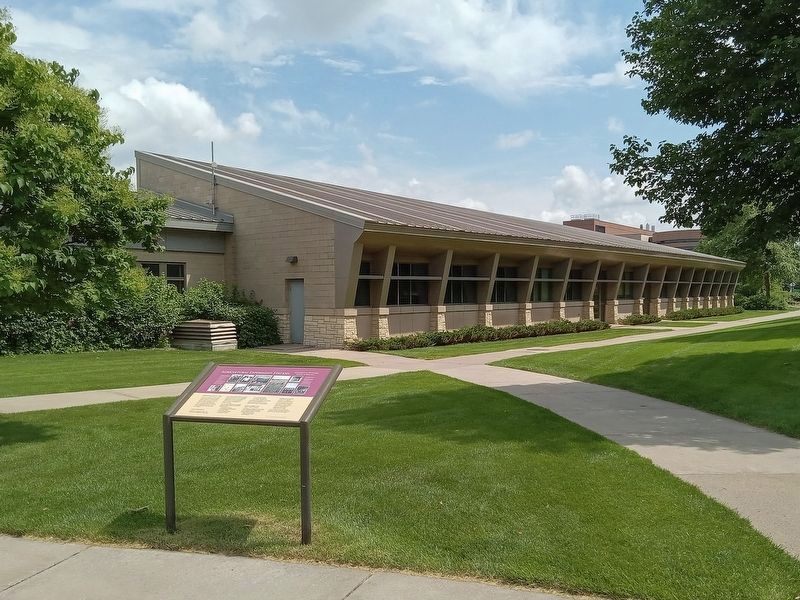
2. Agricultural Experiment Station Marker in front of Plant Growth Facilities–West
- Possibilities for the replacement of nonrenewable fossil fuels
- Agricultural sustainability (e.g., soil replacement, water conservation)
- Improved utilization of agricultural, forest, and native plant materials
- Rapid response to sudden outbreaks of disease in plants and animals
- Eradication of diseases that threaten plants and animals
In the 21st century, this research keeps the University of Minnesota a leader in agriculture, natural resources, and veterinary medicine.
Erected 2009 by Regents of the University of Minnesota.
Topics. This historical marker is listed in these topic lists: Agriculture • Education • Science & Medicine. A significant historical year for this entry is 1885.
Location. 44° 59.277′ N, 93° 10.908′ W. Marker is in Falcon Heights, Minnesota, in Ramsey County. It is at the intersection of Gortner Avenue and Folwell Avenue, on the right when traveling north on Gortner Avenue. The marker is on the Saint Paul Campus of the University of Minnesota, in front of Plant Growth Facilities–West. Touch for map. Marker is at or near this postal address: 1552 Gortner Avenue, Saint Paul MN 55108, United States of America. Touch for directions.

Regionally, this marker is in the Twin Cities Metropolitan Area. It is also in the American Midwest, in the Corn Belt, and in the Great River Road Region. Globally, it is in North America, the Western Hemisphere, the Western World, and the Anglosphere. Historically, it finds itself in what was once Rupert’s Land, the territory of the Mississippian Culture, and the Louisiana Purchase.
Other nearby markers. At least 8 other markers are within walking distance of this marker: Growing in Minnesota (about 600 feet away, measured in a direct line); Agricultural Excellence (approx. 0.2 miles away); The Goldstein Legacy (approx. ¼ mile away); Extending the U (approx. ¼ mile away); The St. Paul Campus (approx. 0.3 miles away); Old Anatomy Building (approx. 0.4 miles away); Veterinary Medicine (approx. 0.4 miles away); World War I Memorial Grove (approx. half a mile away). Touch for a list and map of all markers in Falcon Heights.
Credits. This page was last revised on August 15, 2026. It was originally submitted on August 15, 2026, by McGhiever of Minneapolis, Minnesota. This page has been viewed 10 times since then. Photos: 1, 2. submitted on August 15, 2026, by McGhiever of Minneapolis, Minnesota.
