Charleston in Charleston County, South Carolina — The American South (South Atlantic)
Fort Moultrie
Photographed by Craig Swain, May 3, 2010
1. Fort Moultrie Marker
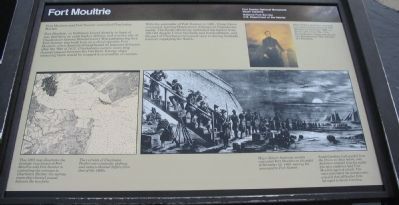
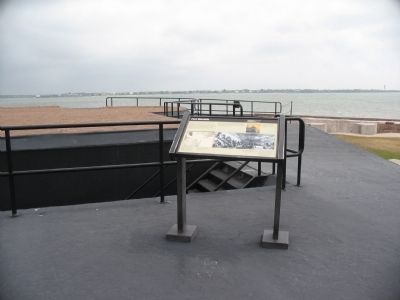
Fort Moultrie, on Sullivan's Island directly in front of you, had been an early harbor defense and was the site of Charleston's famous Revolutionary War palmetto-log fort. Fort Sumter was built here on a shoal opposite Fort Moultrie when America strengthened its seacoast defenses after the War of 1812. Charleston's narrow main ship channel passed between the two forts. Enemy ships venturing there would be trapped in a crossfire of cannon.
With the surrender of Fort Sumter in 1861, Union forces evacuated, leaving Charleston's defenses in Confederate hands. The South effectively controlled the harbor from 1861-65 despite Union blockade and bombardment, and the port of Charleston remained open to daring blockade runners supplying the South.
Erected by Fort Sumter National Monument, South Carolina - National Park Service - U.S. Department of the Interior.
Topics. This historical marker is listed in these topic lists: Forts and Castles • War, US Civil • Waterways & Vessels. A significant historical month for this entry is April 1812.
Location. 32° 45.141′ N, 79° 52.475′ W.
this page online

Regionally, this marker is in Historic Charleston and in the Lowcountry. It is also in the American South, specifically in the Deep South, and on the Eastern Seaboard. Globally, it is in the North Atlantic Region, North America, the Western Hemisphere, the Western World, and the Anglosphere. Historically, it finds itself in what was once the territory of the Mississippian Culture, one of the original Thirteen Colonies, one of the Confederate States of America, and the Antebellum South.
Other nearby markers. At least 8 other markers are within walking distance of this marker: Flags of the Fort (here, next to this marker); Charleston Besieged (a few steps from this marker); Fort Johnson (a few steps from this marker); Morris Island (a few steps from this marker);
Photographed by Craig Swain, May 3, 2010
2. Map of Charleston Harbor
Another marker is no longer nearby. Morris Island (was a few steps from this marker but has been replaced with another marker now near it).
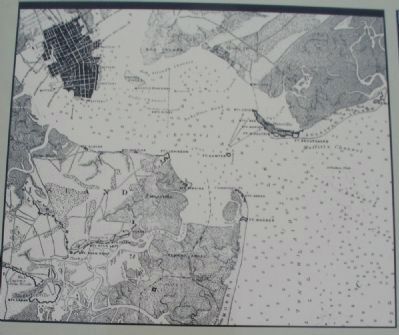
More about this marker. On the lower left is a map of Charleston harbor with the defenses noted. This 1863 map illustrates the strategic importance of Fort Moultrie and Fort Sumter in controlling the entrance to Charleston Harbor; the narrow main ship channel passed between the two forts. The currents of Charleston Harbor are constantly shifting, and today's channel differs from that of the 1860s.
On the upper right is a portrait of Major Robert Anderson, who assumed command of Union forces at Fort Moultrie in November 1860, on the eve of the Civil War. This Kentucky-born major was the son of a Revolutionary War defender of Charleston.
In the bottom right is an illustration depicting the Federal
Photographed by Craig Swain, May 3, 2010
3. Fort Moultrie Marker
Also see . . . Fort Moultrie. National Park Service page for Fort Moultrie. (Submitted on May 18, 2010, by Craig Swain of Leesburg, Virginia.)
Photographed by Craig Swain, May 3, 2010
4. Sullivan's Island From Fort Sumter
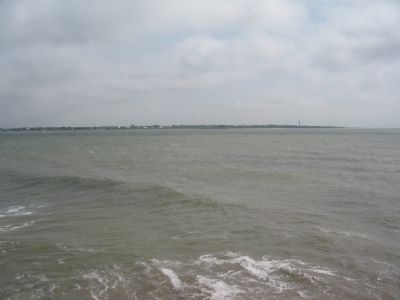
Fort Moultrie stands in the distant center, on Sullivan's Island.
Photographed by Bill Coughlin, August 3, 2013
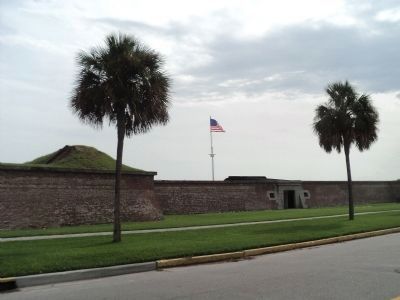
5. Fort Moultrie
Photographed by Bill Coughlin, August 3, 2013
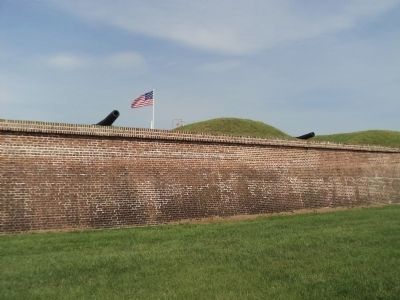
6. Fort Moultrie on Sullivans Island
Credits. This page was last revised on January 4, 2026. It was originally submitted on May 18, 2010, by Craig Swain of Leesburg, Virginia. This page has been viewed 1,839 times since then and 61 times this year. Photos: 1, 2, 3, 4. submitted on May 18, 2010, by Craig Swain of Leesburg, Virginia. 5, 6. submitted on August 18, 2013, by Bill Coughlin of Woodland Park, New Jersey.
