
Naperville in Will County, Illinois — The American Midwest (Great Lakes)
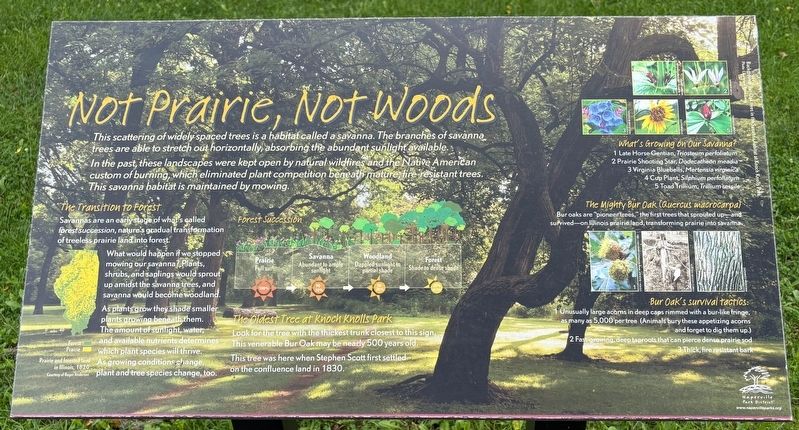
Not Prairie, Not Woods
Photographed by Sean P. Flynn, August 18, 2026
1. Not Prairie, Not Woods Marker
In the past, these landscapes were kept open by natural wildfires and the Native American custom of burning, which eliminated plant competition beneath mature, fire resistant trees. This savanna habitat is maintained by mowing.
The Transition to Forest
Savannas are an early stage of what's called forest succession, nature's gradual transformation of treeless prairie land into forest.
What would happen if we stopped mowing our savanna? Plants, shrubs, and saplings would sprout up amidst the savanna trees, and savanna would become woodland.
As plants grow they shade smaller plants growing beneath them. The amount of sunlight, water, and available nutrients determines which plant species will thrive. As growing conditions change, plant and tree species change, too.
The Oldest Tree at Knoch Knolls Park
Look for the tree with the thickest trunk closest to this sign, This venerable Bur Oak may be nearly 500 years old. This tree was
this page online
What's Growing on Our Savanna?
1 Late Horse Gentian, Triosteum perfoliatum
2 Prairie Shooting Star, Dodecatheon meadia
3 Virginia Bluebells, Mertensia virginica
4 Cup Plant, Silphium perfoliatumn
5 Toad Trillium, Trillium sessile
The Mighty Bur Oak (Quercus macrocarpa)
Bur oaks are "pioneer trees," the first trees that sprouted up-and survived-on Illinois prairie land, transforming prairie into savanna.
Bur Oak's survival tactics:
1 Unusually large acorns in deep caps rimmed with a bur-like fringe, as many as 5,000 per tree (Animals bury these appetizing acorns and forget to dig them up.)
2 Fast-growing, deep taproots that can pierce dense prairie sod
3 Thick, fire resistant bark
Erected by Naperville Park District.
Topics. This historical marker is listed in these topic lists: Environment • Horticulture & Forestry • Indigenous Peoples and Communities • Settlements & Settlers. A significant historical year for this entry is 1830.
Location. 41° 42.786′ N, 88° 8.443′ W. Marker is in Naperville, Illinois, in Will County. It is on Knoch
Photographed by Sean P. Flynn, August 18, 2026
2. Not Prairie, Not Woods Marker
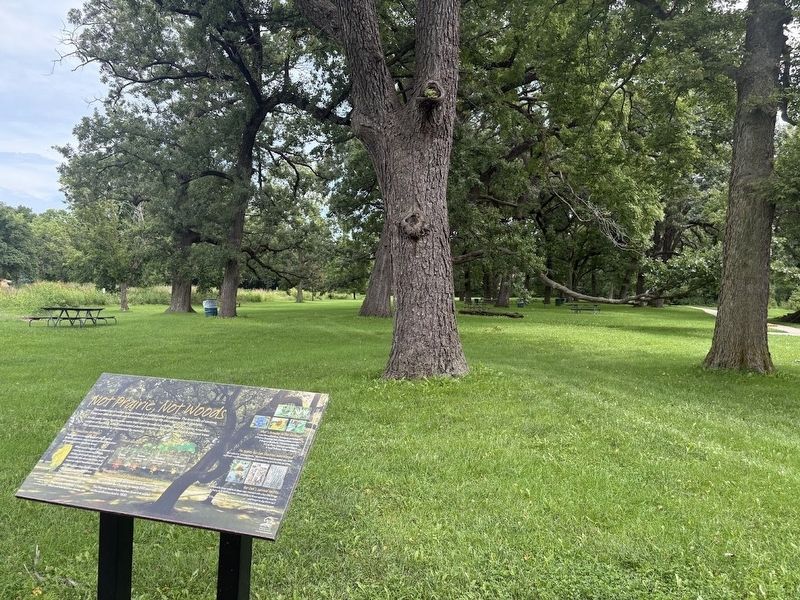
It could not be determined for certain whether the 500-year-old tree referenced in the text is indeed the nearest one to the marker.

Regionally, this marker is in Greater Chicago. It is also in the American Midwest. Globally, it is in North America, on the Great Lakes, in the Western Hemisphere, in the Western World, and in the Anglosphere. Historically, it finds itself in what was once the territory of the Mississippian Culture and also the Northwest Territory.
Other nearby markers. At least 8 other markers are within walking distance of this marker: Where the Rivers Meet (a few steps from this marker); Scott Settlement (about 300 feet away, measured in a direct line); First Claim on the Confluence (about 300 feet away); The Land Where the Rivers Meet (about 300 feet away); Are You Curious About the River? (about 300 feet away); Knoch Knolls Park (about 400 feet away); a different marker also named Where the Rivers Meet (about 500 feet away); a different
Photographed by Sean P. Flynn, August 18, 2026
3. Not Prairie, Not Woods Marker
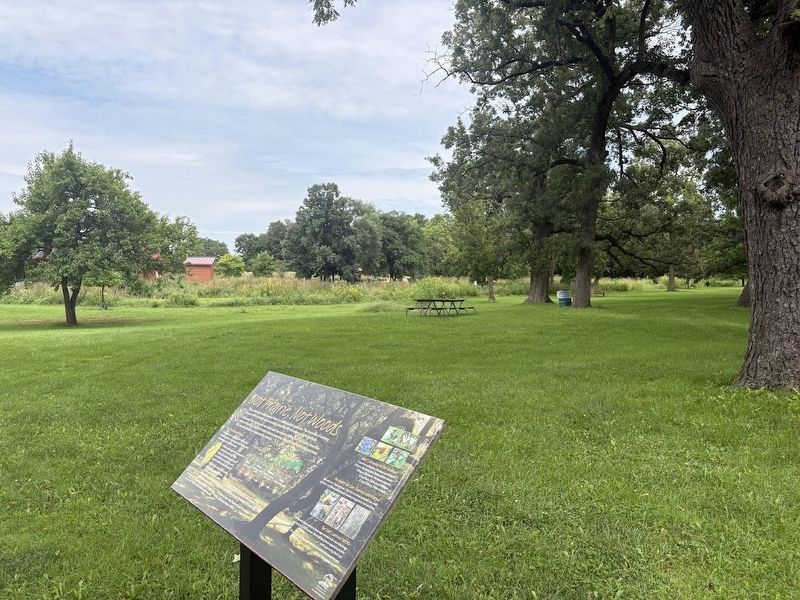
The Knoch Knolls Nature Center is in the distance.
Credits. This page was last revised on August 20, 2026. It was originally submitted on August 20, 2026, by Sean P. Flynn of Oak Park, Illinois. This page has been viewed 6 times since then. Photos: 1, 2, 3. submitted on August 20, 2026, by Sean P. Flynn of Oak Park, Illinois.
