South Loop in Chicago in Cook County, Illinois — The American Midwest (Great Lakes)
Fort Dearborn Massacre Monument
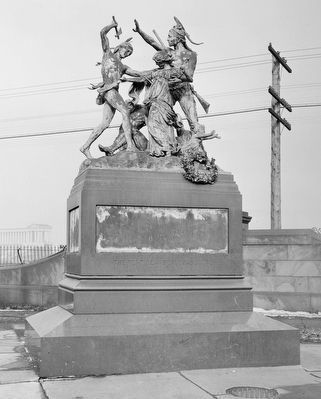
Photographed by Kaufmann & Fabry Co.; courtesy of Chicago History Museum (NN0038), circa 1926
1. Fort Dearborn Massacre Monument
This photo shows the memorial in its original location, on 18th Street near Calumet Avenue. Visible in the far background on the left is the colonnade of Soldier Field, which opened in 1924.
August 15, 1812
Black Partridge saving Mrs. Helm
Erected 1893 by George Pullman.
Topics. This historical marker and monument is listed in these topic lists: Arts, Letters, Music • Indigenous Peoples and Communities • War of 1812 • Women. A significant historical date for this entry is August 15, 1812.
Location. Marker has been permanently removed. It was located near 41° 51.48′ N, 87° 37.186′ W. Marker was in Chicago, Illinois, in Cook County. It was in South Loop. It could be reached from the intersection of East 18th Street and South Calumet Avenue, on the left when traveling east. The location used for this listing is an estimate of its original spot along 18th Street near Prairie Avenue. Touch for map. Marker was at or near this postal address: 1801 South Calumet Avenue, Chicago IL 60616, United States of America.
We have been informed that this marker is no longer there and will not be replaced. This page is an archival view of what was.
Regionally, this marker and monument was on Chicago’s South Side. It was also in the American Midwest. Globally, it was in North America, on

this page online
Other nearby markers. At least 8 other markers are within walking distance of this location: Battle of Fort Dearborn (within shouting distance of this marker); George Pullman (within shouting distance of this marker); Prairie Avenue Historic District (within shouting distance of this marker); John J. and Frances M. Glessner House (about 300 feet away, measured in a direct line); A Heritage Preserved (about 300 feet away); Outside the District (about 300 feet away); Lost Houses of Prairie Avenue: 1600-1700 Blocks (about 400 feet away); Beginnings 1812-1871 (about 400 feet away). Touch for a list and map of all markers in Chicago.
Another marker is no longer nearby. John J. Glessner House (was about 300 feet away but has been replaced with another marker now near it).
More about this marker. The location used for this listing is a rough estimate of where it originally stood on
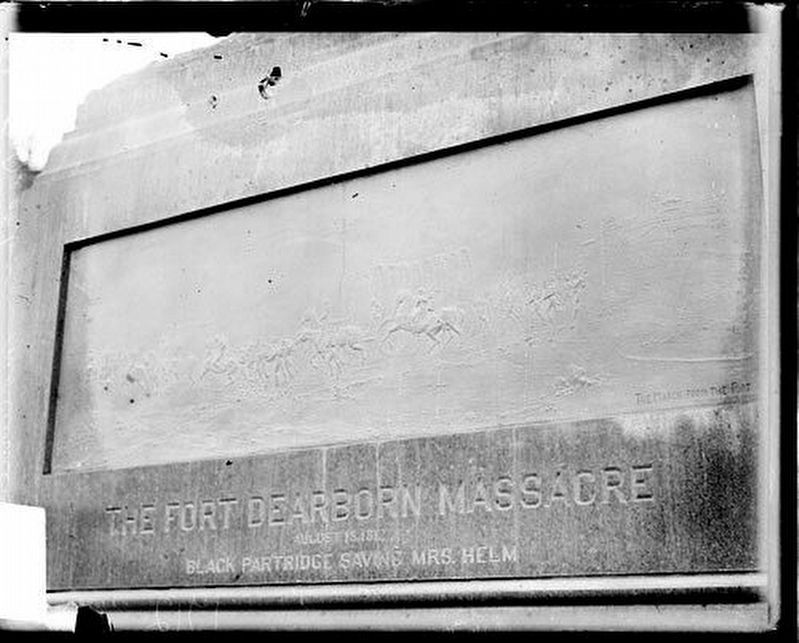
Chicago Daily News Collection, Chicago History Museum (DN-0058261), circa 1912
2. The base of the Fort Dearborn Massacre Monument
The relief depicts a scene from the 15-minute engagement that left more than 60 U.S. troops and civilians dead on August 15, 1812.
Pullman died in 1897, and his will called for the statue to be given to the Chicago Historical Society, in trust of the City of Chicago. Pullman's home was razed in 1922 and finally in 1931 the statue was moved to the historical society,
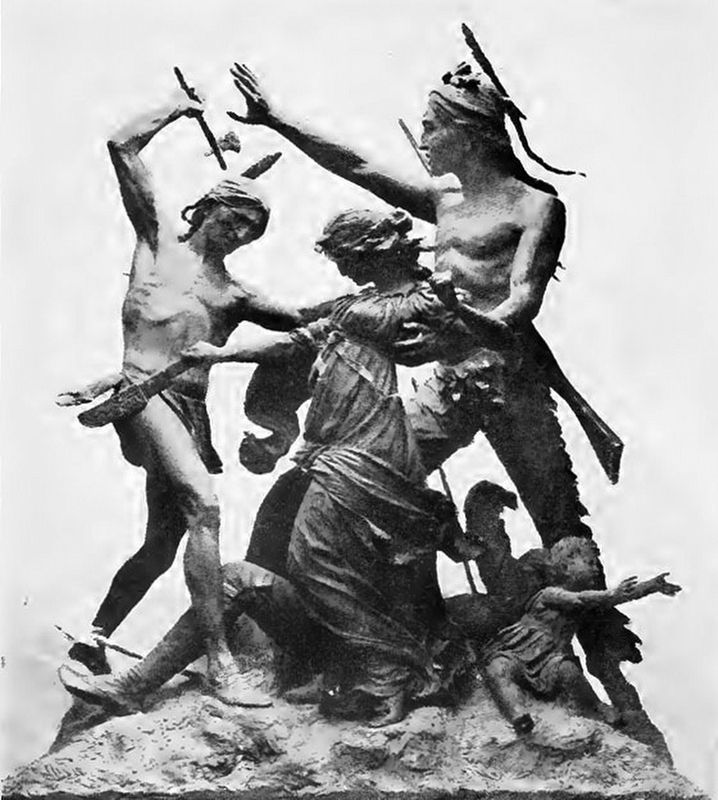
The Fort Dearborn Massacre, via Wikimedia Commons, circa 1912
3. The monument's sculpture
The photo comes from the 1912 publication of the 1814 recollections of Lt. Linai T. Helm, a survivor of the incident whose wife is depicted being protected by a Potawatomi chief named Black Partridge in the 1893 statue commissioned by George Pullman. According to the book, linked below, Mrs. Helm was captured and returned safely to her stepfather, early Chicago settler John Kinzie.
Click for more information.
Click for more information.
Today, the site of the incident is marked by a modern park, called Battle of Fort Dearborn Park. An Illinois State Historical Society plaque was placed there when it opened in 2009.
The bronze sculpture was designed by Carl Rohl-Smith, who had around that same period created a statue of Benjamin Franklin for the World's Columbian Exposition in Chicago. This Fort Dearborn statue depicts Black Partridge, the Potawatomi chief, saving the life of Margaret
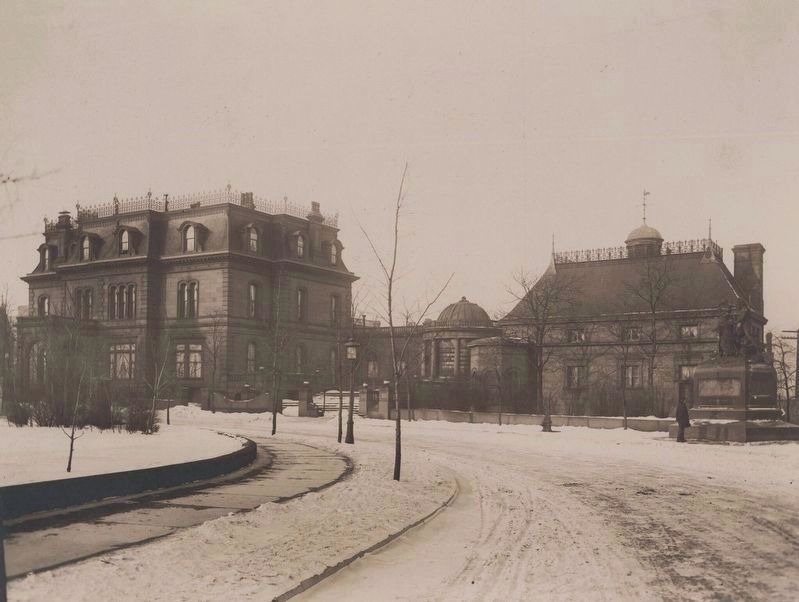
Courtesy of Chicago History Museum (ICHi-038227), circa 1895
4. Fort Dearborn Massacre Monument
The monument is visible on the right, near the Pullman mansion.
While this statue is no longer on display, another memorial to the massacre is still prominent today: "Defense," a 1928 bas relief by Henry Hering that is located on one of the bridgehouses of the DuSable Bridge at Michigan Avenue and Wacker Drive, where Fort Dearborn once stood.
Regarding Fort Dearborn Massacre Monument. The Battle of Fort Dearborn, as it is known today, lasted only 15 minutes, but it was a formative moment in the historiography of Chicago. It also remains to this day a source of controversy related to both its depiction and its meaning.
Fort Dearborn was established by U.S. troops in 1803, close to where the Chicago River emptied into Lake Michigan, roughly where the modern Michigan Avenue meets Wacker Drive in downtown Chicago. The fort was part of the young country's efforts to establish a foothold in the Northwest Territory, which it had obtained from Great Britain after the Revolution, yet was still the subject of land claims by Native American tribes. Tensions rose in the years lead-up to the War of 1812, as Great Britain sought to ally
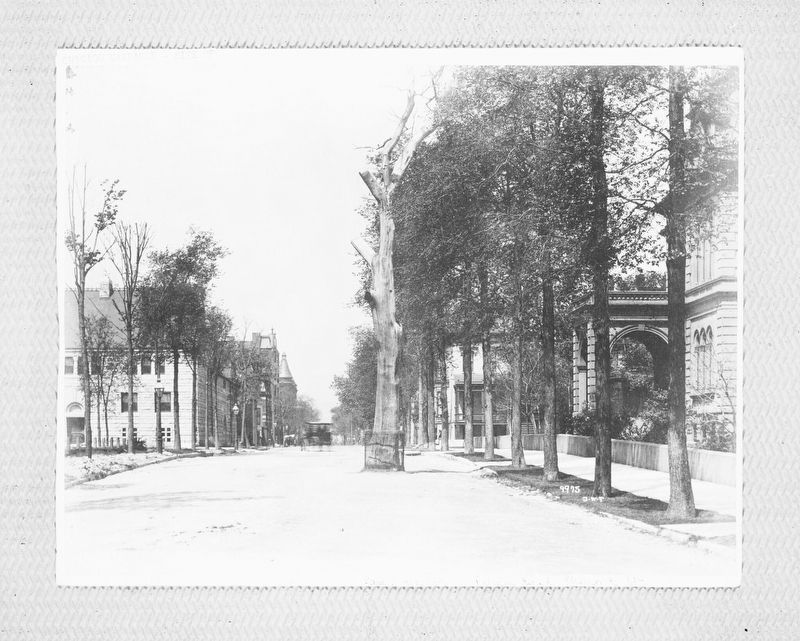
Attributed to J. W. Taylor, photographer; courtesy of Chicago History Museum (ICHi-003063), circa 1890
5. "The Massacre Tree"
This purported "witness tree" to the Battle of Fort Dearborn sat in the middle of 18th Street near Prairie Avenue until coming down in a storm in 1894. Industrialist George Pullman, whose house is on the right of this circa-1890 photo, commissioned the Fort Dearborn Massacre Monument in 1893, and erected it just behind where the photographer would have been standing for this photo. The Glessner House, visible on the left in this photo, still stands today on the southwest corner of 18th and Prairie.
Tensions in the region around Fort Dearborn reached new heights in April 1812, when a group of Winnebago tribesmen killed two white settlers at a farm located near the modern-day Bridgeport neighborhood in Chicago. Fearing for their safety, other nearby settlers moved inside the walls of Fort Dearborn. That June, after the U.S. declared war on Great Britain, Fort Mackinac in Michigan was seized by the British. As news of this capture reached military leaders, Nathan Heald, Fort Dearborn's commander, was ordered to evacuate.
After waiting several days for an armed escort to arrive, the Fort Dearborn garrison finally left on the morning of August 15, 1812, en for Fort Wayne. The group included about 100 people, including roughly nine women and 18 children, a group of local militiamen and several soldiers; the armed escort comprised about 30 Miami Indians led by a soldier named William Wells. Somewhere between one and two miles from the fort—the original site of this monument is about 1½ miles from the fort—the party was ambushed by a group of Potawatomi. The
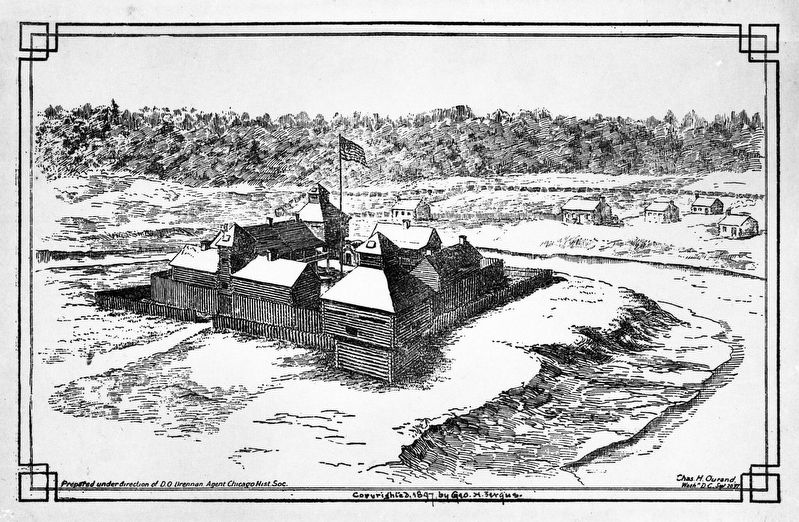
George M. Fergus, artist; courtesy of Chicago History Museum (ICHi-003038), 1897
6. Depiction of the first Fort Dearborn
This drawing, from the late 19th century, offers a rendering of the original Fort Dearborn, which was built in 1803 and burned down during the War of 1812.
The rest of the party was taken prisoner; some died in captivity and others were later paroled. Fort Dearborn was burned down by the Potawatomi. (Fort Dearborn was rebuilt at basically the same location in 1816, and stood there until it mostly destroyed by fires in the 1850s; its last remnants burned down in the Great Chicago Fire of 1871.)
While the Battle of Fort Dearborn was relatively minor in scale, the event has long carried outsized importance, starting with its use as a pretense for attacking and/or removing Native Americans from the region both during the War of 1812 and after. In 1833, only two decades after the battle, the Treaty of Chicago ended the Black Hawk War and forced the displacement of all Native American tribes in northeastern Illinois to west of the Mississippi River, and Chicago was officially
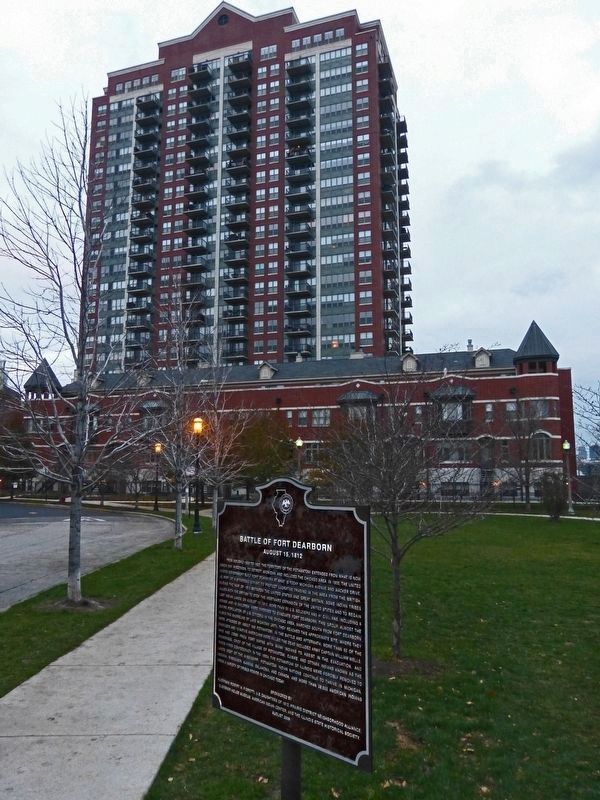
Photographed by Allen C. Browne, November 5, 2012
7. Battle of Fort Dearborn Marker
The site of the original memorial to the Fort Dearborn Massacre is in the background of this photo, near where 18th Street meets Calumet Ave. Pullman's mansion is long gone, and today is the site of high-rise.
In modern times, both the incident and this monument have symbolized the event's complicated legacy as a small but notable cultural flashpoint. Activist groups long opposed this memorial for what they believed to be a depiction of Native Americans as warmongers. Meanwhile, efforts successfully led to a renaming of the event from "Massacre" to "Battle." The memorial was removed in 1997 and has remained in storage, out of the public eye, for almost 30 years since.
Also see . . .
1. Chicagology: Fort Dearborn Massacre Memorial. The Chicagology site includes a look at the history of this memorial. It includes a reprint of a 2009 article about the naming of Battle of Fort Dearborn Park, which included a photograph of the 1893 memorial when it was reinstalled outdoors in 1987.
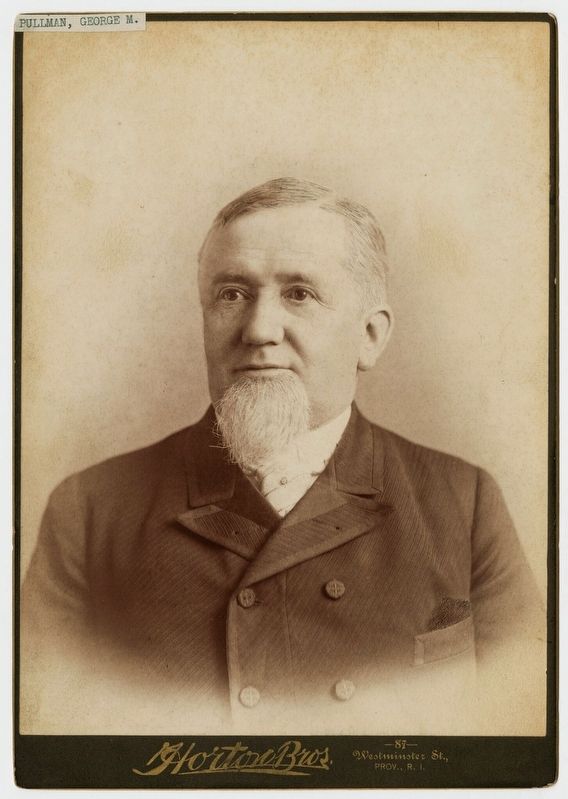
Excerpt(Submitted on August 21, 2026, by Sean P. Flynn of Oak Park, Illinois.)from June 23, 1893, Chicago Tribune article: "In the presence of ex-President Harrison, Chief Justice Fuller of the United States Sutreme Court, and an assemblage of men and ramen foremost in Chicago’s business and society circles yesterday afternoon Miss Florence Pullman drew aside the silken folds us covered from view the Fort Dearborn massacre group, presented by her father, George M. Pullman, to the city to commemorate a tragedy that took place what is now the foot of Eighteenth street eighty-one years ago. More than a year ago Mr. Pullman decided to erect this memorial, influenced by the fact that his home stands on the battlefield. Near it, in the middle of Eighteenth street, surrounded by an iron fence, is the old, dead cottonwood tree so indissolubly associated with that brave fight and subsequent massacre. Mr. Pullman commissioned Carl Rohl-Smith to make the statue of bronze."Horton Bros., photographer; courtesy of Chicago History Museum (ICHi-021773)8. George M. Pullman (1831-1897Industrial George Pullman developed the Pullman sleeper car and is the namesake of the Chicago neighborhood where he founded a company town. Pullman's mansion at Prairie and 18th was located close to where the Battle of Fort Dearborn (then known as the Fort Dearborn Massacre) was believed to have occurred, and in 1893 he commissioned a statue in memory of the event that was placed next to his home.
2. The Missing Monument. A 2012 article from WBEZ, Chicago's public radio station, about the now-hidden Fort Dearborn Massacre Monument.
Excerpt: "Today Rohl-Smith’s sculpture is nowhere to be seen. It was removed from the Clarke grounds around 1997, and is stored in a warehouse, supposedly awaiting another restoration. A proposal to locate the monument in The Battle of Fort Dearborn Park has been opposed by native groups."(Submitted on August 21, 2026, by Sean P. Flynn of Oak Park, Illinois.)
3. Memorials of the Fort Dearborn Massacre which occurred on August 15, 1812. A 2019 blog by the Digital Research Library of Illinois History Journal. (Submitted on August 21, 2026, by Sean P. Flynn of Oak Park, Illinois.)
4. War of 1812 and the bloody Battle of Fort Dearborn. From the Potawatomi Nation official site. (Submitted on August 21, 2026, by Sean P. Flynn of Oak Park, Illinois.)
5. Black Partridge (Wikipedia).
Excerpt: "Returning to his village on Peoria Lake [after the Battle of Fort Dearborn] however, he found his village had been burned by the Illinois Rangers from Edwardsville under orders from Governor Ninian Edwards. Among those massacred at the village were his daughter and grandchild. Taking 200 warriors from nearby villages, as well as 100 from Shequenebec and another 100 from Mittitass, e joined in the attack against Fort Clark on September 19, 1813, although this attack was repulsed by the fort's defenders. Black Hawk, then a young warrior, was also present at the attack. Black Partridge and his band eventually surrendered after being driven back to Fort Clark by General Henry Dodge and Major Zachary Taylor. e was one of the 13 chieftains escorted by Colonel George Davenport to St. Louis where peace was signed between the Potawatomi and the United States. He was a later signatory of several treaties between the Potawatomi and the United States government."(Submitted on August 21, 2026, by Sean P. Flynn of Oak Park, Illinois.)
6. Which Historical Monuments Have Sparked Controversy In Chicago?. Curious City, by WBEZ, Chicago's public radio station, looks at some of the more controversial monuments erected in Chicago through the years.
Excerpt: "But in the late 1960s, a coalition of Native American activists called the American Indian Movement (AIM) began staging protests against certain portrayals of Native Americans. The activists believed that the Fort Dearborn monument promoted racist stereotypes of Native Americans as savages, and furthered the biased narrative that the event was a 'massacre' rather than a battle, explains Ann Keating, a professor of history at North Central College and author of Rising Up from Indian Country."(Submitted on August 21, 2026, by Sean P. Flynn of Oak Park, Illinois.)
Credits. This page was last revised on September 22, 2026. It was originally submitted on August 21, 2026, by Sean P. Flynn of Oak Park, Illinois. This page has been viewed 41 times since then. Photos: 1, 2, 3, 4, 5, 6. submitted on August 21, 2026, by Sean P. Flynn of Oak Park, Illinois. 7. submitted on February 24, 2013, by Allen C. Browne of Silver Spring, Maryland. 8. submitted on August 21, 2026, by Sean P. Flynn of Oak Park, Illinois.
