Butte in Silver Bow County, Montana — The American West (Mountains)
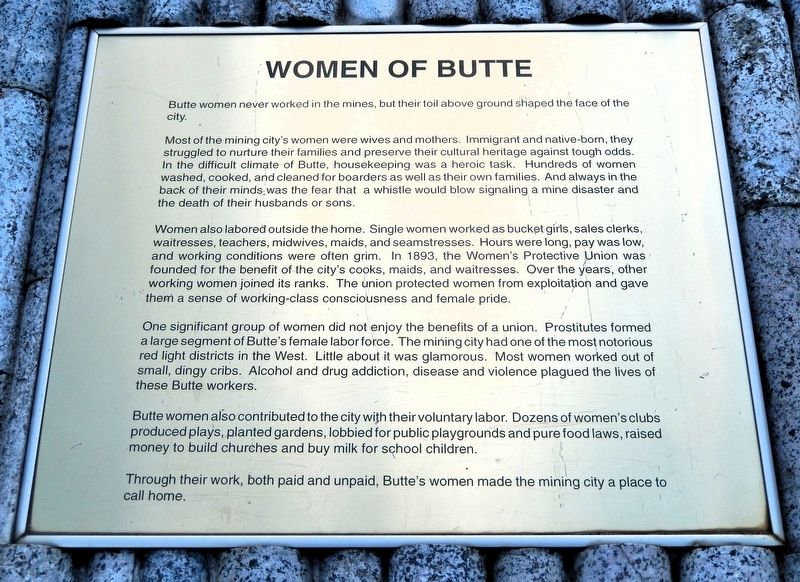
Women of Butte
Photographed by Cosmos Mariner, July 6, 2024
1. Women of Butte Marker
Butte women never worked in the mines, but their toil above ground shaped the face of the city.
Most of the mining city's women were wives and mothers. Immigrant and native-born, they struggled to nurture their families and preserve their cultural heritage against tough odds. In the difficult climate of Butte, housekeeping was a heroic task. Hundreds of women washed, cooked, and cleaned for boarders as well as their own families. And always in the back of their minds was the fear that a whistle would blow signaling a mine disaster and the death of their husbands or sons.
Women also labored outside the home. Single women worked as bucket girls, sales clerks, waitresses, teachers, midwives, maids, and seamstresses. Hours were long, pay was low, and working conditions were often grim. In 1893, the Women's Protective Union was founded for the benefit of the city's cooks, maids, and waitresses. Over the years, other working women joined its ranks. The union protected women from exploitation and gave them a sense of working-class consciousness and female pride.
One significant group of women did not enjoy the benefits of a union.
this page online
Butte women also contributed to the city with their voluntary labor. Dozens of women's clubs produced plays, planted gardens, lobbied for public playgrounds and pure food laws, raised money to build churches and buy milk for school children.
Through their work, both paid and unpaid, Butte's women made the mining city a place to call home.
Topics. This historical marker is listed in these topic lists: Charity & Public Work • Industry & Commerce • Labor Unions • Women. A significant historical year for this entry is 1893.
Location. 46° 1.599′ N, 112° 31.422′ W. Marker is in Butte, Montana, in Silver Bow County. It can be reached from Bernie's Way just north of Alexander Street, on the right when traveling north. The marker is within the Granite Mountain Speculator Mine Memorial. Touch for map. Marker is in this post

Photographed by Cosmos Mariner, July 6, 2024
2. Women of Butte Marker
Looking south; the city of Butte is in the background. The marker is mounted atop a concrete and granite pedestal on the southeast perimeter of the Granite Mountain Speculator Mine Memorial.

Regionally, this marker is in andspecifically outhwest Montana, in Gold West Country, in Mining Country. It is also in the American Mountain West and in the Lewis & Clark Corridor. Globally, it is in North America, the Rocky Mountains, the Western Hemisphere, the Western World, and the Anglosphere. Historically, it finds itself in what was once Rupert’s Land and also the Louisiana Purchase.
Other nearby markers. At least 8 other markers are within walking distance of this marker: Labor History in Butte, Montana (here, next to this marker); Badger State Mine / The Speculator-Granite Mountain Mine / The Bell-Diamond Mine (a few steps from this marker); The Bell Diamond (about 400 feet away, measured in a direct line); The Con (approx. 0.4 miles away); The Con Hoist House (approx. 0.4 miles away); Cornish of Centerville (approx. 0.4 miles away); The Irish of Centerville (approx. 0.4 miles away); Mines of Centerville (approx. 0.4 miles away). Touch for a list and map of all markers in Butte.
Also see . . . The Women’s Protective Union (Montana Historical Society).

Photographed by Cosmos Mariner, July 6, 2024
3. Gerry Day Walter Plaque
(mounted just below the historical marker)
The Butte community thanks Gerry Day Walter for her unwavering perseverance and volunteer efforts to erect this monument to Butte’s mining history. • • • Preserving our past to create our future
The Butte community thanks Gerry Day Walter for her unwavering perseverance and volunteer efforts to erect this monument to Butte’s mining history.
Excerpt: From its inception, the Butte Women’s Protective Union (WPU) labored to improve the conditions of women’s work and to extend a network of support and friendship to Butte’s working women. Most working women in Butte engaged in “commercialized domesticity.” Miners, carpenters, blacksmiths, pipefitters, and men who worked in scores of other occupations dominated the mining city. Until well into the twentieth century the majority of them were single. They needed to be fed, clothed, nursed, entertained, and generally looked after by women who performed domestic tasks for wages. Working men ate in cafes and boardinghouses, slept in rooming houses, sent their laundry out, and spent their evenings in saloons, dance halls, and theaters—except for the saloons, these were all places where women worked. Women’s work made men’s work possible. Most working men in Butte were members of labor unions. In fact, the extensive nature of union membership had earned Butte the nickname, “the Gibraltar of Unionism.” The Women’s Protective Union offered female workers a similar kind of organization and solidarity. The WPU eventually encompassed all female restaurant workers and a variety of hotel and motel maids, public building janitresses, hospital maids, girls who sold candy and popcorn in movie theaters, carhops at drive-ins, cocktail waitresses, and women employed at the local tamale factory. Best known of the early union’s members were the “bucket girls” who worked in boardinghouses and cafes, each day packing thousands of lunch buckets for three shifts of hard-rock miners. The WPU reached its peak membership of 1,149 in 1955.(Submitted on August 22, 2026, by Cosmos Mariner of Cape Canaveral, Florida.)
Credits. This page was last revised on August 22, 2026. It was originally submitted on August 22, 2026, by Cosmos Mariner of Cape Canaveral, Florida. This page has been viewed 13 times since then. Photos: 1, 2, 3. submitted on August 22, 2026, by Cosmos Mariner of Cape Canaveral, Florida.
