Liberty Township near Powell in Delaware County, Ohio — The American Midwest (Great Lakes)
North American River Otter
Lontra canadensis
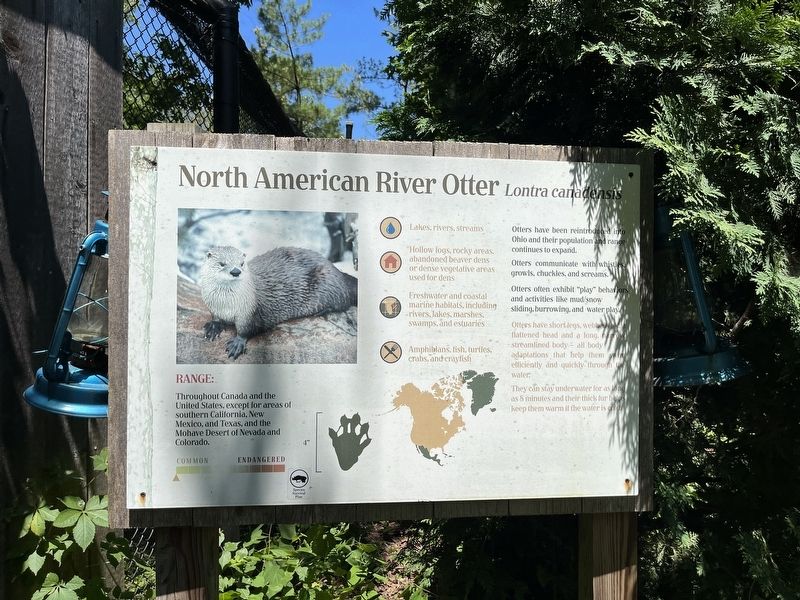
💧 Lakes, rivers, streams
🏠 Hollow logs, rocky areas, abandoned beaver dens or dense vegetative areas used for dens
🏞️ Freshwater and coastal marine habitats, including rivers, lakes, marshes, swamps, and estuaries
🍴 Amphibians, fish, turtles, crabs, and crayfish
Otters have been reintroduced into Ohio and their population and range continues to expand.
Otters communicate with whistles, growls, chuckles, and screams.
Otters often exhibit "play" behaviors and activities like mud/snow sliding, burrowing, and water play.
Otters have short legs, webbed feet, a flattened head and a long, narrow, streamlined body - all body adaptations that help them swim efficiently and quickly through the water.
They can stay underwater for as long as 8 minutes and their thick fur helps keep them warm if the water is cold.
Range:
Throughout Canada and the United States, except for areas of southern California, New Mexico, and Texas, and the Mohave Desert of Nevada and Colorado.
Erected by Columbus Zoo and Aquarium.
Topics. This historical marker is listed in these topic
this page online
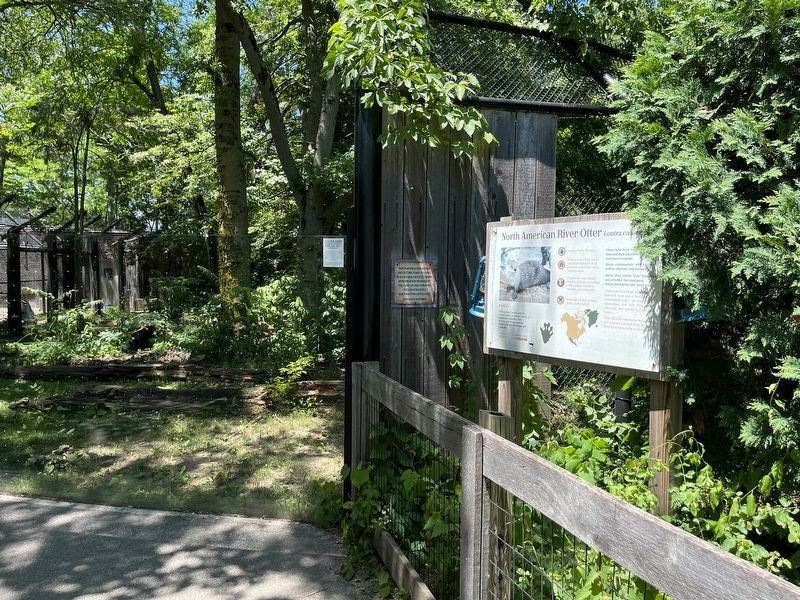
Location. This marker has been replaced by another marker nearby. It was located near 40° 9.514′ N, 83° 6.952′ W. Marker was near Powell, Ohio, in Delaware County. It was in Liberty Township. It was on West Powell Road (Ohio Route 750) east of Route 257, on the right when traveling west. Touch for map. Marker was in this post office area: Powell OH 43065, United States of America. Touch for directions.

Regionally, this marker was in the Scioto Valley and in the Columbus Metropolitan Area. It was also in the American Midwest and in the Corn Belt. Globally, it was in North America, the Western Hemisphere, the Western World, and the Anglosphere. Historically, it found itself in what was once the Haudenosaunee (Iroquois) Confederacy, the territory of the Mississippian Culture, and the Northwest Territory.
Other nearby markers. At least 8 other markers are within walking distance of this location: Canada Lynx (within shouting distance of this marker); Little House on the Prairie (within shouting distance of this marker);
Other markers no longer nearby. Dr. Bernard Master (was about 300 feet away but has been permanently removed); Federal Conservation History of the Bald Eagle (was about 400 feet away but has been permanently removed); Bald Eagles in Ohio (was about 400 feet away but has been permanently removed).
Additional commentary.
1. About the marker
This marker display qualifies because it explains how human history has affected the population of the North American River Otter in Ohio, for better and worse.
— Submitted June 28, 2022, by Devry Becker Jones of Washington, District of Columbia.
Credits. This page was last revised on August 25, 2026. It was originally submitted on June 28, 2022, by Devry Becker Jones of Washington, District of Columbia. This page has been viewed 285 times since then and 44 times this year. Last updated on August 23, 2026, by Craig Doda of Napoleon, Ohio. Photos: 1, 2. submitted on June 28, 2022, by Devry Becker Jones of Washington, District of Columbia.
