Northwest Portland in Multnomah County, Oregon — The American West (Northwest)
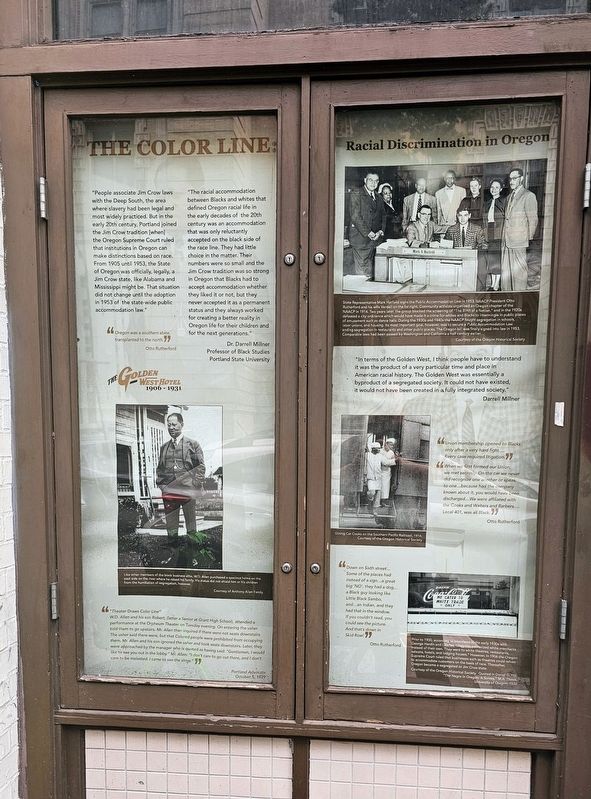
The Color Line
Racial Discrimination in Oregon
| — | The Golden West Hotel 1906–1931 | — |
Photographed by Ian Lefkowitz, June 25, 2026
1. The Color Line: Racial Discrimination in Oregon Marker
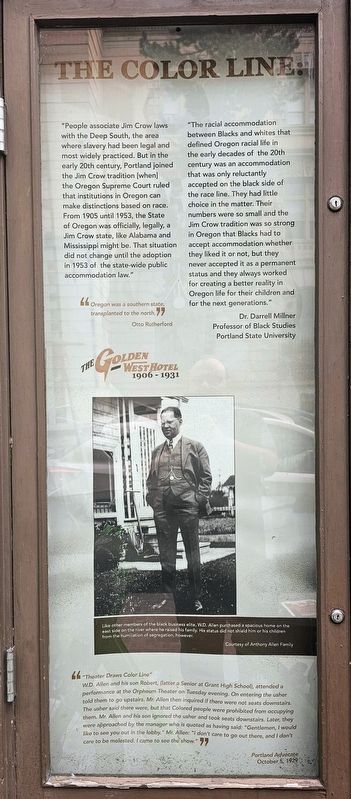
“People associate Jim Crow laws with the Deep South, the area where slavery had been legal and most widely practiced. But in the early 20th century, Portland joined the Jim Crow tradition [when] the Oregon Supreme Court ruled that institutions in Oregon can make distinctions based on race. From 1905 until 1953, the State of Oregon was officially, legally, a Jim Crow state, like Alabama and Mississippi might be. That situation did not change until the adoption in 1953 of the state-wide public accommodation law.”
“The racial accommodation between Blacks and whites that defined Oregon racial life in the early decades of the 20th century was an accommodation that was only reluctantly accepted on the black side of the race line. They had little choice in the matter. Their numbers were so small and the Jim Crow tradition was so strong in Oregon that Blacks had to accept accommodation whether they liked it or not, but they never accepted it as a permanent status and they always worked for creating a better reality in Oregon life for their children and for the next generations.”
Dr. Darrell Millner
Professor of Black Studies
PortlandState University
Click or scan to see
this page online
“Oregon was a southern state, transplanted to the north.”
Otto Rutherford
“Theater Draws Color Line”
W.D. Allen and his son Robert, (latter a Senior at Grant High School), attended a performance at the Orpheum Theater on Tuesday evening. On entering the usher told them to go upstairs. Mr. Allen then inquired if there were not seats downstairs. The usher said there were, but that Colored people were prohibited from occupying them. Mr. Allen and his son ignored the usher and took seats downstairs. Later, they were approached by the manager who is quoted as having said: “Gentlemen, I would like to see you out in the lobby.” Mr. Allen: “I don’t care to go out there, and I don’t care to be molested. I came to see the show.”
Portland Advocate
October 5, 1929
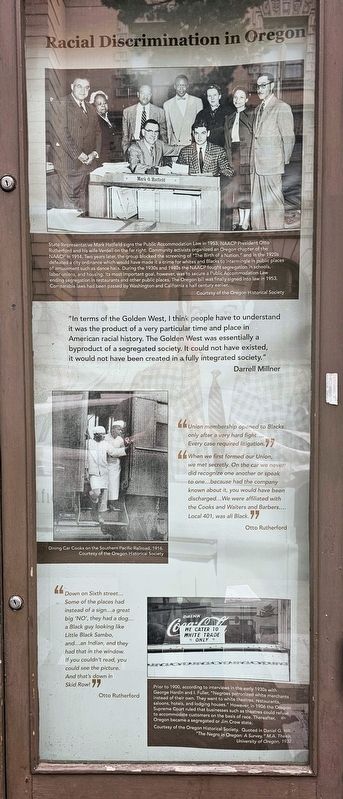
“In terms of the Golden West, I think people have to understand it was the product of a very particular time and place in American racial history. The Golden West was essentially a byproduct of a segregated society. It could not have existed, it would not have been created in a fully integrated society.”
Darrell Millner
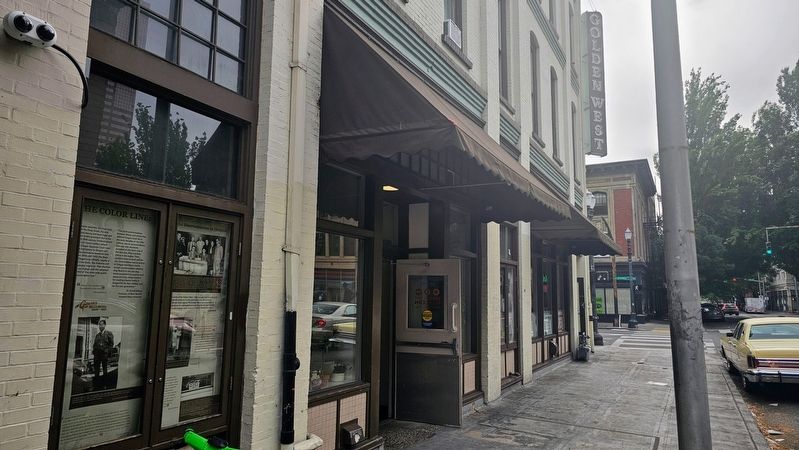
“Union membership opened to Blacks only aftera very hard fight… Every case required litigation.”Photographed by Ian Lefkowitz, June 25, 20262. The Color Line: Racial Discrimination in Oregon MarkerThis marker series is part of the Portland Black History Project, found wrapping the historic Golden West Hotel.
“When we first formed our Union, we met secretly. On the car we never did recognize one another or speak to one…because had the company known about it, you would have been discharged…We were affiliated with the Cooks and Waiters and Barbers… Local 401, was all Black.”
Otto Rutherford
“Down on Sixth street… Some of the places had instead of a sign…a great big ‘NO’, they had a dog… a Black guy looking like Little Black Sambo, and…an Indian, and they had that in the window. If you couldn’t read, you could see the picture. And that’s down in Skid Row!”
Otto Rutherford
(Captions)
Like other members of the black business elite, W.D. Allen purchased a spacious home on the east side on the river where he raised his family. His status did not shield him or his children from the humiliation of segregation, however.
Courtesy of Anthony Allen Family
State Representative Mark Hatfield signs the Public Accommodation Law in 1953. NAACP President Otto Rutherford and his wife Verdell on the far right. Community activists organized an Oregon chapter of the NAACP in 1914. Two years later, the group blocked the screening of “The Birth of a Nation,” and in the 1920s defeated a city ordinance which would have made it a crime for whites and Blacks to intermingle in public places of amusement such as dance halls. During the 1930s and 1940s the NAACP fought segregation in schools, labor unions, and housing. Its most important goal, however, was to secure a Public Accommodation Law ending segregation in restaurants and other public places. The Oregon bill was finally signed into law in 1953. Comparable laws had been passed by Washington and California a half century earlier.
Courtesy of the Oregon Historical Society
Dining Car Cooks on the Southern Pacific Railroad, 1916. Courtesy of the Oregon Historical Society
Prior
Photographed by Ian Lefkowitz, June 25, 2026
3. Golden West Hotel
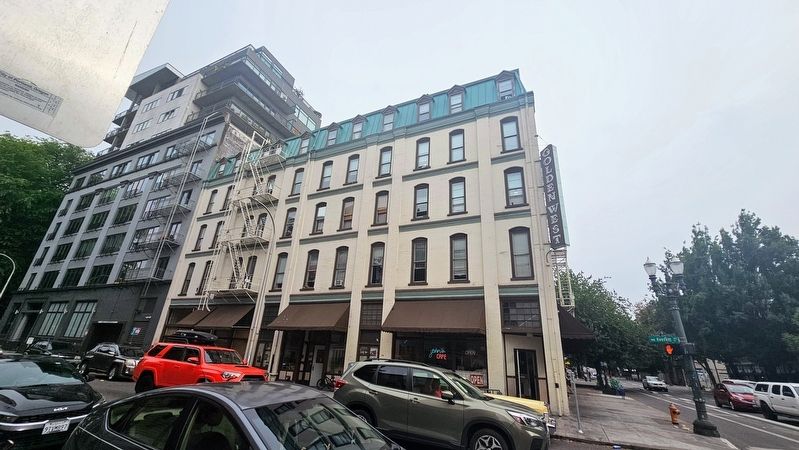
The site of the former Golden West Hotel.
Courtesy of the Oregon Historical Society. Quoted in Daniel G. Hill, “The Negro in Oregon: A Survey,” M.A. Thesis, University of Oregon, 1932.
Topics. This historical marker is listed in these topic lists: African Americans • Civil Rights • Industry & Commerce • Labor Unions. A significant historical year for this entry is 1906.
Location. 45° 31.515′ N, 122° 40.674′ W. Marker is in Portland, Oregon, in Multnomah County. It is in Northwest Portland. It is on Northwest Everett Street west of Northwest Broadway, on the left when traveling east. Touch for map. Marker is at or near this postal address: 709 NW Everett St, Portland OR 97209, United States of America. Touch for directions.

Regionally, this marker
Photographed by Ian Lefkowitz, June 25, 2026
4. The Color Line: Left Panel closeup
Other nearby markers. At least 8 other markers are within walking distance of this marker: Working on The Railroad (a few steps from this marker); Golden West Hotel (a few steps from this marker); Minnesota Hotel (about 700 feet away, measured in a direct line); The Salvation Army (approx. 0.2 miles away); Portlandia (approx. ¼ mile away); James Russel Baxter (approx. ¼ mile away); United States National Bank Building (approx. ¼ mile away); Imperial Hotel, 1894–95 (approx. 0.3 miles away). Touch for a list and map of all markers in Portland.
Photographed by Ian Lefkowitz, June 25, 2026
5. The Color Line: Right Panel closeup
Credits. This page was last revised on September 25, 2026. It was originally submitted on August 23, 2026, by Ian Lefkowitz of New York, New York. This page has been viewed 10 times since then. Photos: 1, 2, 3, 4, 5. submitted on August 23, 2026, by Ian Lefkowitz of New York, New York. • Devry Becker Jones was the editor who published this page.
