Huntley in Yellowstone County, Montana — The American West (Mountains)
Volga Germans on the Huntley Project
Photographed by Cosmos Mariner, July 3, 2024
1. Volga Germans on the Huntley Project Marker
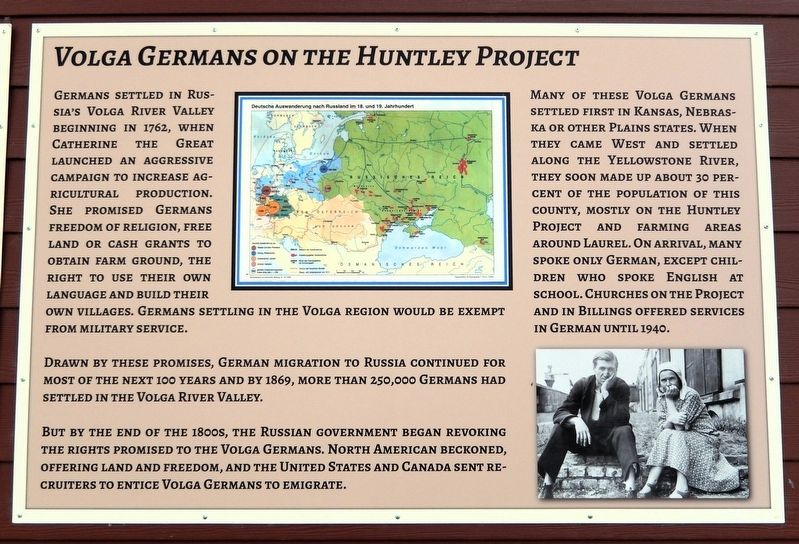
Germans settled in Russia’s Volga River Valley beginning in 1762, when Catherine the Great launched an aggressive campaign to increase agricultural production. She promised Germans freedom of religion, free land or cash grants to obtain farm ground, the right to use their own language and build their own villages. Germans settling in the Volga region would be exempt from military service.
Drawn by these promises, German migration to Russia continued for most of the next 100 years and by 1869, more than 250,000 Germans had settled in the Volga River Valley.
But by the end of the 1800s, the Russian government began revoking the rights promised to the Volga Germans. North American beckoned, offering land and freedom, and the United States and Canada sent recruiters to entice Volga Germans to emigrate.
Many of these Volga Germans settled first in Kansas, Nebraska or other plains states. When they came West and settled along the Yellowstone River, they soon made up about 30 percent of the population of this county, mostly on the Huntley Project and farming areas around Laurel. On arrival, many spoke only German, except children
this page online
Erected by Huntley Project Museum.
Topics. This historical marker is listed in these topic lists: Agriculture • Immigration • Settlements & Settlers. A significant historical year for this entry is 1762.
Location. 45° 55.579′ N, 108° 14.406′ W. Marker is in Huntley, Montana, in Yellowstone County. It can be reached from Railroad Highway 0.2 miles west of South 8th Road, on the left when traveling west. The marker is on the Huntley Project Museum grounds. Touch for map. Marker is at or near this postal address: 770 Railroad Highway, Huntley MT 59037, United States of America. Touch for directions.

Regionally, this marker is in Yellowstone Country and in Greater Billings. It is also in the American Mountain West and in the Lewis & Clark Corridor. Globally, it is in North America, the Western Hemisphere, the Western World, and the Anglosphere. Historically, it finds itself in what was once Rupert’s Land and also the Louisiana Purchase.
Other nearby markers. At least 8 other markers are within walking distance
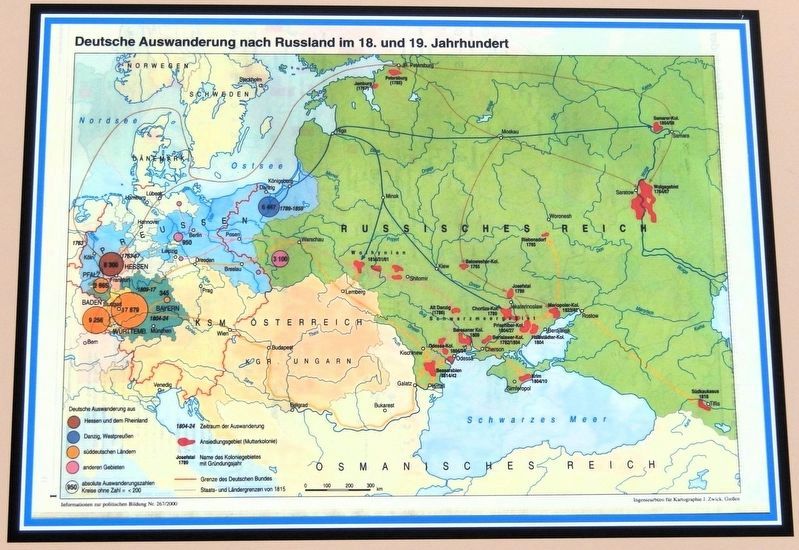
2. Marker detail: German emigration to Russia in the 18th and 19th Centuries
Related markers. Click here for a list of markers that are related to this marker.
Also see . . .
1. Volga Germans (Wikipedia).
Excerpt: Germans from Russia were the most traditional of German-speaking arrivals to North America. In the United States, many settled primarily in the Dakotas, Kansas, and Nebraska by 1900. A smaller number moved farther west, finding employment as ranchers and cowboys. They also settled in Ohio, Iowa, Michigan, Minnesota, Oregon, Washington, Wisconsin, and Fresno County in California's Central Valley. They often succeeded in dryland farming, which they(Submitted on August 26, 2026, by Cosmos Mariner of Cape Canaveral, Florida.)had practiced in Russia. Many of the immigrants who arrived between 1870 and 1912 spent a period doing farm labor, especially in northeastern Colorado and in Montana along the lower Yellowstone River in sugar beet fields. By author Richard Sallet's count, there were 118,493 descendants of Volga Germans of the first and second generation living in the United States according to the 1920 United States census.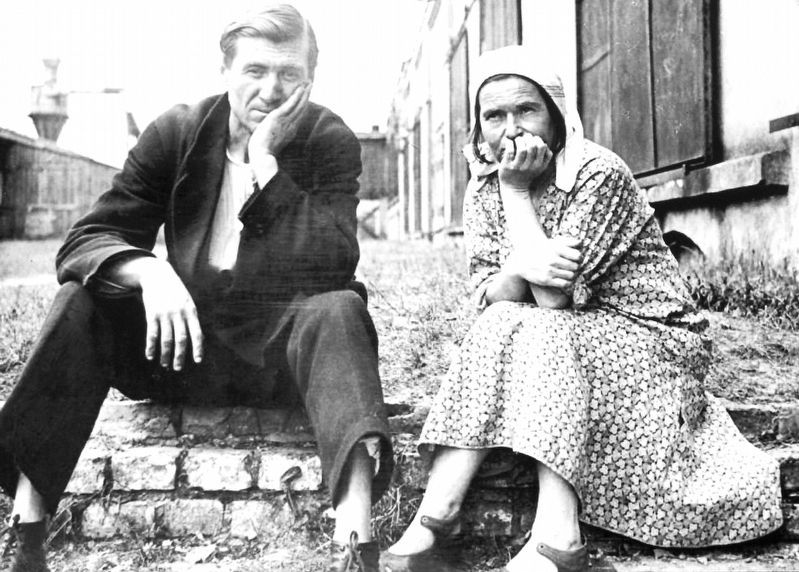 3. Marker detail: Volga German Immigrants
2. Huntley Project History (Huntley Project Museum).
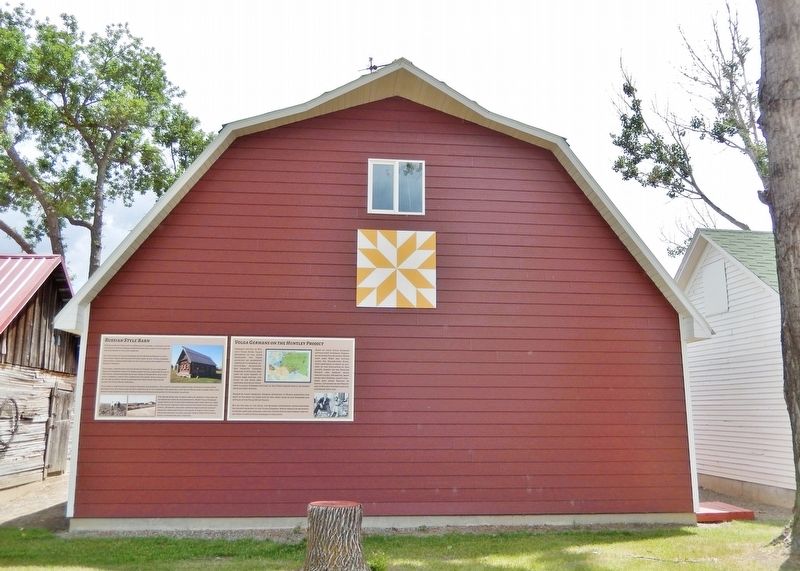
Excerpt: They came from Europe: Swedes, Norwegians, German Russians, Italians, along with Americans from the Midwest and the Eastern United States. The hope of owning their own land drew them here to face harsh weather conditions and backbreaking work to make it happen. Many of the first settlers failed and others took their place or the neighbors increased the acreage of their own place. Imagine today if you were given 40 acres of land, free. It would be worth somewhere between a quarter and a half million dollars. They knew it was more than they could ever imagine. But it took blood,(Submitted on August 26, 2026, by Cosmos Mariner of Cape Canaveral, Florida.)sweat and tears to make the land what it is today.Photographed by Cosmos Mariner, July 3, 20244. Volga Germans on the Huntley Project MarkerThis marker is the rightmost of two interpretive panels mounted on the modern barn structure.
Credits. This page was last revised on August 26, 2026. It was originally submitted on August 26, 2026, by Cosmos Mariner of Cape Canaveral, Florida. This page has been viewed 14 times since then. Photos: 1, 2, 3, 4. submitted on August 26, 2026, by Cosmos Mariner of Cape Canaveral, Florida.
