Downtown Fayetteville in Washington County, Arkansas — The American South (West South Central)
Nelson Hackett
| — | National Underground Railroad Network to Freedom Program | — |
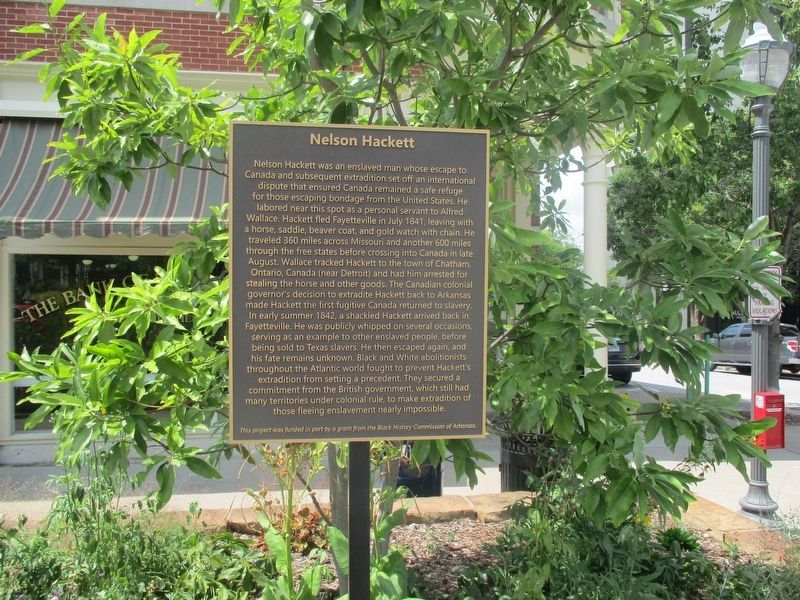
Photographed by Marc Hayot, August 26, 2026
1. Nelson Hackett Marker
this page online
Erected 2023 by City of Fayetteville's Black Preservation Commission.
Topics. This historical marker is listed in these topic lists: Abolition & Underground RR • African Americans • Civil Rights. A significant historical year for this entry is 1810.
Location. 36° 3.752′ N, 94° 9.638′ W. Marker is in Fayetteville, Arkansas, in Washington County. It is in Downtown Fayetteville. It is at the intersection of South Block Avenue (Road 1) and West Center Street, on the right when traveling south on South Block Avenue. The marker is located in front of the Bank of Fayetteville. Touch for map. Marker is at or near this postal address: 1 S Block AVe, Fayetteville AR 72701, United States of America. Touch for directions.

Regionally, this marker is in Northwest Arkansas, on the Ozark Plateau, in the Cherokee Heritage Region, and in Osage Territory. It is also in the American South, specifically in the Upper South, and in the Ozarks. Globally, it is in North America, the Western Hemisphere, the Western World, and the Anglosphere. Historically, it finds itself in what was once the territory of the Mississippian Culture, the Louisiana Purchase, one of the Confederate States of America, and the Antebellum South.
Other nearby markers. At least 8 other markers are within walking distance of this marker: Lewis Brothers Building (here, next to this marker); Mrs. Young Block (a few steps from this marker); Significant Dates in Fayetteville History (within shouting distance of this marker); Fayetteville Center Square (within shouting distance of this marker); Evolution of Fayetteville (within shouting distance of this marker); Fayetteville's Earliest Methodist Church (within shouting distance of this marker); First Confederate Company Organized in Washington County (about 300 feet away, measured in a direct line); Guisinger Building (about 400 feet away). Touch for a list and map of all markers in Fayetteville.
Regarding Nelson Hackett. The marker was funded in part by a grant from the Black History Commission of Arkansas and is part of the National Underground Railroad Network to Freedom Program.
Also see . . .
1. Celebrate Nelson Hackett Legacy With Downtown Historical Marker and Street Sign Unveiling. The link is a press release from the University of Arkansas announcing the dedication of the marker.
The U of A’s Nelson Hackett Project and the City of Fayetteville’s Black Heritage Preservation Commission are celebrating the life of Nelson Hackett, an enslaved man who fled Fayetteville in search of freedom, beginning at 4 p.m. Friday, June 16, in downtown Fayetteville.(Submitted on August 26, 2026, by Marc Hayot of Siloam Springs, Arkansas.)
2. The Nelson Hackett Project. This is a link to the Nelson Hackett Project, which is part of the Arkansas Stories of Place and Belonging, an innovative public scholarship and engagement series based at the University of Arkansas Humanities Center and funded by a Chancellor's Innovation Grant.
Sometime in the middle of July 1841, Nelson Hackett fled both Arkansas and slavery, setting off an international dispute that would ensure that Canada remained a safe refuge for those escaping bondage in the United States.(Submitted on August 26, 2026, by Marc Hayot of Siloam Springs, Arkansas.)
3. Fayetteville holds ceremony commemorating Nelson Hackett (Youtube, 1:40). Short newsclip about Nelson Hackett and the marker dedication (Submitted on August 27, 2026.)
4. Nelson Hackett (1810? - ?) (Encyclopedia of Arkansas). Excerpt:
Hackett’s case provoked a public furor in Canada, which had long been a haven for those who had fled slavery in the United States, and many abolitionists worried that the case set a precedent by which the American slaveocracy would seek the return of their human property by means of extradition requests. Indeed, the Canadian Western Herald reported that the legal and other fees incurred by Wallace came to some $1,500, far more than Hackett’s market value, and that Wallace’s motive was to “deter other slaves from running away” to Canada. The return of Hackett to his owner also went counter to Canadian traditions regarding fugitive slaves. Previous extradition laws did not mention escaped slaves. Likely as a consequence of the Hackett case, Article 10 of the Webster-Ashburton Treaty, approved by the British and American governments on August 9, 1842, carefully limited extradition to criminals, thus protecting fugitive slaves from automatic surrender to their owners.(Submitted on August 27, 2026.)
Little is known of Hackett’s fate. He was never actually tried on the charges that secured his extradition. Another slave who escaped from Wallace reported that, upon Hackett’s return to Fayetteville, he was bound and flogged several times, the first time in front of all the slaves. Hackett was then sold to someone in the Texas interior. Abolitionist societies in Britain attempting to purchase and free him could find no trace of him after this transaction.
Credits. This page was last revised on August 27, 2026. It was originally submitted on August 26, 2026, by Marc Hayot of Siloam Springs, Arkansas. This page has been viewed 14 times since then. Photo 1. submitted on August 26, 2026, by Marc Hayot of Siloam Springs, Arkansas. • Andrew Ruppenstein was the editor who published this page.
