Lexington in Lauderdale County, Alabama — The American South (East South Central)
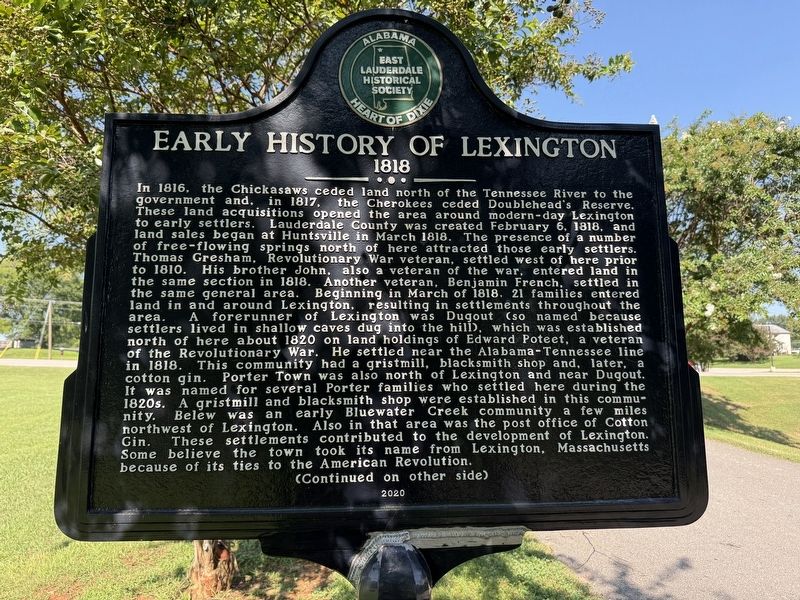
Early History of Lexington
1818
Photographed by Deborah Spencer, August 22, 2026
1. Early History of Lexington Marker
In 1816, the Chickasaws ceded land north of the Tennessee River to the government and, in 1817, the Cherokees ceded Doublehead's Reserve. These land acquisitions opened the area around modern-day Lexington to early settlers. Lauderdale County was created February 6, 1818, and land sales began at Huntsville in March 1818. The presence of a number of free-flowing springs north of here attracted those early settlers. Thomas Gresham, Revolutionary War veteran, settled west of here prior to 1810. His brother John, also a veteran of the war, entered land in the same section in 1818. Another veteran, Benjamin French, settled in the same general area. Beginning in March of 1818, 21 families entered land in and around Lexington, resulting in settlements throughout the area. A forerunner of Lexington was Dugout (so named because settlers lived in shallow caves dug into the hill), which was established north of here about 1820 on land holdings of Edward Poteet, a veteran of the Revolutionary War. He settled near the Alabama-Tennessee line in 1818. This community had a gristmill, blacksmith shop and, later, a cotton gin. Porter Town was also north of Lexington and near Dugout. It was named for several Porter families who settled here during the 1820s. A gristmill and blacksmith shop were established in this community. Belew was an early Bluewater Creek community a few miles northwest of Lexington. Also in that area was the post office of Cotton Gin. These settlements contributed to the development of Lexington. Some believe the town took its name from Lexington, Massachusetts because of its ties to the
this page online
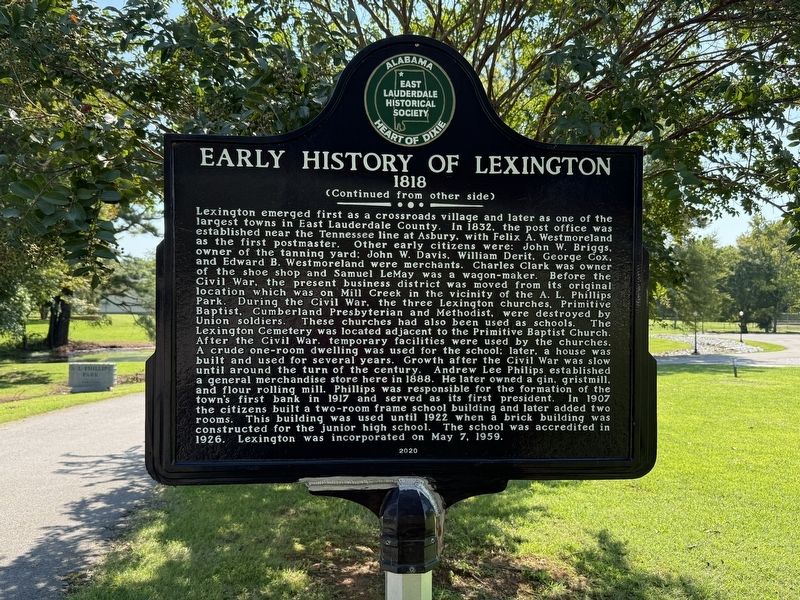
(Reverse Side)
Lexington emerged first as a crossroads village and later as one of the largest towns in East Lauderdale County. In 1832, the post office was established near the Tennessee line at Asbury, with Felix A. Westmoreland as the first postmaster. Other early citizens were: John W. Briggs, owner of the tanning yard; John W. Davis, William Derit, George Cox, and Edward B. Westmoreland were merchants. Charles Clark was owner of the shoe shop and Samuel LeMay was a wagon-maker. Before the Civil War, the present business district was moved from its original location which was on Mill Creek in the vicinity of the A. L. Phillips Park. During the Civil War, the three Lexington churches, Primitive Baptist, Cumberland Presbyterian and Methodist, were destroyed by Union soldiers. These churches had also been used as schools. Lexington Cemetery was located adjacent to the Primitive Baptist Church. After the Civil War, temporary facilities were used by the churches. A crude one-room dwelling was used for the school; later, a house was built and used for several years. Growth after the Civil War was slow until around the turn of the century. Andrew Lee Phillips established a general merchandise store here in 1888. He later owned a gin, gristmill, and flour rolling mill. Phillips was responsible for the formation of the town's first bank in 1917 and served as its first president. In 1907 the citizens built a two-room frame school building and later added two rooms. This building was used until 1922 when a brick building was constructed for the junior high school. The school was accredited
Photographed by Deborah Spencer, August 22, 2026
2. Early History of Lexington Marker (back)
Erected 2020 by East Lauderdale Historical Society.
Topics. This historical marker is listed in these topic lists: Indigenous Peoples and Communities • Settlements & Settlers • War, US Civil. A significant historical date for this entry is February 6, 1818.
Location. 34° 58.17′ N, 87° 22.214′ W. Marker is in Lexington, Alabama, in Lauderdale County. It is at the intersection of Alabama Route 101 and Mill Creek Cir, on the right when traveling north on Alabama Route 101. Marker is located just inside the entrance to A. L. Phillips Park on Appreciation Avenue (which is not labeled on any map). Touch for map. Marker is in this post office area: Lexington AL 35648, United States of America. Touch for directions.

Regionally, this marker is in North Alabama and in the Shoals. It is also in the American South, specifically in the Deep South, in Appalachia, and specifically in Southern Appalachia. Globally, it is in North America, a Gulf of Mexico state, the Western Hemisphere, the Western World, and the Anglosphere. Historically, it finds itself in what was once the territory of the Mississippian Culture, one of the Confederate States of America, and the Antebellum South.
Other nearby markers. At least 8 other markers are within 8 miles of this marker, measured as the crow flies: Andrew Lee Phillips (about 500 feet away, measured in a direct line); French-Glover Farm (approx. 1.7 miles away); Mount Pleasant Baptist Church (approx. 3 miles away); Grassy Memorial Chapel and Cemetery (approx. 4 miles away); Springfield Community / Springfield Church and School (approx.
Photographed by Deborah Spencer, August 22, 2026
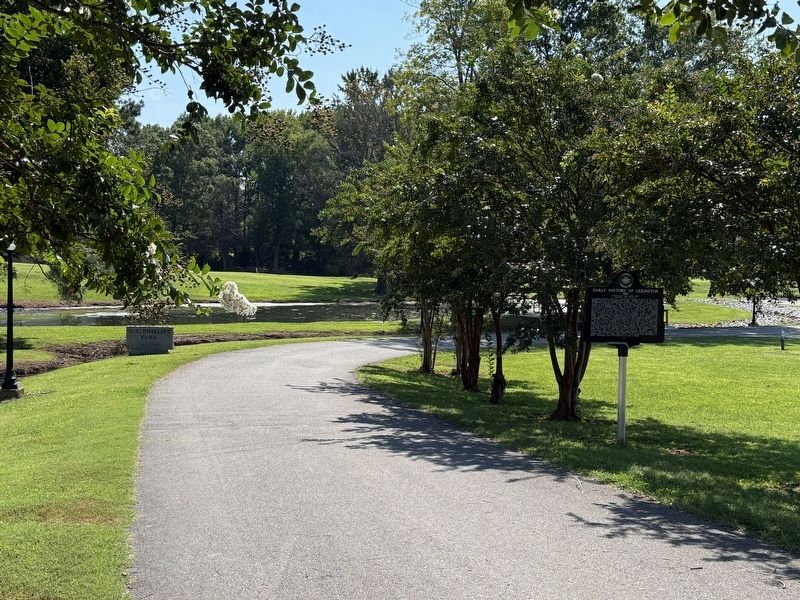
3. View of Early History of Lexington Marker from Highway 101
Credits. This page was last revised on September 4, 2026. It was originally submitted on August 29, 2026, by Deborah Spencer of Huntsville, Alabama. This page has been viewed 10 times since then. Photos: 1, 2, 3. submitted on August 29, 2026, by Deborah Spencer of Huntsville, Alabama. • James Hulse was the editor who published this page.
