Bundoora in Banyule, Victoria, Australia — Oceania
Gresswell Forest Nature Conservation Reserves
Photographed by Dean Barton-Ancliffe, July 20, 2026
1. Gresswell Forest Nature Conservation Reserves Marker
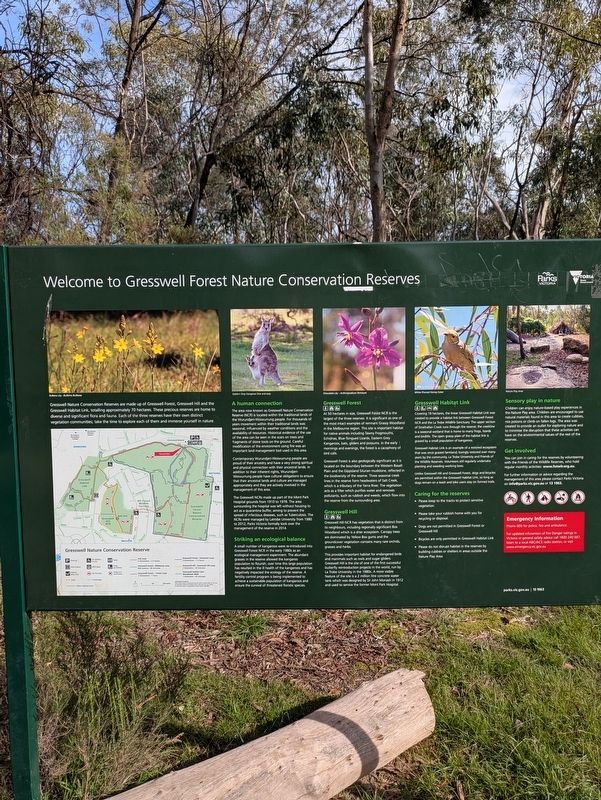
Gresswell Nature Conservation Reserves are made up of Gresswell Forest, Gresswell Hill and the Gresswell Habitat Link, totalling approximately 70 hectares. These precious reserves are home to diverse and significant flora and fauna. Each of the three reserves have their own distinct vegetation communities; take the time to explore each of them and immerse yourself in nature.
The area now known as Gresswell Nature Conservation Reserve (NCR) is located within the traditional lands of the Wurundjeri-Woiwurrung people. For thousands of years movement within their traditional lands was seasonal; influenced by weather conditions and the availability of resources. Historical evidence of the use of the area can be seen in the scars on trees and fragments of stone tools on the ground. Careful modification of the environment using fire was an important land management tool used in this area.
Contemporary Wurundjeri-Woiwurrung people are proud of their ancestry and have a very strong spiritual and physical connection with their ancestral lands. In addition to their inherent rights, Wurundjeri-Woiwurrung
this page online
The Gresswell NCRs made up part of the Mont Park Hospital grounds from 1910 to 1978. The area surrounding the hospital was left without housing to act as a quarantine buffer, aiming to prevent the spread of infectious diseases, such as Tuberculosis. The NCRs were managed by Latrobe University from 1980 to 2012; Parks Victoria formally took over the management of the reserve in 2014.
Striking an ecological balance
A small number of kangaroos were re-introduced into Gresswell Forest NCR in the early 1980s as an ecological management experiment. The abundant grasses in the reserve allowed the kangaroo population to flourish; over time this large population has resulted in the ill health of the kangaroos and has negatively impacted the ecology of the reserve. A fertility control program is being implemented to achieve a sustainable population of kangaroos and ensure the survival of threatened floristic species.
Gresswell Forest
At 50 hectares in size, Gresswell
Photographed by Dean Barton-Ancliffe, July 20, 2026
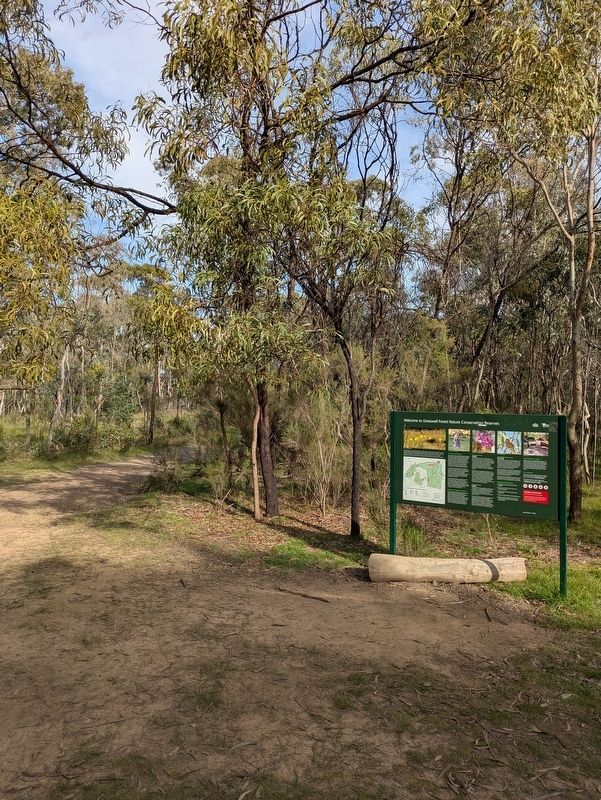
2. Gresswell Forest Nature Marker in the Forest
Gresswell Forest is also geologically significant as it is located on the boundary between the Western Basalt Plain and the Gippsland Silurian mudstone, reflected in the biodiversity of the reserve. Three seasonal creek lines in the reserve form headwaters of Salt Creek, which is a tributary of the Yarra River. The vegetation acts as a filter which purifies water and removes pollutants, such as rubbish and weeds, which flow into the reserve from the surrounding area.
Gresswell Hill
Gresswell Hill NCR has vegetation that is distinct from its neighbours, including regionally significant Box Woodland which is a drier ecosystem. Canopy trees are dominated by Yellow Box gums and the groundcover vegetation contains many rare orchids, grasses and herbs.
This provides important habitat for endangered birds and mammals such as owls and sugar gliders. Gresswell Hill is the site of one of the first successful butterfly reintroduction projects in the world, run by La Trobe University in the 1980s. A more visible feature of the site is a 2 million litre concrete water tank which was designed by Sir John Monash in 1912 and used to service the former Mont Park Hospital.
Gresswell Habitat Link
Covering 18 hectares, the linear Gresswell Habitat Link was created to provide a habitat link between Gresswell Forest NCR and the La Trobe Wildlife Sanctuary. The upper section of Strathallan Creek runs through the reserve; the creekline is a seasonal wetland that is home to many frogs, lizards and birdlife. The open grassy plain of the habitat link is grazed by a small population of kangaroos.
Gresswell Habitat Link is an example of a restored ecosystem that was once grazed farmland; lovingly restored over many years by the community, La Trobe University and Friends of the Wildlife Reserves. Volunteers still regularly undertake planting and weeding working bees.
Unlike Gresswell Hill and Gresswell Forest, dogs and bicycles are permitted within the Gresswell Habitat Link, so long as dogs remain on a leash and bike users stay on formed trails.
Erected by Parks Victoria.
Topics. This historical marker is listed in these topic lists: Animals • Horticulture & Forestry • Parks & Recreational Areas • Science & Medicine. A significant historical year for this entry is 1910.
Location. 37° 42.524′ S, 145° 4.348′ E. Marker is in Bundoora, Victoria, in Banyule. It can be reached from Greenwood Drive 0.1 kilometers south of Lea Crescent. Touch for map. Marker is at or near this postal address: 230 Greenwood Drive, Bundoora VIC 3083, Australia. Touch for directions.

Regionally, it is in Oceania, in Australasia, in the Pacific Ocean, in South Pacific, on the Pacific Rim, in the Western World, and in the Anglosphere. Historically, it finds itself in what was once a British colony.
Other nearby markers. At least 8 other markers are within 8 kilometers of this marker, measured as the crow flies: Greenwood Reserve (about 90 meters away, measured in a direct line); 40mm Bofurs No 12 (Bristol) Anti Aircraft Gun (approx. 0.8 kilometers away); Citizens of Diamond Valley and Watsonia R.S.L. War Memorial (approx. 0.8 kilometers away); 25 Pounder Mark 2 on Carriage 25 Pounder Mark I/L (approx. 0.9 kilometers away); Quirk's the Tailor and Mrs Quirk's Tea Rooms (approx. 3.1 kilometers away); Swimming Pool on the Plenty River (approx. 3.2 kilometers away); Eltham Avenue of Honour (North) (approx. 6.6 kilometers away); The Barak Bushlands (approx. 6.7 kilometers away).
Also see . . . Gresswell Nature Conservation Reserves. Parks Victoria
The Gresswell Nature Conservation Reserves, made up of Gresswell Forest, Gresswell Hill and Gresswell Habitat Link, protect 70 hectares of important flora and fauna habitat. Experience the area's diverse vegetation and abundant wildlife on the reserves' many walking trails, and explore this precious pocket of wilderness in Melbourne's north-east.(Submitted on September 2, 2026, by Dean Barton-Ancliffe of Rowville, Victoria.)
Gresswell Forest Nature Conservation Reserve is the largest of the three Nature Conservation Reserves. Here you'll find remnant River Red Gum woodland that's home to many different bird and animal species. It is significant as one of the most intact examples of remnant Grassy Woodland in the Melbourne region Gresswell Forest Nature Conservation Reserve was first created as a buffer zone around a quarantine wing of the Mont Park Hospital in the early 20th century. The land was then excised from the hospital in 1976 and managed by La Trobe University from 1978 until 2011.
Gresswell Hill Nature Conservation is part of the endangered Box Woodland environment and is dominated by Yellow Box and River Red Gums. Gresswell Hill is also considered to be regionally significant animal habitat. The nine hectare reserve was once part of the Mont Park Psychiatric Hospital grounds and formed a Nature Conservation Reserve in 1978. La Trobe University commenced management of the reserve in the mid 1990’s at the time the land around it was developed for housing. Gresswell Hill once contained a former army signal tower and still contains a decommissioned water tower.
Credits. This page was last revised on September 3, 2026. It was originally submitted on September 2, 2026, by Dean Barton-Ancliffe of Rowville, Victoria. This page has been viewed 18 times since then. Photos: 1, 2. submitted on September 2, 2026, by Dean Barton-Ancliffe of Rowville, Victoria. • Andrew Ruppenstein was the editor who published this page.
