
Fort Frances in Rainy River District, Ontario — Central Canada (North America)
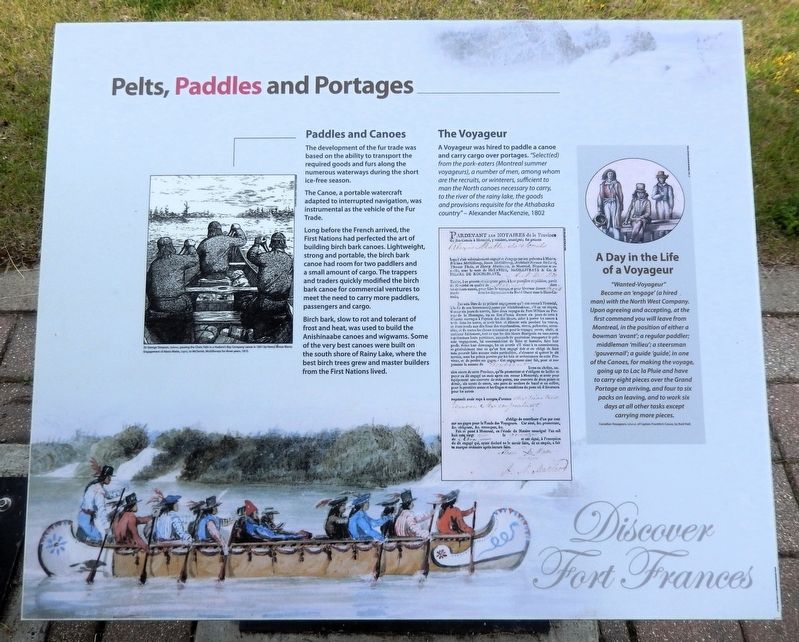
Pelts, Paddles and Portages
| — | Discover Fort Frances | — |
Photographed by Cosmos Mariner, June 17, 2024
1. Pelts, Paddles and Portages Marker
Paddles and Canoes
The development of the fur trade was based on the ability to transport the required goods and furs along the numerous waterways during the short ice-free season.
The Canoe, a portable watercraft adapted to interrupted navigation, was instrumental as the vehicle of the Fur Trade.
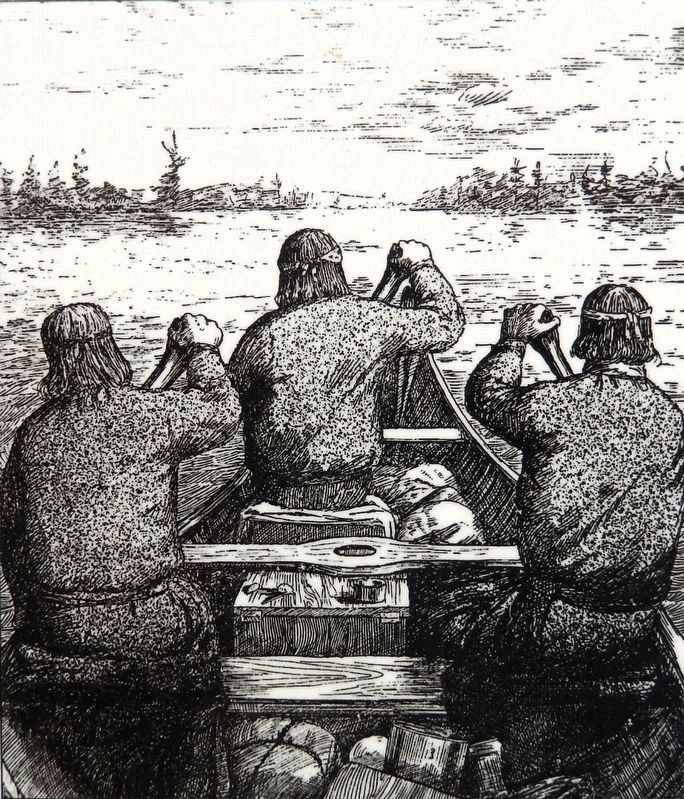
Long before the French arrived, the First Nations had perfected the art of building birch bark canoes. Lightweight, strong and portable, the birch bark canoe had room for two paddlers and a small amount of cargo. The trappers and traders quickly modified the birch bark canoe for commercial ventures to meet the need to carry more paddlers, passengers and cargo.
Birch bark, slow to rot and tolerant of frost and heat, was used to build the Anishinaabe canoes and wigwams. Some of the very best canoes were built on the south shore of Rainy Lake, where the best birch trees grew and master builders from the First Nations lived.
The Voyageur
A Voyageur was hired to paddle a canoe and carry cargo over portages. “Select(ed) from the pork-eaters (Montreal summer voyageurs), a number of men, among whom are the recruits, or winterers, sufficient to man the North canoes necessary to carry, to the river of the rainy lake, the goods and provisions requisite for the Athabaska country”
—Alexander
this page online
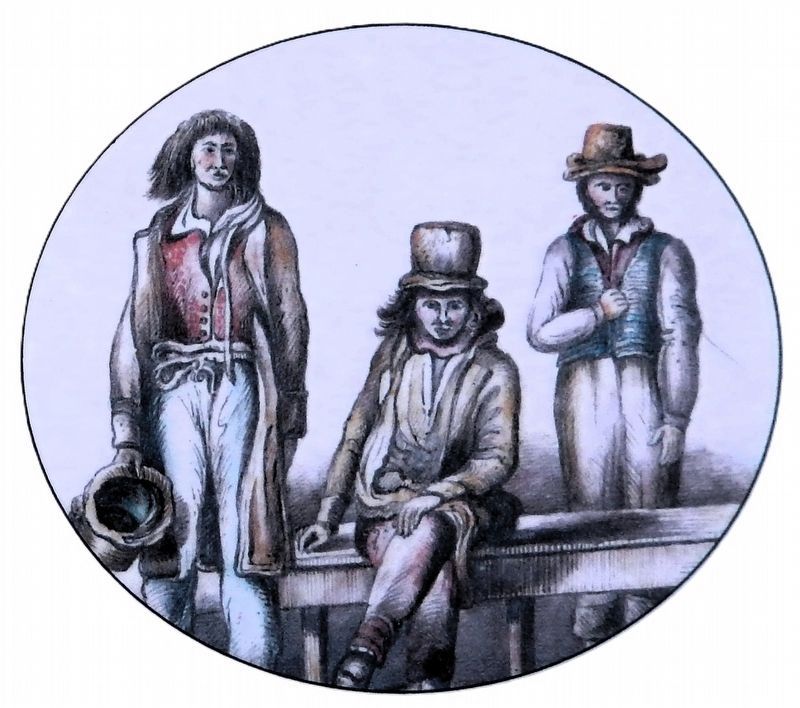
A Day in the Life of a Voyageur
“Wanted-Voyageur”
Become an 'engage' (a hired man) with the North West Company. Upon agreeing and accepting, at the first command you will leave from Montreal, in the position of either a bowman ‘avant’; a regular paddler; middleman ‘milieu’; a steersman ‘gouvernail’; a guide ‘guide’; in one of the Canoes, for making the voyage, going up to Lac la Pluie and have to carry eight pieces over the Grand Portage on arriving, and four to six packs on leaving, and to work six days at all other tasks except carrying more pieces.
[background image caption] Sir George Simpson, passing the Chats Falls in a Hudson’s Bay Company canoe in 1841, by Henry James Warre.
Topics. This historical marker is listed in these topic lists: Indigenous Peoples and Communities • Industry & Commerce • Waterways & Vessels.
Location. 48° 36.664′ N, 93° 22.131′ W. Marker is in Fort Frances, Ontario, in Rainy River District. It is at the intersection of Agamiing Drive (Trans Canada Highway) (Provincial Highway 11) and 1st Street East, on the right when traveling
Minnesota Historical Society
2. Marker detail: Birch Bark Canoe

Regionally, this marker is in Northern Ontario and specifically in Northwest Ontario. It is also in Central Canada. Globally, it is in North America, the Great North Woods, the Western Hemisphere, the Western World, and the Anglosphere. Historically, it finds itself in what was once a British colony, the Viceroyalty of New France, the Haudenosaunee (Iroquois) Confederacy, and Rupert’s Land.
Other nearby markers. At least 8 other markers are within walking distance of this marker: Establishing the Fur Trade (here, next to this marker); The Fur Trade Competition (approx. 0.4 kilometers away); a different marker also named Pelts, Paddles and Portages (approx. 0.4 kilometers away); Explore Fort Frances West (approx. 0.4 kilometers away); Forest to Wood Yard (approx. 0.7 kilometers away); History of the Lookout Tower (approx. 0.7 kilometers away); The Shevlin Wood Yard (approx.
Fort William Historical Park
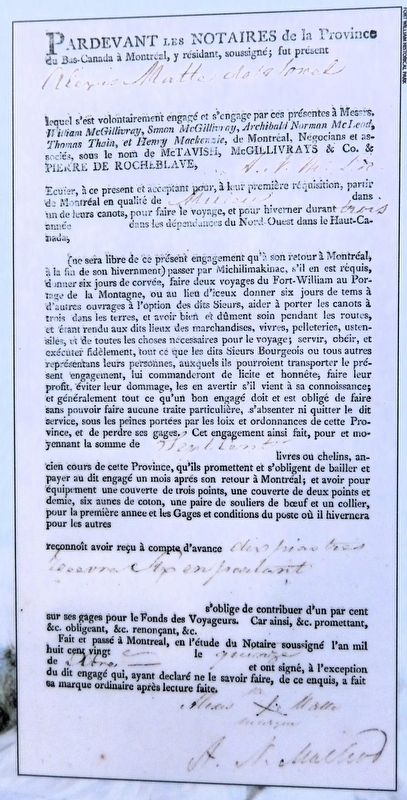
3. Marker detail: Engagement of Alexis Matte, to McTavish, McGillivrays for three years, 1815
Also see . . . Voyageurs (Wikipedia).
Excerpt: Voyageurs were 18th- and 19th-century French people and later French Canadians who transported furs by canoe at the peak of the North American fur trade. They traversed and explored many regions in what is now Canada and the United States. Despite their fame, their lives were arduous and not nearly as glamorous as folk tales made out. For example, they had to be able to carry two 90-pound bundles of fur over portages. Some carried four or five, and there is a report of a voyageur carrying seven bundles for half a mile. Hernias were common and frequently caused death. Most voyageurs started working in their early twenties and continued working until in their sixties. They never made enough money to consider early retirement from a physically grueling lifestyle.(Submitted on September 4, 2026, by Cosmos Mariner of Cape Canaveral, Florida.)
Courtesy Royal Ontario Museum
4. Marker detail: Canadian Voyageurs of Captain Franklin’s Canoe, by Basil Hall
Photographed by Cosmos Mariner, June 17, 2024
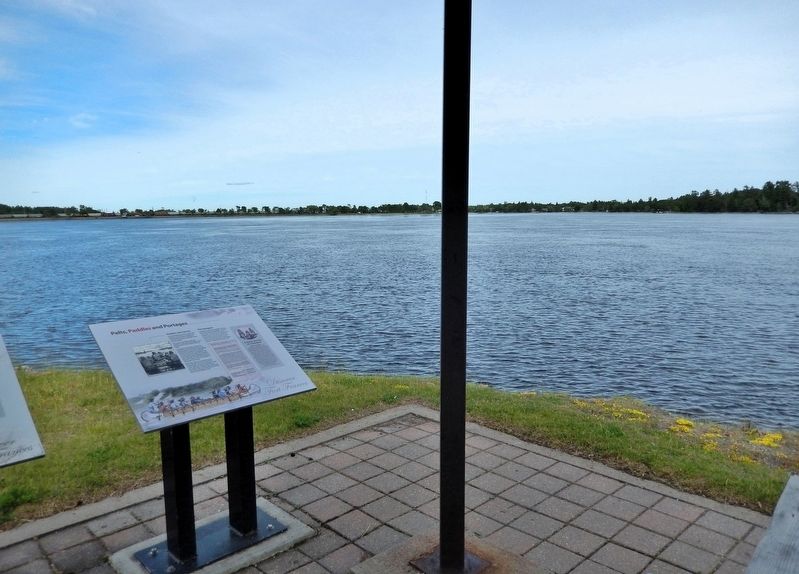
5. Pelts, Paddles and Portages Marker
Looking northeast across the Rainy River. This marker is the rightmost of two interpretive panels on the north side of the picnic shelter.
Credits. This page was last revised on September 4, 2026. It was originally submitted on September 3, 2026, by Cosmos Mariner of Cape Canaveral, Florida. This page has been viewed 5 times since then. Photos: 1, 2, 3, 4, 5. submitted on September 4, 2026, by Cosmos Mariner of Cape Canaveral, Florida.
