Coburg in Merri-Bek, Victoria, Australia — Oceania
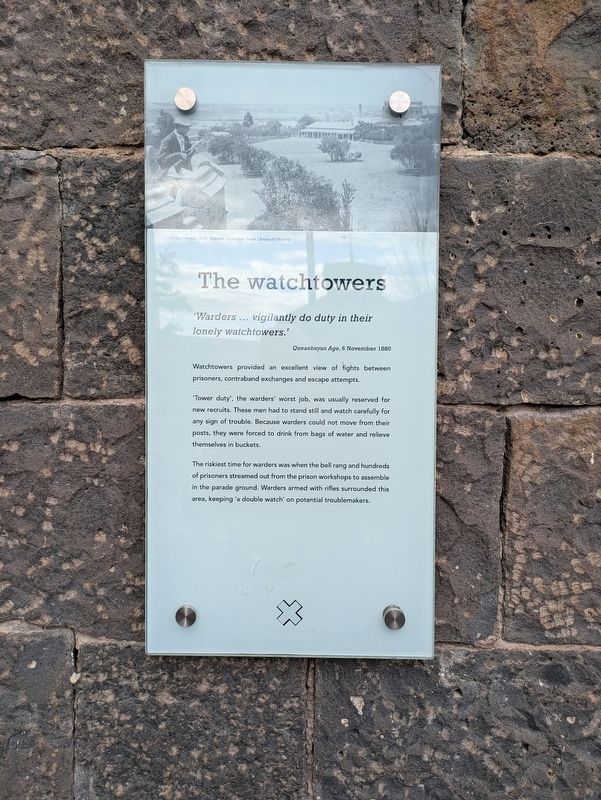
The Watchtowers
Photographed by Dean Barton-Ancliffe, August 5, 2026
1. The Watchtowers Marker
Queanbeyan Age, 6 November 1880
Watchtowers provided an excellent view of fights between prisoners, contraband exchanges and escape attempts.
'Tower duty', the warders' worst job, was usually reserved for new recruits. These men had to stand still and watch carefully for any sign of trouble. Because warders could not move from their posts, they were forced to drink from bags of water and relieve themselves in buckets.
The riskiest time for warders was when the bell rang and hundreds of prisoners streamed out from the prison workshops to assemble in the parade ground. Warders armed with rifles surrounded this area, keeping 'a double watch' on potential troublemakers.
Topics. This historical marker is listed in these topic lists: Colonial Era • Law Enforcement. A significant historical date for this entry is November 6, 1880.
Location. 37° 44.184′ S, 144° 58.131′ E. Marker is in Coburg, Victoria, in Merri-Bek. It is on Success Lane 0.1 kilometers east of Champ Street, on the left when traveling south. Touch for map. Marker is at or near this postal address: 1
this page online

Regionally, it is in Oceania, in Australasia, in the Pacific Ocean, in South Pacific, on the Pacific Rim, in the Western World, and in the Anglosphere. Historically, it finds itself in what was once a British colony.
Other nearby markers. At least 8 other markers are within 8 kilometers of this marker, measured as the crow flies: Pentridge Timeline (within shouting distance of this marker); The Muster (about 90 meters away, measured in a direct line); Coburg Lake Reserve (approx. 0.3 kilometers away); Sydney Road (approx. half a kilometer away); Keith Haring Mural (approx. 7.2 kilometers away); Rudder Grange Historical Chronology (approx. 7.2 kilometers away); World Heritage Site (approx. 7.6 kilometers away); Colonial Mutual Life Building (approx. 7.6 kilometers away). Touch for a list and map of all markers in Coburg.
Also see . . . Pentridge Prison. National Trust Victoria
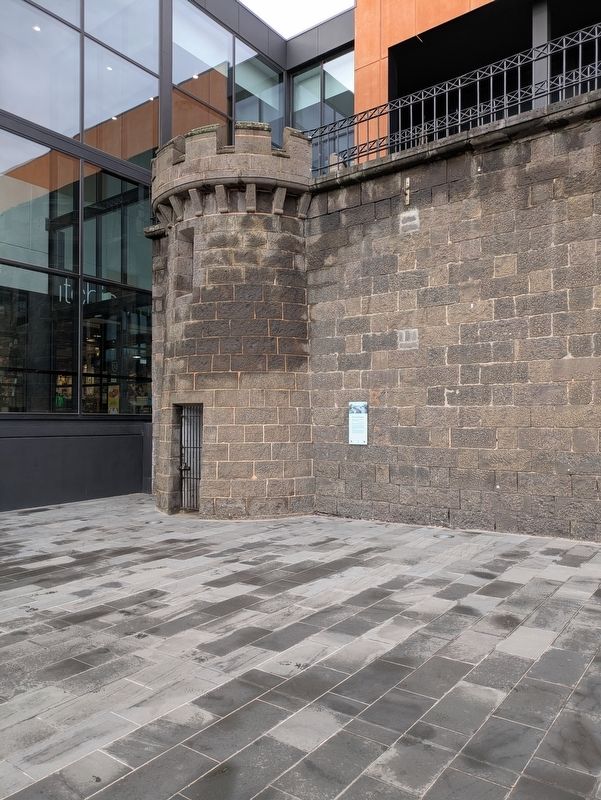
Until its closure in 1997, Pentridge was Victoria’s central prison and the most well-known and used gaol in the State’s history. Most of Victoria’s convicted and notorious criminals(Submitted on September 6, 2026, by Dean Barton-Ancliffe of Rowville, Victoria.)were gaoled there between 1900 and the 1990s. In 1967, Ronald Ryan, who was convicted of the murder of a prison officer during an escape from Pentridge, became the last person in Victoria to be hanged at Pentridge.Photographed by Dean Barton-Ancliffe, August 5, 20262. The Watchtowers Marker at an old Watchtower
Established in 1850, as a penal stockade, the prison was largely constructed in the period 1858 – 64, Pentridge was the largest prison complex constructed in Victoria in the 19th century and operated as the central establishment in the wider prison system, which included the Melbourne Gaol, from the early 1860s.
The complex of buildings, which remain on site, demonstrate a number of phases in the development of the penal system, including the ‘separate system’, which dominated penology in Victoria in the 19th century.
The 19th century prison buildings at Pentridge have a monumental scale and austere style, expressive of the requirements of containment and order. The front entrance gate was designed like a medieval fortification. Constructed from ashlar bluestone, much of it quarried on site, the building was imposing and grim – intimidating in scope and severe in purpose.
Credits. This page was last revised on September 8, 2026. It was originally submitted on September 6, 2026, by Dean Barton-Ancliffe of Rowville, Victoria. This page has been viewed 9 times since then. Photos: 1, 2. submitted on September 6, 2026, by Dean Barton-Ancliffe of Rowville, Victoria. • Andrew Ruppenstein was the editor who published this page.
