Johnson City in Blanco County, Texas — The American South (West South Central)
LBJ Boyhood Home

Photographed by Mansfieldphoto.com, August 16, 2025
1. LBJ Boyhood Home Marker
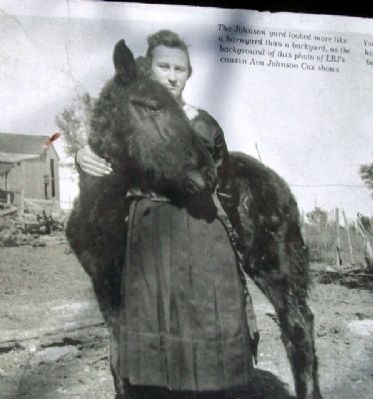
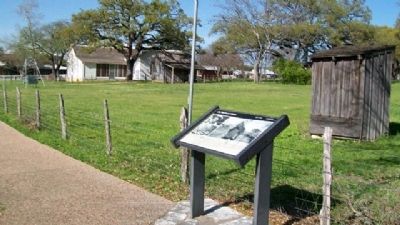
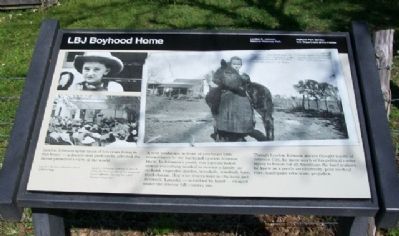
A neat landscape in front of you bears little resemblance to the backyard Lyndon Johnson knew. In Johnson's youth, this yard included almost everything needed to sustain a family: an orchard, vegetable garden, woodpile, windmill, barn, smokehouse. Hog wire fences kept in chickens and livestock. Laundry - scrubbed by hand - swayed under the intense hill country sun.
Though Lyndon Johnson always thought fondly of Johnson City, he spent much of his political career trying to lessen for all Americans the hard realities he knew as a youth: no electricity, poor medical care, inadequate education, prejudice.
Erected by National Park Service.
Topics and series. This historical marker is listed in these topic lists: Agriculture • Education • Patriots & Patriotism • Science & Medicine • Settlements & Settlers. In addition, it is included in the Former U.S. Presidents: #36 Lyndon B. Johnson, and the Windmills series lists.
Location. 30° 16.498′ N,
this page online

Regionally, this marker is in the Hill Country. It is also in the American South. Globally, it is in North America, a Gulf of Mexico state, the Western Hemisphere, the Western World, and the Anglosphere. Historically, it finds itself in what was once New Spain, the Republic of Texas, and one of the Confederate States of America.
Other nearby markers. At least 8 other markers are within walking distance of this marker: Johnson Settlement Trail (within shouting distance of this marker); The LBJ Legacy (within shouting distance of this marker); Johnson City (within shouting distance of this marker); L. B. J. Boyhood Home (within shouting distance of this marker); Pedernales Electric Cooperative (about 400 feet away, measured in a direct line); Lyndon B. Johnson and Hill Country Electrification
Photographed by William Fischer, Jr., March 30, 2010
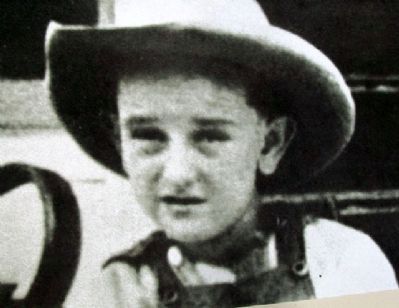
2. LBJ Photo on Marker
[Caption reads] Lyndon Baines Johnson, age 7.
Also see . . .
1. L. B. J. National Historical Park. (Submitted on May 23, 2010, by William Fischer, Jr. of Reynoldsburg, Ohio.)
2. LBJ Library & Museum. (Submitted on May 23, 2010, by William Fischer, Jr. of Reynoldsburg, Ohio.)
Photographed by William Fischer, Jr., March 30, 2010
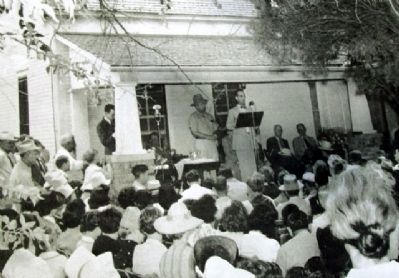
3. Speech from Boyhood Home Photo on Marker
[Caption reads] Lyndon Johnson making a speech from the front porch of his boyhood home during his 1941 Senate campaign.
Photographed by William Fischer, Jr., March 30, 2010
4. Boyhood Home Backyard Photo on Marker
[Caption reads] The Johnson yard looked more like a barnyard than a backyard, as the background of this photo of LBJ's cousin Ava Johnson Cox shows. Young Lyndon once broke his leg when he fell from the barn visible behind Ava.
Photographed by William Fischer, Jr., March 30, 2010
5. LBJ Boyhood Home Marker
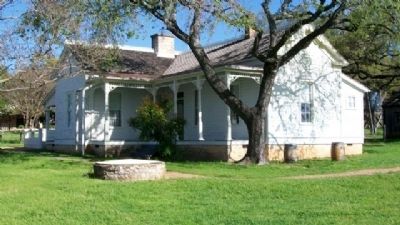
Photographed by William Fischer, Jr.
6. L. B. J. Boyhood Home
Looking SE.
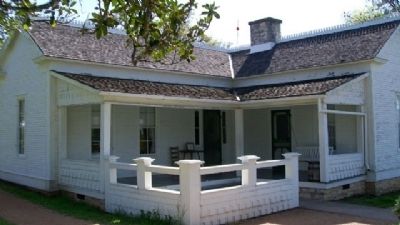
Photographed by William Fischer, Jr.
7. L. B. J. Boyhood Home Entrance
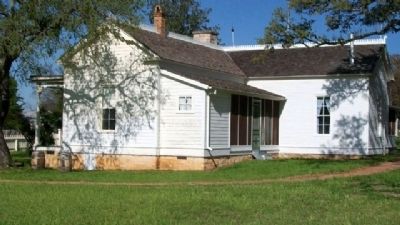
Photographed by William Fischer, Jr.
8. L. B. J. Boyhood Home
Looking NE.
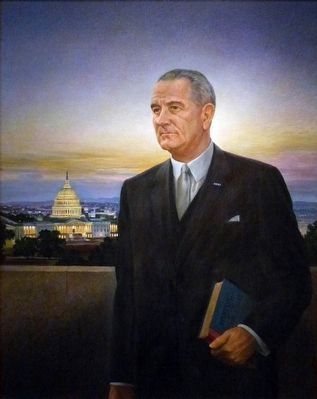
Photographed by Allen C. Browne, August 9, 2015
9. Lyndon B. Johnson
This 1967 portrait of Lyndon B. Johnson by Peter Hurd hangs in the National Portrait Gallery in Washington, DC.
“No political figure harnessed the forces of American politics better than Lyndon Johnson as majority leader of the Senate. His decision to serve as John Kennedy's vice president seemed like a demotion, but when Johnson became president upon Kennedy's assassination, his mastery of the legislative process and legendary persuasiveness produced a string of landmark legislation and actions: farreaching civil rights acts, "war on poverty" initiatives, Medicare, Medicaid, major federal funding for education, and the appointment of the first African American —Thurgood Marshall— to the Supreme Court. Unfortunately, Johnson's escalation of the Vietnam War transformed his presidency from one of the most popular to one of the most maligned.
This portrait by Peter Hurd was meant to be Johnson's official White House likeness. But that plan was quickly scrapped after Johnson declared it ‘the ugliest thing I ever saw.’ Soon the pun was making the rounds in Washington that ‘artists should be seen around the White House-but not Hurd.’ ” — National Portrait Gallery
“No political figure harnessed the forces of American politics better than Lyndon Johnson as majority leader of the Senate. His decision to serve as John Kennedy's vice president seemed like a demotion, but when Johnson became president upon Kennedy's assassination, his mastery of the legislative process and legendary persuasiveness produced a string of landmark legislation and actions: farreaching civil rights acts, "war on poverty" initiatives, Medicare, Medicaid, major federal funding for education, and the appointment of the first African American —Thurgood Marshall— to the Supreme Court. Unfortunately, Johnson's escalation of the Vietnam War transformed his presidency from one of the most popular to one of the most maligned.
This portrait by Peter Hurd was meant to be Johnson's official White House likeness. But that plan was quickly scrapped after Johnson declared it ‘the ugliest thing I ever saw.’ Soon the pun was making the rounds in Washington that ‘artists should be seen around the White House-but not Hurd.’ ” — National Portrait Gallery
Photographed by William Fischer, Jr., March 30, 2010
10. LBJ Boyhood Home Marker
Credits. This page was last revised on September 29, 2025. It was originally submitted on May 22, 2010, by William Fischer, Jr. of Reynoldsburg, Ohio. This page has been viewed 1,631 times since then and 63 times this year. Photos: 1. submitted on September 29, 2025, by James Hulse of Medina, Texas. 2, 3, 4, 5. submitted on May 23, 2010, by William Fischer, Jr. of Reynoldsburg, Ohio. 6, 7, 8. submitted on May 19, 2010, by William Fischer, Jr. of Reynoldsburg, Ohio. 9. submitted on November 1, 2015, by Allen C. Browne of Silver Spring, Maryland. 10. submitted on May 23, 2010, by William Fischer, Jr. of Reynoldsburg, Ohio.
