Grachtengordel in Amsterdam, North Holland, Netherlands — Northwestern Europe
Miriam van der Have
| — | Walk of Pride Amsterdam | — |
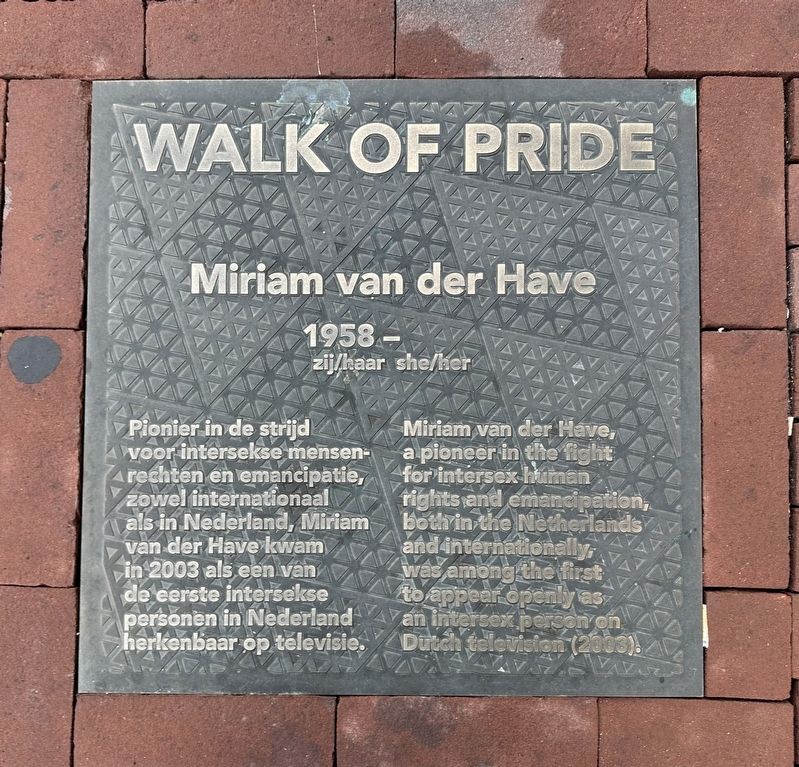
Photographed by Andrew Ruppenstein, August 31, 2026
1. Miriam van der Have Marker

Miriam de Have
1958-
zij/haar she/her
Erected 2026 by Walk of Pride Amsterdam. (Marker Number 37.)
Topics and series. This historical marker is listed in these topic lists: Civil Rights • Women. In addition, it is included in the Walk of Pride Amsterdam series list. A significant historical year for this entry is 2003.
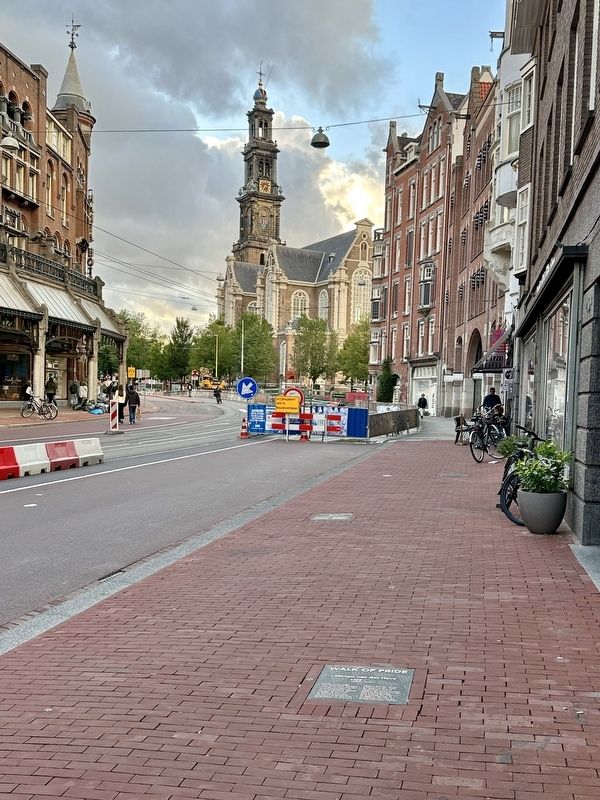
Location. 52° 22.426′ N, 4° 53.173′ E. Marker is in Amsterdam, Noord-Holland (North Holland). It is in Grachtengordel. It is on Raadhuisstraat, on the right when traveling west. Touch for map. Marker is at or near this postal address: Raadhuisstraat 40-1, Amsterdam, Noord-Holland 1016 DG, Netherlands. Touch for directions.

Regionally,
this page online
Other nearby markers. At least 8 other markers are within walking distance of this marker: Herculine Barbin (here, next to this marker); Marielle Franco (here, next to this marker); Brenda Howard (a few steps from this marker); Betty Paërl (a few steps from this marker); Alje Klamer (a few steps from this marker); Benno Premsela (within shouting distance of this marker); Georgina Beyer (within shouting distance of this marker); Nico (Niek) Engelschman 1913-1988 (about 90 meters away, measured in a direct line). Touch for a list and map of all markers in Amsterdam.
Also see . . . Miriam van der Have (Walk of Pride Amsterdam). Excerpt:
Miriam van der Have knows from personal experience what it means to grow up as an intersex person. She was born in 1958 with androgen insensitivity syndrome (AIS): a variation in which the body develops into a female even though the person has XY chromosomes. Already from a young(Submitted on September 13, 2026.)age, she could feel that something was not right in her body, but for a long time no one would answer her questions. It was only when she was 19 that a doctor told her she was intersex. She experienced that conversation as alienating. Her first reaction was: “This is not about me.” What was even more painful was the discovery that those around her had already known about the diagnosis for years but had kept it hidden from her. “Because of that secrecy, I felt a great deal of shame,” she recalled later.Photographed by Andrew Ruppenstein, August 31, 20262. Miriam van der Have Marker - wide view
In 2003, Van der Have broke the silence by speaking openly about her experiences on the Dutch television program Vinger aan de Pols (Finger on the pulse). Although she was warned that this might damage her career, she considered it important to break the taboo surrounding intersex. The road to the broadcast was not without obstacles, however. At that time, people in the media knew very little about intersex, and questions that had been labeled inappropriate beforehand were nevertheless asked during filming. Miriam experienced the broadcast as a severe ordeal, but her television appearance, along with two other women, did have the desired effect. The episode drew 890,000 viewers—almost three times the usual number—and formed a turning point in the visibility of intersex people in the Netherlands. It became an important milestone. At one point during the broadcast, Miriam said: “We are not dissatisfied with our bodies; we are simply confused by our bodies.” By this she referred to the uncertainty that can arise through secrecy and a lack of understanding.
Credits. This page was last revised on September 13, 2026. It was originally submitted on September 13, 2026, by Andrew Ruppenstein of Lamorinda, California. This page has been viewed 2 times since then. Photos: 1, 2. submitted on September 13, 2026, by Andrew Ruppenstein of Lamorinda, California.
