Gebel el-Silsila in Al Kagoug in Markaz Kom Ombo, Aswan Governorate, Egypt — مصر (Northeast Africa)
Royal Stelae
اللوحات الملكية
Photographed by Tracy Andersen Roberts, January 25, 2026
1. Royal Stelae Marker
(Arabic not transcribed)
Royal Stelae
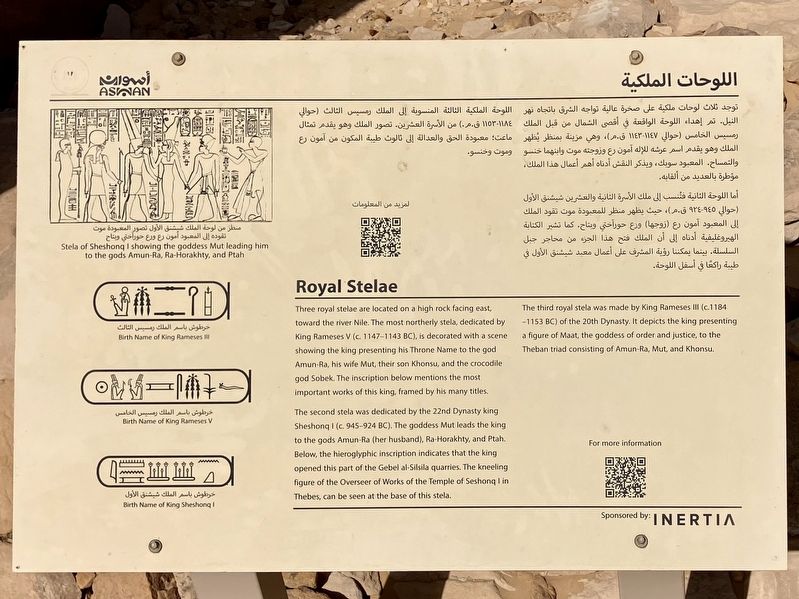
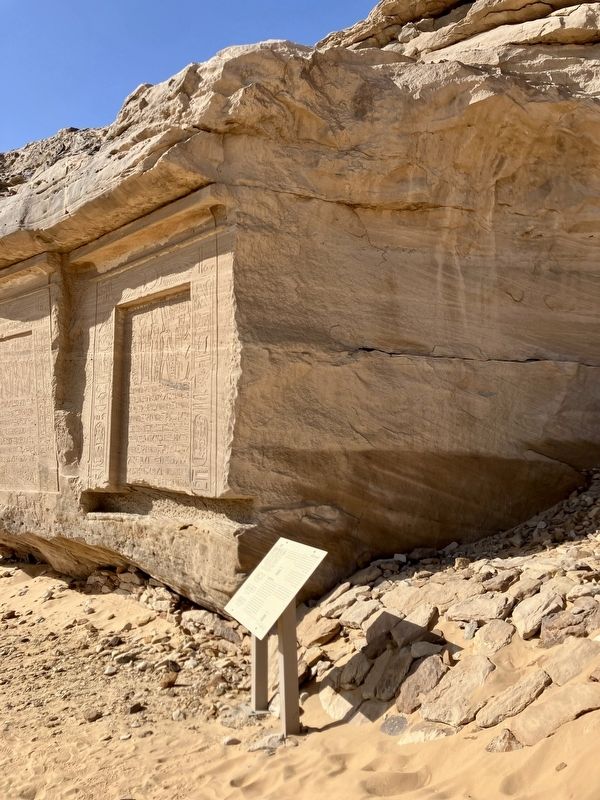
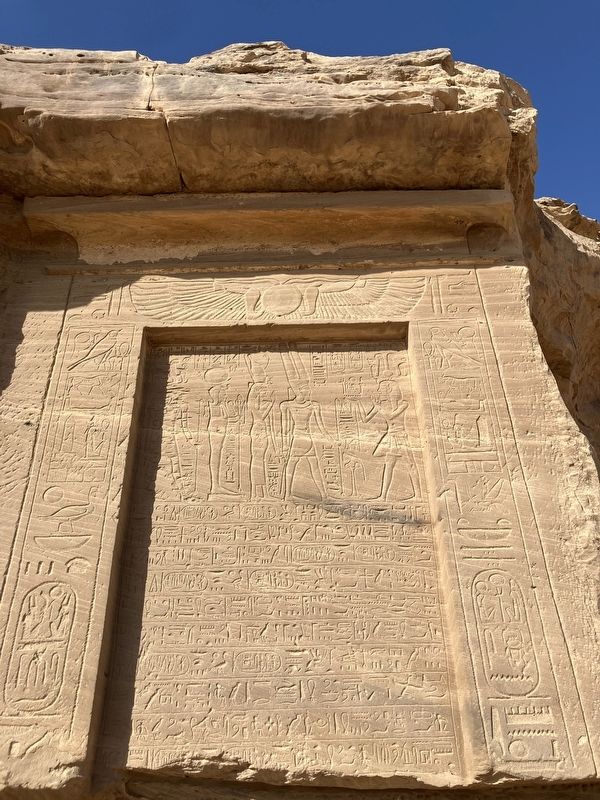
Three royal stelae are located on a high rock facing east, toward the river Nile. The most northerly stela, dedicated by King Rameses V (c. 1147-1143 BC), is decorated with a scene showing the king presenting his Throne Name to the god Amun-Ra, his wife Mut, their son Khonsu, and the crocodile god Sobek. The inscription below mentions the most important works of this king, framed by his many titles.
The second stela was dedicated by the 22nd Dynasty king Sheshong | (c. 945-924 BC). The goddess Mut leads the king to the gods Amun-Ra (her husband, Ra-Horakhty, and Ptah. Below, the hieroglyphic inscription indicates that the king opened this part of the Gebel al-Silsila quarries. The kneeling figure of the Overseer of Works of the Temple of Seshong I in Thebes, can be seen at the base of this stela.
The third royal stela was made by King Rameses III (c.1184-1153 BC) of the 20th Dynasty. It depicts the king presenting a figure of Maat, the goddess of order and justice, to the Theban triad consisting of Amun-Ra, Mut, and Khonsu.
Erected by Ministry of Antiquities, Egypt.
this page online
Topics. This historical marker is listed in these topic lists: Anthropology & Archaeology • Cemeteries & Burial Sites • Religion & Religious Structures. A significant historical year for this entry is 1184 BCE.
Location. 24° 39.009′ N, 32° 55.797′ E. Marker is in Al Kagoug, Aswan Governorate, in Markaz Kom Ombo. It is in Gebel el-Silsila. It can be reached from no nearby street. Touch for map. Marker is in this post office area: Al Kagoug, Aswan Governorate 12804-82, Egypt. Touch for directions.

Regionally, it is in Africa, specifically in North Africa, in the Middle East, on the Red Sea, and in a coastal Mediterranean country. Historically, it finds itself in what was once the Byzantine Empire, the Ottoman Empire, a British colony, and the Roman Empire.
Other nearby markers. At least 8 other markers are within 23 kilometers of this marker, measured as the crow flies: The Surgical Instruments Scene (approx. 22 kilometers away); Chapel of the Hearing Ear (approx. 22 kilometers away); a different marker also named The Surgical Instruments Scene (approx. 22 kilometers away); Festival Calendars (approx. 22 kilometers away);
Photographed by Tracy Andersen Roberts, January 25, 2026
2. Royal Stelae Marker
Regarding Royal Stelae. Sandstone Quarry, Temples. Shrines, and Chapels
Also see . . .
1. Gebel al-Silsila (Ministry of Antiquities). The QR code on the marker leads to this page. Excerpt:
Gebel al-Silsila is a mountainous region with sandstone quarries on both sides of the Nile. The sandstone quarries of Gebel al-Silsila have been used from the Middle Kingdom (c. 2034–1650 BC) until the 20th century. More than a hundred quarries were exploited to extract the sandstone blocks needed to construct many of ancient Egypt’s famous temples. The quarries have preserved tool marks and workers’ inscriptions that can be seen today.(Submitted on January 25, 2026.)
Two temples existed on the west bank of Gebel al-Silsila, both dating to the reign of Horemheb (c. 1323–1295 BC), but only one has survived. This rock-cut temple is called the Speos of Horemheb and was dedicated toseven deities whose statues can be seen in its sanctuary.Photographed by Tracy Andersen Roberts, January 25, 20263. Royal Stelae Marker
2. What is the Gebel el-Silsila Survey Project?.
The Gebel el Silsila Archaeological Project was established in 2012 by Dr Maria Nilsson and John Ward of Lund University, with the kind permission of the Egyptian Ministry of Antiquities. The project seeks to document and preserve the archaeological evidence contained within this 30km² site.(Submitted on February 2, 2026, by Tracy Andersen Roberts of Atlanta, Georgia.)
3. Stelae of Shoshanq I and Ramesses IV.
The royal stela of Shoshanq I (left) was erected by King Sheshonk I, founder of the Libyan 22nd Dynasty who ruled around 950 BCE between two ramesside stelae dating to Ramesses III and Ramesses V.(Submitted on February 2, 2026, by Tracy Andersen Roberts of Atlanta, Georgia.)
The stela (right) erected under the orders of Ramesses V. It is set on the West Bank of the Nile, right by the river in an area that was later carved by quarry fronts.
Additional keywords. Sandstone Quarry, Temples. Shrines, and Chapels
Credits. This page was last revised on September 15, 2026. It was originally submitted on January 25, 2026, by Tracy Andersen Roberts of Atlanta, Georgia. This page has been viewed 62 times since then. Last updated on September 14, 2026, by Tracy Andersen Roberts of Atlanta, Georgia. Photos: 1, 2, 3. submitted on January 25, 2026, by Tracy Andersen Roberts of Atlanta, Georgia. • Devry Becker Jones was the editor who published this page.
Editor’s want-list for this marker. Transcription of the Arabic text. • Can you help?
