Luxor, Luxor Governorate, Egypt — مصر (Northeast Africa)
Luxor Temple Fragment Conservation Project & Open Air Museum
Photographed by Tracy Andersen Roberts, January 28, 2026
1. Luxor Temple Fragment Conservation Project & Open Air Museum Marker
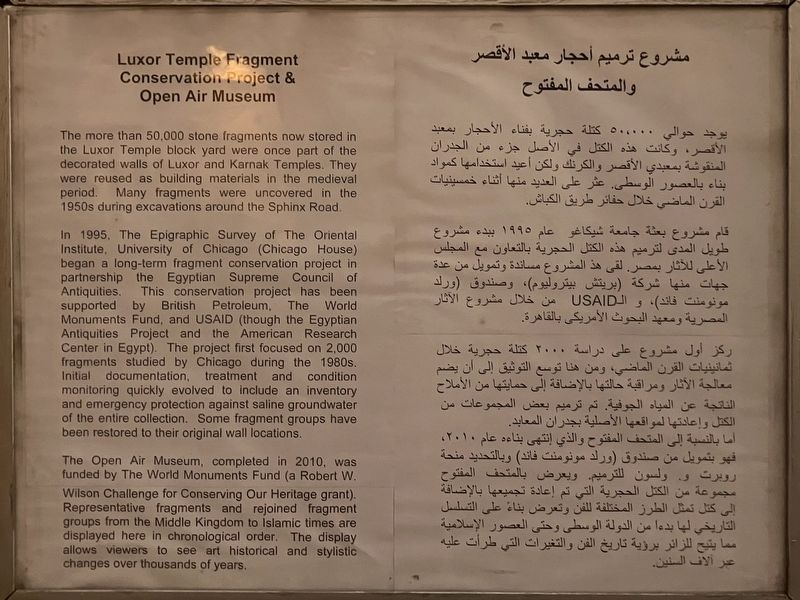
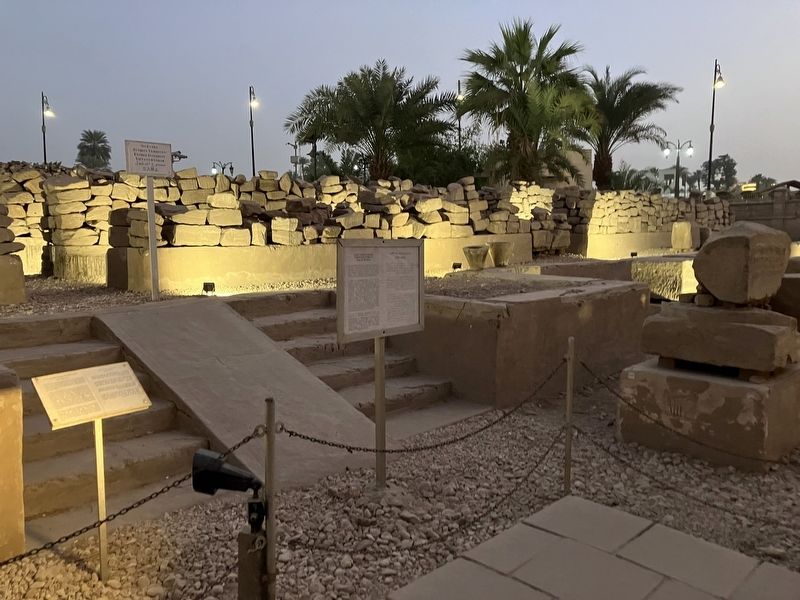
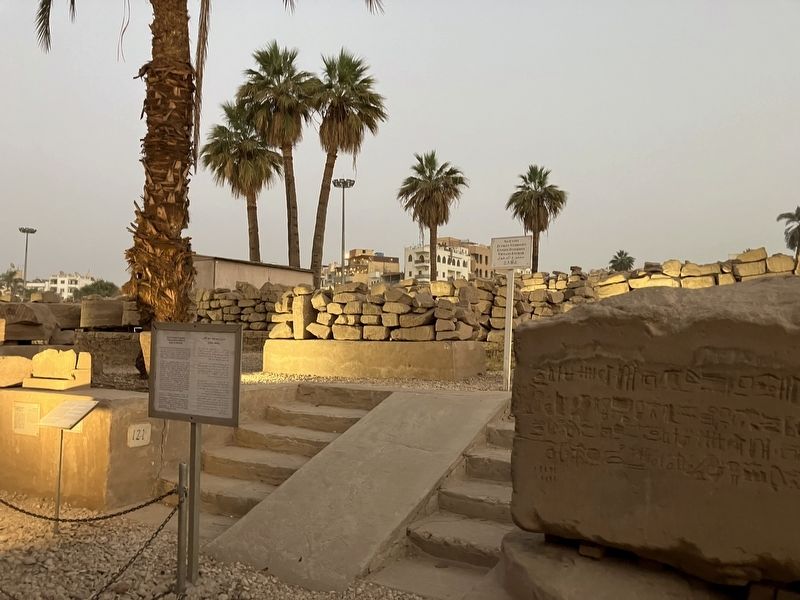
The more than 50,000 stone fragments now stored in the Luxor Temple block yard were once part of the decorated walls of Luxor and Karnak Temples. They were reused as building materials in the medieval period. Many fragments were uncovered in the 1950s during excavations around the Sphinx Road.
In 1995, The Epigraphic Survey of The Oriental Institute, University of Chicago (Chicago House) began a long-term fragment conservation project in partnership with the Egyptian Supreme Council of Antiquities. This conservation project has been supported by British Petroleum, The World Monuments Fund, and USAID (though the Egyptian Antiquities Project and the American Research Center in Egypt). The project first focused on 2,000 fragments studied by Chicago during the 1980s. Initial documentation, treatment and condition monitoring quickly evolved to include an inventory and emergency protection against saline groundwater of the entire collection. Some fragment groups have been restored to their original wall locations.
The Open Air Museum, completed in 2010, was funded by The World Monuments Fund (a Robert W. Wilson Challenge
this page online
مشروع ترميم أحجار معبد الأقصر
والمتحف المفتوح
يوجد حوالي ٥٠،٠٠٠ كتلة حجرية بفناء الاحجار بمعبد الأقصر، وكانت هذه الكتل في الاصل جزء من الجدران المنقوشة
Photographed by Tracy Andersen Roberts, January 28, 2026
2. Luxor Temple Fragment Conservation Project & Open Air Museum Marker
قام مشروع بعثة جامعة شيكاغو عام ١٩٩٥ ببدء مشروع طويل
Photographed by Tracy Andersen Roberts, January 28, 2026
3. Luxor Temple Fragment Conservation Project & Open Air Museum Marker
ركز أول مشروع على دراسة ٢٠٠٠ كتلة حجرية خلال ثمانينيات القرن الماضي، ومن هنا توسع التوثيق إلى أن يضم معالجة الآثار ومراقبة حالتها بالإضافة إلى حمايتها من الأملاح الناتجة عن المياه الجوفية. تم ترميم بعض المجموعات من الكتل وإعادتها لمواقعها الأصلية بجدران المعابد.
أما بالنسبة إلى المتحف المفتوح والذي إنتهى بناءه عام ٢٠١٠، فهو بتمويل من صندوق (ورلد مونومنت فاند) وبالتحديد منحة روبو من الكيون الرية التى يعرض تحمعها بالإضات إلى كتل تمثل الطرز المختلفة للفن وتعرض بناءً على التسلسل التاريخي لها بدها من الدولة الوسطى وحتى العصور الإسلامية مما يتيح للزائر برؤية تاريخ الفن والتغيرات التي طرأت عليه عبر آلاف السنين.
Topics. This historical marker is listed in these topic lists: Anthropology & Archaeology • Parks & Recreational Areas • Religion & Religious Structures. A significant historical year for this entry is 1400 BCE.
Location. 25° 41.958′ N, 32° 38.368′ E. Marker is in Luxor, Luxor Governorate. It can be reached from Mabad Al Oksor. Touch for map. Marker is in this post office area: Luxor, Luxor Governorate 13625-01, Egypt. Touch for directions.

Regionally, it is in Africa, specifically in North Africa, in the Middle East, on the Red Sea, and in a coastal Mediterranean country. Historically, it finds itself in what was once the Byzantine Empire, the Ottoman Empire, a British colony, and the Roman Empire.
Other nearby markers. At least 8 other markers are within walking distance of this marker: Great Colonnade Hall (within shouting distance of this marker); Ramesses II Court (about 90 meters away, measured in a direct line); Roman Luxor Temple (about 120 meters away); Sanctuary Area (about 120 meters away); Pylon of Ramesses II (about 120 meters away); Luxor Temple / معبد الأقصر (about 120 meters away); Avenue of Sphinxes/ طريق الكباش (about 180 meters away); Hatshepsut (about 180 meters away). Touch for a list and map of all markers in Luxor.
Also see . . .
1. Conservation of Inscribed Sandstone Fragments at Luxor Temple in Egypt.
CONSERVATION OF INSCRIBED SANDSTONE FRAGMENTS AT LUXOR TEMPLE IN EGYPT(Submitted on February 2, 2026, by Tracy Andersen Roberts of Atlanta, Georgia.)
CASE STUDY
HIROKO KARIYA
ABSTRACT
Since 1995, the Epigraphic Survey of the Oriental Institute, University of Chicago, known as Chicago House has been carrying out conservation of inscribed sandstone fragments in Luxor Temple, Egypt.
Over the last 18 years, the project went through various phases in order to meet the most immediate needs on site. The original focus on documentation, treatment, and condition monitoring of about 2000 registered fragments quickly evolved to include emergency protection of additional 40,000 unstudied, inscribed fragments. After the emergency protection of the fragments was achieved, the project focus shifted to site management including stabilization of temple walls by reconstruction and providing public access to the collection by creation of an open-air museum.
This article discusses challenges such as managing a massive amount of semiportable artifacts with limited resources, balancing protection with public access and working with a community heavily reliant on the tourist industry. In addition, it includes the ongoing impact of Egypt’s 2011 revolution on the community surrounding the site as well as on our conservation
approach.
2. Luxor Temple Block Fragments.
During the New Kingdom reigns of Amenhotep III, Tutankhamun, and Seti I, a large collection of sandstone block reliefs were carved for Luxor Temple. The Epigraphic Survey would later discover that a majority of these fragments composed scenes from the Colonnade Hall and the Sun Court of Amenhotep III of the Luxor Temple. The Colonnade Hall in particular depicted the Opet celebration, an ancient Egyptian celebration affirming the Pharaoh’s possession of the royal Ka, and “the site of [Amun-Re]’s annual regeneration and rebirth through the medium of the king” (Art of Empire, 48). “Both god and king were rejuvenated in the process, and Amun-Re returned to Karnak youthful and renewed...The culmination of the king’s first coronation also took place here, when he united with Amun-Re during the Opet ritual and was thenceforth Amun’s son and thus the legitimate ruler of Egypt” (Art of Empire, 56). Many of these fragments “depict the divine barge of the moon-god Khonsu in the first register Opet festival water procession” (Preserving Egypt’s Cultural Heritage, 42). Over the years, these fragments have repeatedly been reused for the foundations of structures. The practice is dated to late antiquity, the medieval period and extended to the 19th century. In the 1800s, French and Egyptian excavators cleared the monument and most likely reused the fragmentary blocks for the Corniche Boulevard built along the river parallel to the temple.(Submitted on February 2, 2026, by Tracy Andersen Roberts of Atlanta, Georgia.)
Credits. This page was last revised on September 15, 2026. It was originally submitted on January 28, 2026, by Tracy Andersen Roberts of Atlanta, Georgia. This page has been viewed 82 times since then. Last updated on September 14, 2026, by Tracy Andersen Roberts of Atlanta, Georgia. Photos: 1, 2, 3. submitted on January 28, 2026, by Tracy Andersen Roberts of Atlanta, Georgia. • Devry Becker Jones was the editor who published this page.
