Scottsbluff in Scotts Bluff County, Nebraska — The American Midwest (Upper Plains)
Water Challenges/Desafíos del Agua
Photographed by Cosmos Mariner, August 1, 2021
1. Water Challenges/Desafíos del Agua Marker

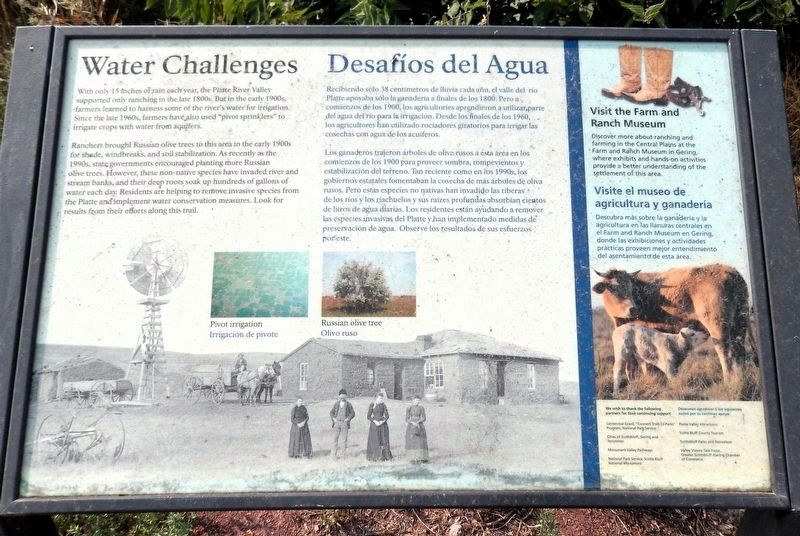
With only 15 inches of rain each year, the Platte River Valley supported only ranching in the late 1800s. But in the early 1900s, farmers learned to harness some of the river's water for irrigation. Since the late 1960s, farmers have also used “pivot sprinklers” to irrigate crops with water from aquifers.
Ranchers brought Russian olive trees to this area in the early 1900s for shade, windbreaks, and soil stabilization. As recently as the 1990s, state governments encouraged planting more Russian olive trees. However, these non-native species have invaded river and stream banks, and their deep roots soak up hundreds of gallons of water each day. Residents are helping to remove invasive species from the Platte and implement water conservation measures. Look for results from their efforts along this trail.
Visit the Farm and Ranch Museum
Discover more about ranching and farming in the Central Plains at the Farm and Ranch Museum in Gering, where exhibits and hands-on activities provide a better understanding of the settlement of this area.
[captions]
• Pivot irrigation
• Russian olive tree
this page online
Recibiendo solo 38 centímetros de lluvia cada año, el valle del río Platte apoyaba sólo la ganadería a finales de los 1800. Pero a comienzos de los 1900, los agricultores aprendieron a utilizar parte del agua del río para la irrigación. Desde los finales de los 1960, los agricultores han utilizado rociadores giratorios para irrigar las cosechas con agua de los acuíferos.
Los ganaderos trajeron árboles de oliva rusos a esta área en los comienzos de los 1900 para proveer sombra, rompevientos y estabilización del terreno. Tan reciente como en los 1990s, los gobiernos estatales fomentaban la cosecha de más árboles de oliva rusos. Pero estas especies no nativas han invadido las riberas de los ríos y los riachuelos y sus raíces profundas absorbían cientos de litros de agua diarias. Los residentes están ayudando a remover las especies invasivas del Platte y han implementado medidas de preservación de agua. Observe los resultados de sus esfuerzos por este.
Visite el museo de agricultura y ganadería
Descubra más sobre la ganadería y la agricultura en las llanuras centrales en el Farm and Ranch Museum en Gering, donde las exhibiciones
Photographed by Cosmos Mariner, August 1, 2021
2. Water Challenges/Desafíos del Agua Marker
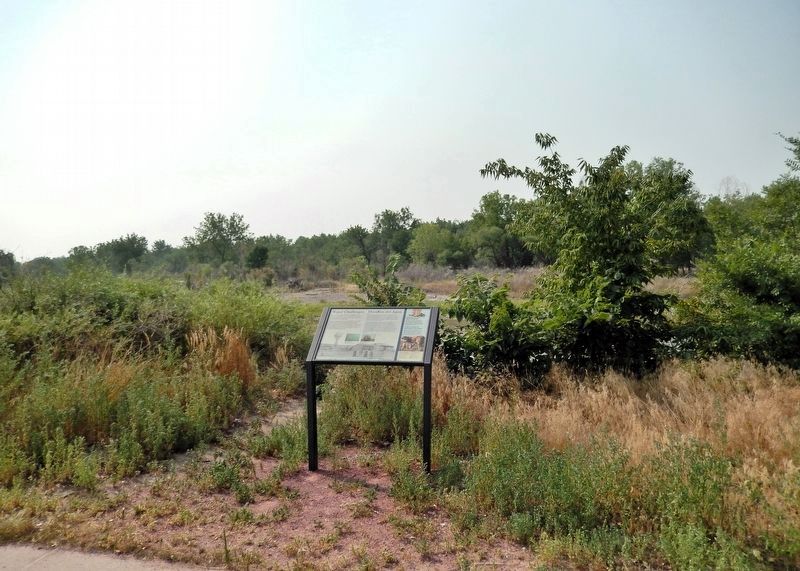
Looking south from the Monument Valley Pathway. The North Platte River is just beyond the marker on the other side of the berm.
[subtítulos]
• Irrigación de pivote
• Olivo ruso
Erected by National Parks Service, Cities of Scottsbluff, Gering and Terrytown, Monument Valley Pathways, and Greater Scottsbluff/Gering Chamber of Commerce.
Topics. This historical marker is listed in these topic lists: Agriculture • Settlements & Settlers • Waterways & Vessels.
Location. 41° 51.112′ N, 103° 40.97′ W. Marker is in Scottsbluff, Nebraska, in Scotts Bluff County. It can be reached from Riverside Drive south of South Beltline Highway West (State Highway 79H Spur). The marker is on the Monument Valley Pathway in Riverside Park. Touch for map. Marker is at or near this postal address: 1600 South Beltline Highway West, Scottsbluff NE 69361, United States of America. Touch for directions.

Regionally, this marker is in the Nebraska Panhandle. It is also in the American Midwest, in the Corn Belt, and on the prairies. Globally, it is in North America, the Western Hemisphere, the Western World, and the Anglosphere. Historically, it finds itself in what was once the Louisiana Purchase.
Other nearby markers. At least 8 other markers are within walking distance of this marker: Treeless Prairie/Pradera sin árboles (about 400 feet away, measured in a direct line); Settling the North Platte Valley/Colonizando el valle North Platte (approx. 0.2 miles away); Rapid Changes/Cambios rápidos (approx. 0.4 miles away); Marching to Zion/Marchando al monte Sion (approx. half a mile away); Me-a-pa-te (approx. 0.6 miles away); Saddle Club, Inc. (approx. 0.7 miles away); Turn Back from Here?/¿Regresar de aquí? (approx. 0.7 miles away); The Great Platte River Road/El camino del gran Río Platte (approx. 0.8 miles away). Touch for a list and map of all markers in Scottsbluff.
Also see . . . Irrigation at Rain’s Edge.
(By Kat Shiffler, March 18, 2015) Excerpt: To the east, annual precipitation – which averages more than twenty inches per year – allows for largely rain-fed agriculture. With much less rainfall to the west, growing crops on a large scale is possible only through human engineering – through irrigation. In the western hemisphere, this ancient method of carrying snowmelt, rain runoff and river water to agricultural fields dates back to the region’s early indigenous cultures. From the time of the first agricultural societies, farmers have experimented with various ways to get enough water to their crops.(Submitted on September 14, 2026, by Cosmos Mariner of Cape Canaveral, Florida.)
Credits. This page was last revised on September 14, 2026. It was originally submitted on September 14, 2026, by Cosmos Mariner of Cape Canaveral, Florida. This page has been viewed 8 times since then. Photos: 1, 2. submitted on September 14, 2026, by Cosmos Mariner of Cape Canaveral, Florida.
