Humble in Harris County, Texas — The American South (West South Central)
Prehistoric Garden
Take a Step Back in Time To Explore Ancient Plants
Photographed by Sean P. Flynn, September 17, 2026
1. Prehistoric Garden Marker
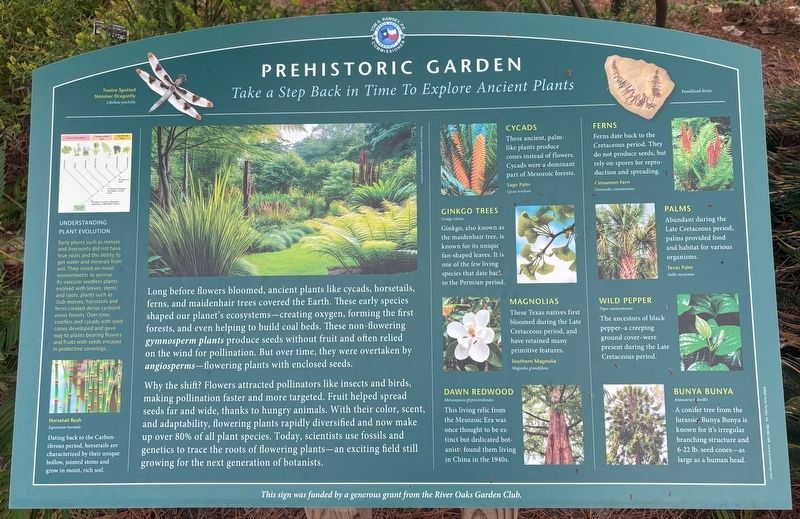
Why the shift? Flowers attracted pollinators like insects and birds, making pollination faster and more targeted. Fruit helped spread seeds far and wide, thanks to hungry animals. With their color, scent, and adaptability, flowering plants rapidly diversified and now make up over 80% of all plant species. Today, scientists use fossils and genetics to trace the roots of flowering plants-an exciting field still growing for the next generation of botanists.
Understanding Plant Evolution
Early plants such as mosses and liverworts did not have true roots and the ability to get water and minerals from soil, They relied on moist environments to survive. As vascular seedless plants
this page online
Horsetail Rush
Equisetum hyemale
Dating back to the Carboniferous period, horsetails are characterized by their unique hollow, jointed stems and grow in moist, rich soil.
Cycads
These ancient, palm like plants produce cones instead of flowers. Cycads were were a dominant part of Mesozoic forests.
Sago Palm
Cycas revoluta
Ginkgo Trees
Ginkgo biloba
Ginkgo, also known as the maidenhair tree, is known for its unique fan-shaped leaves. It is one of the few living species that date back to the Permian period.
Magnolias
These Texas natives first bloomed during the Late Cretaceous period, and have retained many primitive features.
Southern Magnolia
Magnolia grandiflora
Dawn Redwood
Metasequoia glyptostrobides
This living relic from the Mesozoic Era was once thought to be extinct but dedicated botanist found them living in China in the 1940s.
Ferns
Ferns
Photographed by Sean P. Flynn, September 17, 2026
2. Prehistoric Garden Marker
Cinnamon Fern
Cumunda cinnamome
Palms
Abundant during the Late Cretaceous period, palms provided food and habitat for various organisms.
Texas Palm
Sable mexicana
Wild Pepper
Piper sarmentosum
The ancestors of black pepper—a creeping ground cover—were present during the Late Cretaceous period.
Bunya Bunya
Araucaria bidwillii
A conifer tree from the Jurassic, Bunya Bunya is known for it's irregular branching structure and 6-22 lb. seed cones—as large as a human head.
Erected by River Oaks Garden Club.
Topics. This historical marker is listed in these topic lists: Anthropology & Archaeology • Environment • Horticulture & Forestry.
Location. 30° 2.344′ N, 95° 22.848′ W. Marker is in Humble, Texas, in Harris County. It is on Aldine Westfield Road near Treaschwig Road, on the right when traveling north. The marker is in Mercer Botanic Gardens. Touch for map. Marker is at or near this postal address: 22306 Aldine Westfield Road, Humble TX
Photographed by Sean P. Flynn, September 17, 2026
3. Prehistoric Garden Marker

Regionally, this marker is in the Houston Metropolitan Area. It is also in the American South and on the Gulf Coast. Globally, it is in North America, a Gulf of Mexico state, the Western Hemisphere, the Western World, and the Anglosphere. Historically, it finds itself in what was once New Spain, the Republic of Texas, one of the Confederate States of America, and the Antebellum South.
Other nearby markers. At least 8 other markers are within walking distance of this marker: If Tree Facts Give You a Headache.... (here, next to this marker); Petrified Wood (within shouting distance of this marker); Borden Oak (within shouting distance of this marker); Texas Wetlands (within shouting distance of this marker); Endangered Species (within shouting distance of this marker); Rain Gardens in Texas (within shouting distance of this marker); Don't Bag It — Compost It! (within shouting distance of this marker); a different marker also named Endangered Species (within shouting distance of this marker). Touch for a list and map of all markers in Humble.
Credits. This page was last revised on September 18, 2026. It was originally submitted on September 18, 2026, by Sean P. Flynn of Oak Park, Illinois. This page has been viewed 4 times since then. Photos: 1, 2, 3. submitted on September 18, 2026, by Sean P. Flynn of Oak Park, Illinois.
