Granby in Grand County, Colorado — The American Mountains (Southwest)
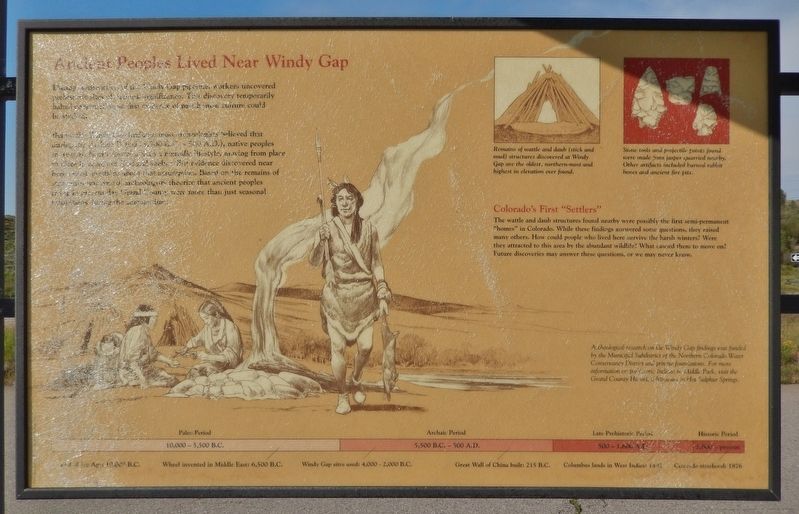
Ancient Peoples Lived Near Windy Gap
Photographed by Cosmos Mariner, July 29, 2025
1. Ancient Peoples Lived Near Windy Gap Marker
During construction of the Windy Gap pipeline, workers uncovered prehistoric sites of national significance. This discovery temporarily halted construction so that evidence of past human culture could be studied.
Before the Windy Gap findings, most archeologists believed that during the Archaic Period (5,500 B.C. - 500 A.D.), native peoples in ancient North America lived a nomadic lifestyle, moving from place to place in search of food and shelter. But evidence discovered near here raised questions about that assumption. Based on the remains of structures discovered, archeologists theorize that ancient peoples living in present-day Grand County were more than just seasonal inhabitants during the summertime.
Colorado’s First “Settlers”
The wattle and daub structures found nearby were possibly the first semi-permanent “homes” in Colorado. While these findings answered some questions, they raised many others. How could people who lived here survive the harsh winters? Were they attracted to this area by the abundant wildlife? What caused them to move on? Future discoveries may answer these questions, or we may never know.
[image captions]
•
this page online
• Stone tools and projectile points found were made from jasper quarried nearby. Other artifacts included buried rabbit bones and ancient fire pits.
[timeline across bottom]
Paleo Period — 10,000 - 5,500 B.C.
End of Ice Age: 10,000 B.C.
Wheel invented in Middle East: 6,500 B.C.
Archaic Period — 5,500 B.C. - 500 A.D.
Windy Gap sites used: 4,000 - 2,000 B.C.
Great Wall of China built: 215 B.C.
Late Prehistoric Period — 500 - 1,600 A.D.
Columbus lands in West Indies: 1492
Historic Period — 1,600 - present
Colorado statehood: 1876
Archeological research on the Windy Gap findings was funded by the Municipal Subdistrict of the Northern Colorado Water Conservancy District and private foundations. For more information on prehistoric Indians in Middle Park, visit the Grand County Historical Museum in Hot Sulphur Springs.
Topics. This historical marker is listed in these topic lists: Anthropology & Archaeology • Indigenous Peoples and Communities.
Location. 40° 6.48′ N, 105° 58.784′ W.
Photographed by Cosmos Mariner, July 29, 2025
2. Ancient Peoples Lived Near Windy Gap Marker
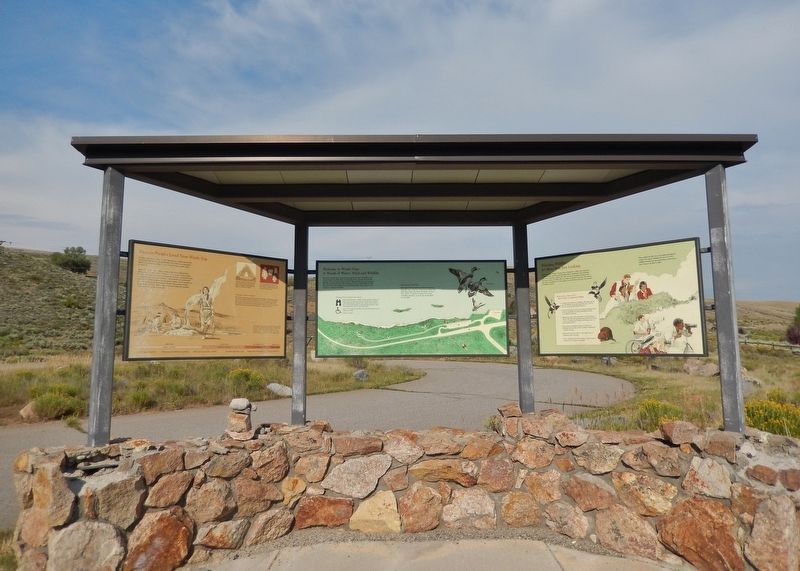
This marker is the leftmost of three panels in the Windy Gap Wildlife Viewing Area interpretive kiosk.

Regionally, this marker is in the Colorado High Rockies and on the Continental Divide. It is also in the American Mountain West. Globally, it is in North America, the Rocky Mountains, the Western Hemisphere, the Western World, and the Anglosphere.
Other nearby markers. At least 8 other markers are within 7 miles of this marker, measured as the crow flies: Against the Flow (approx. 5.7 miles away); The Nation's Backbone (approx. 5.7 miles away); Not Even Ghosts, But Rather Phantoms (approx. 5.7 miles away); Eight Mile Schoolhouse (approx. 6.9 miles away); Grand County Courthouse (approx. 6.9 miles away); Blacksmith Shop (approx. 6.9 miles away); Ranch House (approx. 6.9 miles away); Grand County Jail (approx. 6.9 miles away). Touch for a list and map of all markers in Granby.
Also see . . . Archaeological Findings Provide Connection to the Past (NorthernWater.org).
Excerpt: Archaeology played an important role during Windy Gap Project construction. While excavating the pipeline route in September 1981 north of Granby, crews unearthed several Native American ruins dating back 4,000 to 8,000 years.(Submitted on September 19, 2026, by Cosmos Mariner of Cape Canaveral, Florida.)Construction halted and archaeologists from Western Cultural Resource Management of Boulder excavated the sites, which were later deemed eligible for placement on the National Register of Historic Places. Since the dig sites were on private property and therefore ineligible for federal funding, the Subdistrict provided $370,000 to excavate and study the finds. The federal government obtained an additional $85,000 from private foundations.
Pipeline construction resumed in August 1982. The Grand County Museum in Hot Sulphur Springs contains an exhibit about the archaeological excavations, including a scale model and representations of the artifacts. The museum also features a related exhibit about Native Americans.
Credits. This page was last revised on September 19, 2026. It was originally submitted on September 19, 2026, by Cosmos Mariner of Cape Canaveral, Florida. This page has been viewed 5 times since then. Photos: 1, 2. submitted on September 19, 2026, by Cosmos Mariner of Cape Canaveral, Florida.
