Cane Hill in Washington County, Arkansas — The American South (West South Central)
Archie Leonard Reed Sorghum Shed
Photographed by Marc Hayot, September 19, 2026
1. Archie Leonard Reed Sorghum Shed Marker
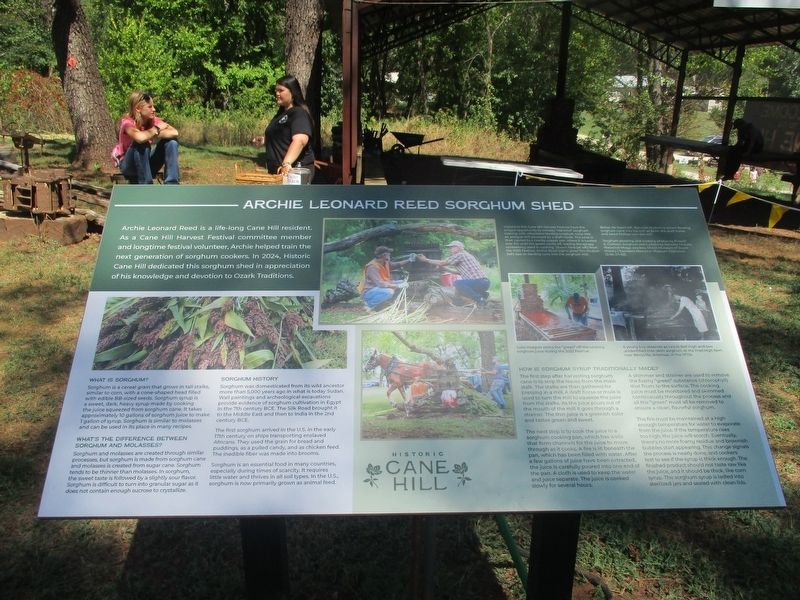
Archie Leonard Reed is a life-long Cane Hill resident. As a Cane Hill Harvest Festival committee member and longtime festival volunteer, Archie helped train the next generation of sorghum cookers. In 2024, Historic Cane Hill dedicated this sorghum shed in appreciation of his knowledge and devotion to Ozark Traditions.
What is Sorghum?
Sorghum is a cereal grain that grows in tall stalks, similar to corn, with a cone-shaped head filled with edible BB-sized seeds. Sorghum syrup is a sweet, dark, heavy syrup made by cooking the juice squeezed from sorghum cane. It takes approximately 10 gallons of sorghum juice to make 1 gallon of syrup. Sorghum is similar to molasses and can be used in its place in many recipes.
What’s the difference between Sorghum and Molasses?
Sorghum and molasses are created through similar processes, but sorghum is made from sorghum cane and molasses is created from sugar cane. Sorghum tends to be thinner than molasses. In sorghum, the sweet taste is followed by a slightly sour flavor. Sorghum is difficult to turn into granular sugar as it does not contain enough sucrose to crystallize.
Sorghum History
Sorghum
this page online
The first sorghum arrived in the U.S. in the early 17th century on ships transporting enslaved Africans. They used the grain for bread and puddings, as a pulled candy, and as chicken feed. The inedible fiber was made into brooms.
Sorghum is an essential food in many countries, especially during times of scarcity. It requires little water and thrives in all soil types. In the U.S., sorghum is now primarily grown as animal feed.
Visitors to the Cane Hill Harvest Festival have the unique opportunity to witness “old time” sorghum making, with volunteers feeding sorghum cane into an antique mill powered by a draft horse. The juice is then carried to a nearby cooking pan, where it is heated over a fire for several hours, until it reaches the syrupy consistency used in cooking. Shown here (at left) from the 2023 festival, Archie Reed (right)
Photographed by Marc Hayot, September 19, 2026
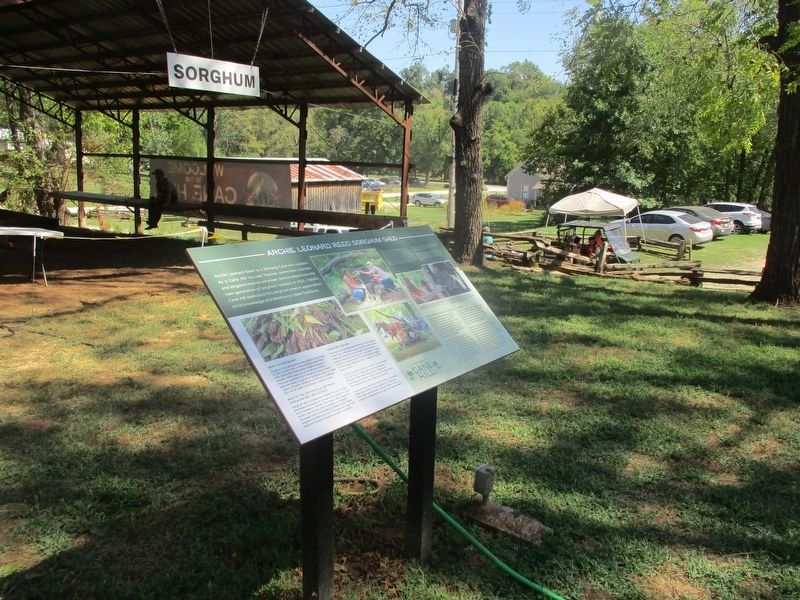
2. Archie Leonard Reed Sorghum Shed Marker and Surrounding Area
Below far lower left: Berwick Hudson is shown feeding sorghum cane into the mill as Belle, the draft horse, and Janet Stratton turn the mill.
Sorghum pressing and cooking photos by Russell A. Cochran; sorghum plant photo by Vanessa McCurdy. Historical images courtesy Shiloh Museum of Ozark History / Fountaine Mercantile Museum Collection (S-86-211-83).
How is Sorghum syrup traditionally made?
The first step after harvesting sorghum cane is to strip the leaves from the main stalk. The stalks are then gathered for pressing in a mill. A draft horse or mule is used to turn the mill to squeeze the juice from the stalks. As the juice pours out of the mouth of the mill it goes through a strainer. The thin juice is a greenish color and tastes green and sweet.
The next step is to cook the juice in a sorghum cooking pan, which has walls that form channels for the juice to move through as it cooks. A fire is lit beneath the pan, which has been filled with water. After a few gallons of juice have been extracted, the juice is carefully poured into one end of the pan. A cloth is used to keep the water and juice separate. The juice is cooked slowly for several hours.
A skimmer and strainer are used to remove the foamy “green” substance (chlorophyll) that floats to the surface. The cooking juice must be monitored and skimmed continuously throughout the process and all the “green” must all be removed to ensure a clean, flavorful sorghum.
The fire must be maintained at a high enough temperature for water to evaporate from the juice. If the temperature rises too high, the juice will scorch. Eventually, there’s no more foamy residue and brownish bubbles start appearing. This change signals the process is nearly done, and cookers test to see if the syrup is thick enough. The finished product should not taste raw like the juice, and it should be thick, like corn syrup. The sorghum syrup is ladled into sterilized jars and sealed with clean lids.
Erected 2024.
Topics. This historical marker is listed in these topic lists: Agriculture • Colonial Era • Food & Drink • Industry & Commerce. A significant historical date for this entry is September 16, 2023.
Location. 35° 54.733′ N, 94° 23.827′ W. Marker is in Cane Hill, Arkansas, in Washington County. It is on College Road, on the left when traveling north. The marker is maybe 15 feet from a shed that is used annually by volunteers who demonstrate how to make Sorghum syrup at the Cane Hill Harvest Festival. Volunteers also pass out lollipops made with Sorghum. Touch for map. Marker is at or near this postal address: 14399 College Road, Canehill AR 72717, United States of America. Touch for directions.

Regionally, this marker is in Northwest Arkansas, on the Ozark Plateau, in the Cherokee Heritage Region, and in Osage Territory. It is also in the American South, specifically in the Upper South, and in the Ozarks. Globally, it is in North America, the Western Hemisphere, the Western World, and the Anglosphere. Historically, it finds itself in what was once the territory of the Mississippian Culture, the Louisiana Purchase, one of the Confederate States of America, and the Antebellum South.
Other nearby markers. At least 8 other markers are within 6 miles of this marker, measured as the crow flies: Washington County Cane Hill College (about 500 feet away); Zebulon and Eunice Edmiston House – 1872 (approx. ¼ mile away); Dr. William and Laura Welch House - 1855 (approx. 0.3 miles away); Fruit Cellar (approx. 0.4 miles away); Bethlehem Cemetery (approx. 4.6 miles away); Bethlehem Methodist-Episcopal Church South (approx. 4.6 miles away); John Tilley House (approx. 5.6 miles away); Hermannsburg-Dutch Mills (approx. 5.8 miles away).
Other markers no longer nearby. The Troops Who Fought at Cane Hill (was about 400 feet away, measured in a direct line but has been permanently removed); Confederates Fall Back Before Union Assault (was about 400 feet away but has been permanently removed); The Battle of Cane Hill (was approx. ¼ mile away but has been confirmed missing).
Regarding Archie Leonard Reed Sorghum Shed. Sorghum is a cereal grain that grows in different parts of Arkansas. Archie Leonard Reed is one of several Cane Hill residents who have passed on the skill of making Sorghum syrup. In a 2015 video Reed talks about having made Sorghum syrup since the 1990s.
Also see . . .
1. Making Sorghum Molasses in Cane Hill, Arkansas. The link is to a YouTube video of Cane Hill resident Archie Leonard Reed's interview with the Northwest Arkansas Democrat-Gazette in September of 2015.
Archie L. Reed of Cane Hill explains how to make sorghum molasses during a living demonstration at the 29th Annual Cane Hill Harvest Festival Sunday Sept. 20, 2015.(Submitted on September 19, 2026, by Marc Hayot of Siloam Springs, Arkansas.)
2. Cane Hill Harvest Festival. This is a link from Only in Arkansas about the upcoming Cane Hill Harvest Festival in September 2015. The article also gives a brief history of the town of Cane Hill, Arkansas.
One Saturday morning in September when I was a student at the University of Arkansas, I took a drive to Tahlequah to visit my sister. I detoured down highway 45 and the road curved around the rolling green foothills of the Ozarks past yellow and green cornfields. As I came around a curve, I spotted a crowd gathered on a hillside. Intrigued, I parked near a quaint post office. A rich, earthy sweet smell drew me to a pavilion where people dressed in pioneer clothes squeezed the juice from sugar cane and cooked it into sorghum. I’d stumbled onto the Cane Hill Harvest Festival.(Submitted on September 19, 2026, by Marc Hayot of Siloam Springs, Arkansas.)
Credits. This page was last revised on September 20, 2026. It was originally submitted on September 19, 2026, by Marc Hayot of Siloam Springs, Arkansas. This page has been viewed 10 times since then. Photos: 1, 2. submitted on September 19, 2026, by Marc Hayot of Siloam Springs, Arkansas. • Andrew Ruppenstein was the editor who published this page.
