Prospect Park in Minneapolis in Hennepin County, Minnesota — The American Midwest (Upper Plains)
Jackson Family Playground/El Área de Recreo de la Familia Jackson
Photographed by McGhiever, August 23, 2026
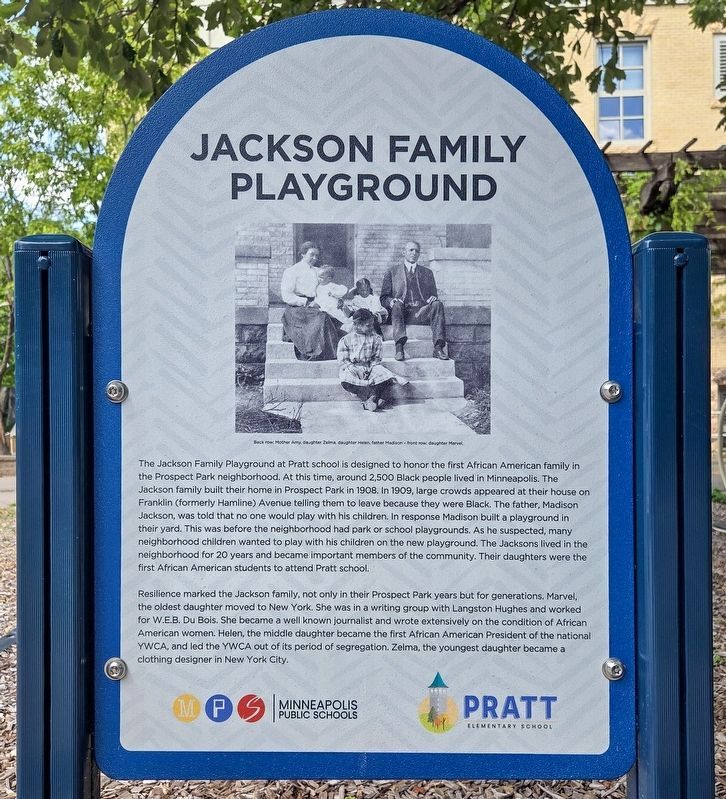
1. Obverse: Jackson Family Playground

Back row: Mother Amy, daughter Zelma, daughter Helen, father Madison – front row: daughter Marvel.
The Jackson Family Playground at Pratt school is designed to honor the first African American family in the Prospect Park neighborhood. At this time, around 2,500 Black people lived in Minneapolis. The Jackson family built their home in Prospect Park in 1908. In 1909, large crowds appeared at their house on Franklin (formerly Hamline) Avenue telling them to leave because they were Black. The father, Madison Jackson, was told that no one would play with his children. In response Madison built a playground in their yard. This was before the neighborhood had park or school playgrounds. As he suspected, many neighborhood children wanted to play with his children on the new playground. The Jacksons lived in the neighborhood for 20 years and became important members of the community. Their daughters were the first African American students to attend Pratt school.
Resilience marked the Jackson family, not only in their Prospect Park years but for generations. Marvel, the oldest daughter moved to New York. She was in
this page online
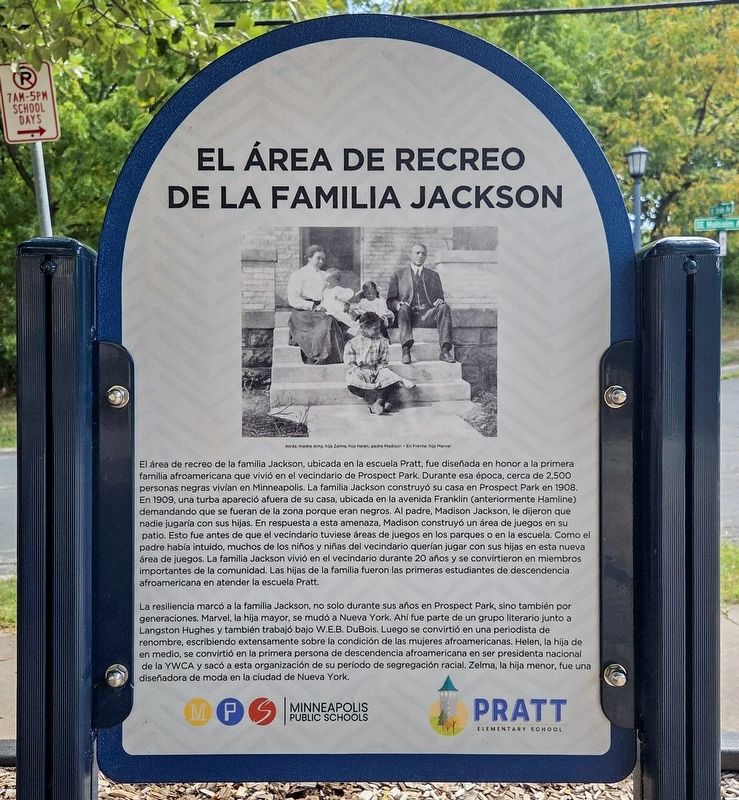
El área de recreo de la familia Jackson, ubicada en la escuela Pratt, fue diseñada en honor a la primera familia afroamericana que vivió en el vecindario de Prospect Park. Durante ese épocha, cerca de 2,500 personas negras vivían en Minneapolis. La familia Jackson construyó su casa en Prospect Park en 1908. En 1909, una turba apareció afuera de su casa, ubicada en la avenida Franklin (anteriormente Hamline) demandando que se fueran de la zona porque eran negros. Al padre, Madison Jackson, le dijeron que nadie jugaría con sus hijas. En respuesta a esta amenaza, Madison construyó un área de juegos en su patio. Esto fue antes de que el vecindario tuviese áreas de juegos
Photographed by McGhiever, August 23, 2026
2. Reverse: El Área de Recreo de la Familia Jackson
La resiliencia marcó a la familia Jackson, no solo durante sus años en Prospect Park, sino también por generaciones. Marvel, la hija mayor, se mudó a Nueva York. Ahí fue parte de un grupo literario junto a Langston Hughes y también trabajó baj W.E.B. DuBois. Luego se convirtió en una periodista de renombre, escribiendo extensamente sobre la condición de las mujeres afroamericanas. Helen, la hija de medio, se convirtió en la primera persona de descendencia afroamericana en ser presidenta nacional de la YWCA y sacó a esta organización de su período de segrecación racial. Zelma, la hija menor, fue una diseñadora de moda en la ciudad de Nueva York.
Erected by Minneapolis Public Schools.
Topics. This historical marker is listed in these
Photographed by McGhiever, August 23, 2026
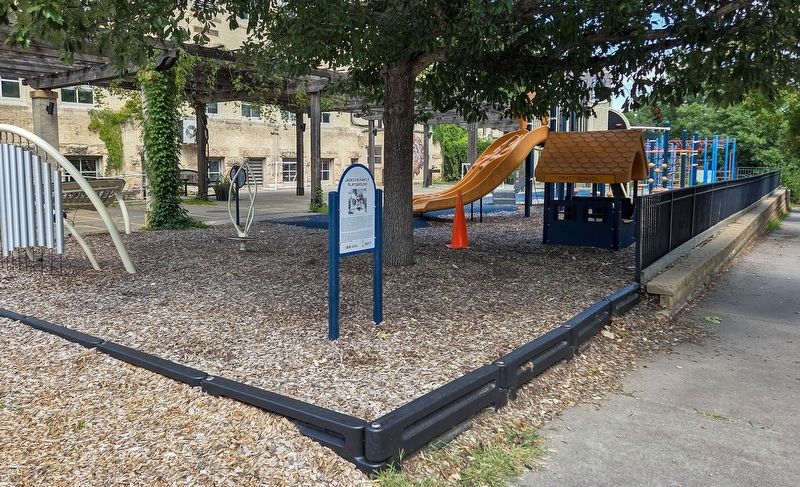
3. Marker at the south corner of the Jackson Family Playground at Pratt Elementary School
Location. 44° 58.122′ N, 93° 12.836′ W. Marker is in Minneapolis, Minnesota, in Hennepin County. It is in Prospect Park. It is at the intersection of Malcolm Avenue SE and SE Orlin Avenue on Malcolm Avenue SE. The marker is at the south corner of the playground next to Pratt Elementary School. Touch for map. Marker is at or near this postal address: 66 Malcolm Avenue SE, Minneapolis MN 55414, United States of America. Touch for directions.

Regionally, this marker is in the Twin Cities Metropolitan Area. It is also in the American Midwest, in the Corn Belt, and in the Great River Road Region. Globally, it is in North America, the Western Hemisphere, the Western World, and the Anglosphere. Historically, it finds itself in what was once Rupert’s Land, the territory of the Mississippian Culture, and the Louisiana Purchase.
Other nearby markers. At least 8 other markers are within one mile of this marker, measured as the crow flies: Prospect Park Water Tower (about 300 feet away, measured in a direct line); The Winchell Trail (approx. 0.7 miles away); Minneapolis War Memorial Blood Bank (approx. ¾ mile away); Women in Science & Medicine (approx. 0.9 miles away); Academic Health Center (approx. 0.9 miles away); Bridging the Mississippi (approx. one mile away); Coffman Memorial Union (approx. 1.1 miles away); Meeker Island Lock and Dam (approx. 1.1 miles away). Touch for a list and map of all markers in Minneapolis.
Credits. This page was last revised on September 20, 2026. It was originally submitted on September 20, 2026, by McGhiever of Minneapolis, Minnesota. This page has been viewed 4 times since then. Photos: 1, 2, 3. submitted on September 20, 2026, by McGhiever of Minneapolis, Minnesota.
