South Kingstown in Washington County, Rhode Island — The American Northeast (New England)
Samuel E. Perry Grist Mill
| — | South Kingstown Land Trust | — |
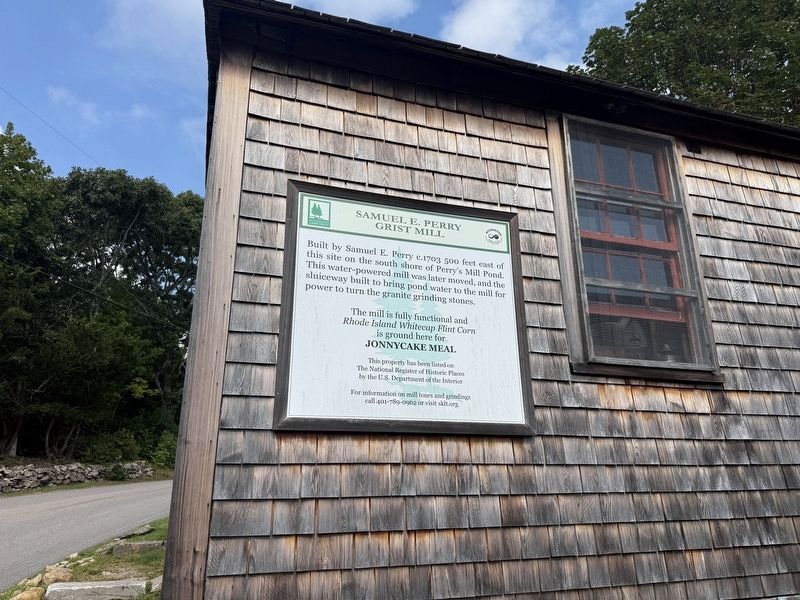
Built by Samuel E. Perry c.1703 500 feet east of this site on the south shore of Perry's Mill Pond. This water-powered mill was later moved, and the sluiceway built to bring pond water to the mill for power to turn the granite grinding stones.
Rhode Island Whitecap Flint Corn
is ground here for
Jonnycake Meal
This property has been listed on
The National Register of Historic Places
by the U.S. Department of the Interior
For information on mill tours and grindings call 401-789-0962 or visit sklt.org
Erected by South Kingstown Land Trust.
Topics. This historical marker is listed in these topic lists: Agriculture • Colonial Era • Food & Drink • Industry & Commerce. A significant historical year for this entry is 1703.
Location. 41° 23.527′ N, 71° 34.625′ W. Marker is in South Kingstown, Rhode Island, in Washington County. It is on Moonstone Beach Road 0.2 miles south of Commodore Perry Highway (U.S. 1), on the right when traveling north. Touch for map. Marker is at or near this postal address: 365 Moonstone Beach Rd, Wakefield RI 02879, United States of
this page online

Regionally, this marker is on Narragansett Bay and in South County. It is also in the American Northeast, in New England, and on the Eastern Seaboard. Globally, it is in the North Atlantic Region, North America, the Western Hemisphere, the Western World, and the Anglosphere. Historically, it finds itself in what was once one of the original Thirteen Colonies.
Other nearby markers. At least 8 other markers are within 4 miles of this marker, measured as the crow flies: Cross' Mills (approx. 3½ miles away); From Trawl to Table (approx. 3½ miles away); Galilee: A Working Waterfront (approx. 3.6 miles away); In It for the Long Haul (approx. 3.6 miles away); Growth and Its Limits (approx. 3.6 miles away); From Fishing Village to Fishing Port (approx. 3.6 miles away); A Model of Innovation (approx. 3.6 miles away); From Trap to Table (approx. 3.6 miles away).
Also see . . . Nomination form for the Perry-Carpenter Grist Mill. This form was prepared by Hetty Startup (Assistant) and Virginia A. Fitch, Architectural Historian with The Public Archaeology Laboratory, Inc. in November 1989.
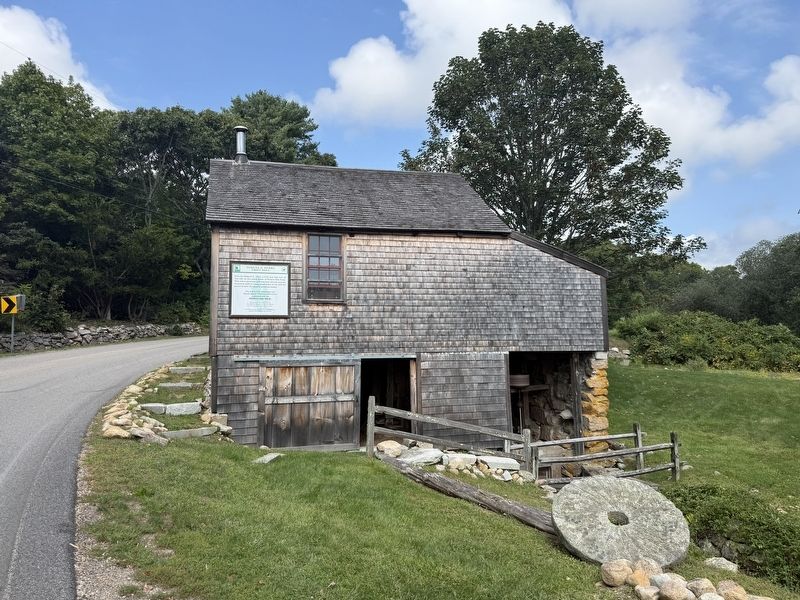
The Perry-Carpenter Grist Mill is significant for its ability to document some important patterns of South Kingstown's agricultural history. In its physical form and function, the grist mill preserves information about an important aspect of agrarian life: the milling of grain.(Submitted on September 20, 2026, by Devry Becker Jones of Washington, District of Columbia.)
Agriculture was the dominant economic activity of South Kingstown in the eighteenth and nineteenth centuries. The town contains some of Rhode Island's best farmland, flatter and more fertile than much of the state. In the eighteenth century, subsistence farmers who grew crops and raised livestock to provide for their families coexisted with large commercial farmers who operated hundreds of acres and produced crops and stock for an export trade through Newport across Narragansett Bay. In the nineteenth century, farming continued to be a mainstay of the economy; both specialty farms, such as dairies and orchards, and general farms (growing corn, potatoes, oats, sheep, swine, and poultry) flourished. Throughout the eighteenth and nineteenth centuries, corn was both the principal crop and a staple food in South Kingstown. Corn was among the first of the town's exports and remained a significant crop into the twentieth century. Corn meal was used in breads (often mixed with rye) and in the characteristic southern Rhode Island specialty, jonny cakes.
The first corn-grinding mill in South Kingstown was built in 1661, a scant decade after initial settlement; it no longer stands. James Perry constructed the Perry-Carpenter Grist Mill c. 1716 in the Matunuck area in southern South Kingstown. Sometime before 1789, the mill was moved a short distance to its present location by the Perrys. Through the eighteenth century, at least three other grist mills were constructed in the town. Located in relatively isolated locations on the small streams which were their power source, these four mills were essential adjuncts of South Kingstown's agriculture and had an influence on patterns of settlement and commerce. Three of the four mills became nuclei around which substantial villages later developed: at Usquepaug on the Queen's River, at Wakefield on the Saugatucket River, and at Glen Rock on Glen Rock Brook. Of the four, only the Perry-Carpenter Grist Mill remains in something akin to its original setting; it can still document at least partly the original relationship of such grist mills to the surrounding farms a minor, isolated industrial outpost set amongst farmed lands.
The Perry-Carpenter Grist Mill was operated by the Perrys until 1789. The mill changed hands a number of times in the nineteenth century; it was operated from the 1870s to the 1960s by members of the Carpenter family. Little is known of the mill's patterns of operation in the eighteenth and nineteenth centuries; no accounts or records survive. The mill's size suggests that it was operated intermittently and served only a local populace, grinding a few bushels at a time as needed by nearby farmers; certainly nothing in the mill's size suggests a commercial scale of operations.
The Perry-Carpenter Grist Mill has special significance because it is a rare survivor; it typifies a once-numerous class of resource, now very much diminished in number. Several dozen grist mills once operated in Rhode Island; only a handful still stand and few still grind corn of these, the Perry-Carpenter Grist Mill is the oldest.
Criteria Consideration B: The Perry-Carpenter Grist Mill was moved early in its history. The mill was probably constructed c. 1716; the first mention of the mill in the documentary record is its inclusion in the 1716 will of Samuel Perry. The mill was moved to its present location before 1789, when John Perry sold it to Thomas Hazard.
Period of Significance: The Perry-Carpenter Grist Mill dates from the eighteenth century and, insofar as is known, has operated at least intermittently since that date. The physical orientation, plan, design, and construction are consistent with what is known of colonial gristmills; but the actual materials of the mill are products of several periods. As with all operating industrial facilities, repair and replacement of physical elements have been required. Such repairs give evidence of being carried out in a manner consistent with the plan, design, and construction methods of the original building, but they do represent change in the actual colonial building materials. Much of the actual fabric may date from the nineteenth and early twentieth century; the runner stone, for example, is marked with a date, "1864"; nails of several periods have been identified; and the turbine pit is marked "1916." The period of significance is, thus, described as c. 1716 to 1940 for two reasons: 1) the mill has been a minor but integral part of the town's agricultural life since its construction to the present, and 2) the mill's physical materials have been repaired and replaced through time, and the resource is thus the product of several centuries of construction.
Credits. This page was last revised on September 20, 2026. It was originally submitted on September 20, 2026, by Devry Becker Jones of Washington, District of Columbia. This page has been viewed 5 times since then. Photos: 1, 2. submitted on September 20, 2026, by Devry Becker Jones of Washington, District of Columbia.
