Historic District in St. Augustine in St. Johns County, Florida — The American South (South Atlantic)
Frederick Douglass
Photographed by Stephen Thomas White, July 30, 2026
1. Frederick Douglass Marker
Lion of Anacostia
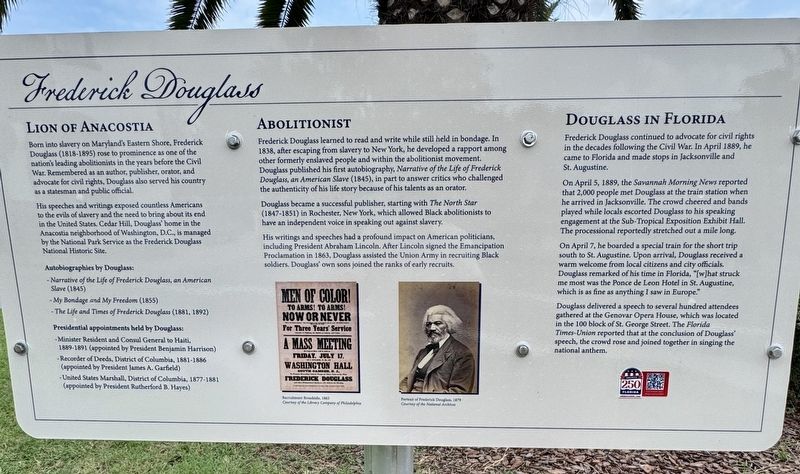
Born into slavery on Maryland's Eastern Shore, Frederick Douglass (1818-1895) rose to prominence as one of the nation's leading abolitionists in the years before the Civil War. Remembered as an author, publisher, orator, and advocate for civil rights, Douglass also served his country as a statesman and public official.
His speeches and writings exposed countless Americans to the evils of slavery and the need to bring about its end in the United States. Cedar Hill, Douglass' home in the Anacostia neighborhood of Washington, D.C., is managed by the National Park Service as the Frederick Douglass National Historic Site.
Autobiographies by Douglass:
- Narrative of the Life of Frederick Douglass, an American Slave (1845)
- My Bondage and My Freedom (1855)
- The Life and Times of Frederick Douglass (1881,1892)
Presidential appointments held by Douglass:
- Minister Resident and Consul General to Haiti,1889-1891 (appointed by President Benjamin Harrison)
- Recorder of Deeds, District of Columbia, 1881-1886 (appointed by President James A. Garfield)
- United
this page online
Abolitionist
Frederick Douglass learned to read and write while still held in bondage. In 1838, after escaping from slavery to New York, he developed a rapport among other formerly enslaved people and within the abolitionist movement. Douglass published his first autobiography, Narrative of the Life of Frederick Douglass, an American Slave (1845), in part to answer critics who challenged the authenticity of his life story because of his talents as an orator.
Douglass became a successful publisher, starting with The North Star (1847-1851) in Rochester, New York, which allowed Black abolitionists to have an independent voice in speaking out against slavery.
His writings and speeches had a profound impact on American politicians, including President Abraham Lincoln. After Lincoln signed the Emancipation Proclamation in 1863, Douglass assisted the Union Army in recruiting Black soldiers. Douglass' own sons joined the ranks of early recruits.
Douglass in Florida
Frederick Douglass continued to advocate for civil rights in the decades
Photographed by Stephen Thomas White, July 30, 2026
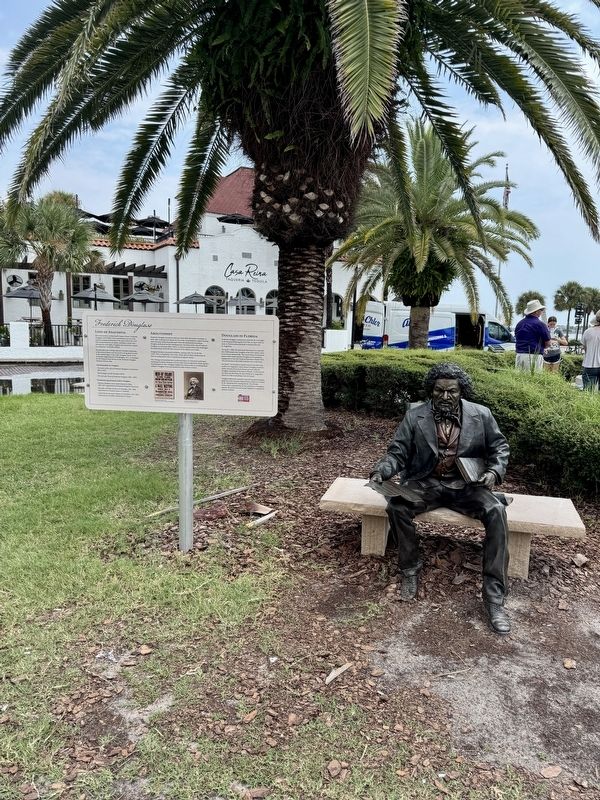
2. Frederick Douglass Marker
On April 5, 1889, the Savannah Morning News reported that 2,000 people met Douglass at the train station when he arrived in Jacksonville. The crowd cheered and bands played while locals escorted Douglass to his speaking engagement at the Sub-Tropical Exposition Exhibit Hall. The processional reportedly stretched out a mile long.
On April 7, he boarded a special train for the short trip south to St. Augustine. Upon arrival, Douglass received a warm welcome from local citizens and city officials. Douglass remarked of his time in Florida, "[w]hat struck me most was the Ponce de Leon Hotel in St. Augustine, which is as fine as anything I saw in Europe."
Douglass delivered a speech to several hundred attendees gathered at the Genovar Opera House, which was located in the 100 block of St. George Street. The Florida Times-Union reported that at the conclusion of Douglass' speech, the crowd rose and joined together in singing the national anthem.
(captions)
Recruitment Broadside, 1863 Courtesy of the Library Company of Philadelphia
Portrait of Frederick Douglass, 1879 Courtesy of the National Archives
Topics. This historical marker is listed in these topic lists: Abolition & Underground RR • African Americans • Civil Rights. A significant historical date for this entry is April 5, 1889.
Location. 29° 53.573′ N, 81° 18.685′ W. Marker is in St. Augustine, Florida, in St. Johns County. It is in the Historic District. It is at the intersection of Charlotte Street and Cathederal Place, on the right when traveling north on Charlotte Street. The marker is within Anderson Circle. Touch for map. Marker is at or near this postal address: 8 Cathedral Pl, Saint Augustine FL 32084, United States of America. Touch for directions.

Regionally, this marker is in First Coast and in Greater Jacksonville. It is also in the American South and on the Eastern Seaboard. Globally, it is in the North Atlantic Region, North America, a Gulf of Mexico state, the Western Hemisphere, the Western World, and the Anglosphere. Historically, it finds itself in what was once New Spain, the territory of the Mississippian Culture, one of the Confederate States of America, and the Antebellum South.
Other nearby markers. At least 8 other markers are within walking distance of this marker: St. Augustine First World War Memorial (a few steps from this marker); Juan Ponce de Leon (within shouting distance of this marker); Slave Market (within shouting distance of this marker); World War II Memorial (within shouting distance of this marker); Juan Ponce De Leon (within shouting distance of this marker); The St. Augustine Foot Soldiers Monument (within shouting distance of this marker); Public Market Place (within shouting distance of this marker); Public Well (within shouting distance of this marker). Touch for a list and map of all markers in St. Augustine.
Also see . . .
1. Statue of Frederick Douglass unveiled in St. Augustine. (Submitted on September 21, 2026, by Stephen Thomas White of Norfolk, Virginia.)
2. A New Tribute to as American Icon. (Submitted on September 21, 2026, by Stephen Thomas White of Norfolk, Virginia.)
Credits. This page was last revised on October 2, 2026. It was originally submitted on September 21, 2026, by Stephen Thomas White of Norfolk, Virginia. This page has been viewed 8 times since then. Photos: 1, 2. submitted on September 21, 2026, by Stephen Thomas White of Norfolk, Virginia. • Bernard Fisher was the editor who published this page.
