Chatsworth in Grey County, Ontario — Central Canada (North America)
Nellie L. McClung
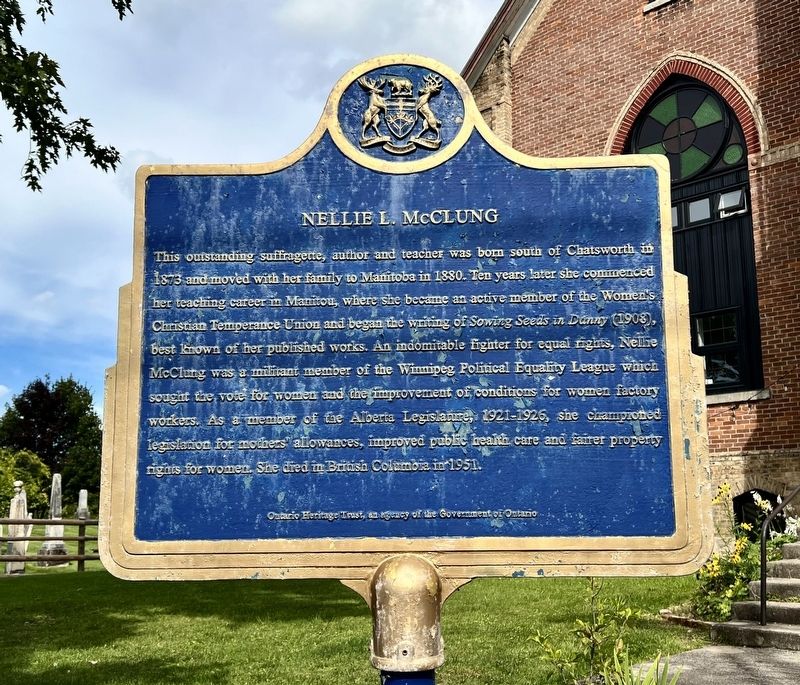
Photographed by Tim Boyd, September 20, 2026
1. Nellie L. McClung Marker
Erected 1975 by Ontario Heritage Trust.
Topics and series. This historical marker is listed in these topic lists: Civil Rights • Women. In addition, it is included in the Canada, Ontario Heritage Trust series list. A significant historical year for this entry is 1873.
Location. 44° 27.276′ N, 80° 53.688′ W. Marker is in Chatsworth, Ontario, in Grey
this page online

Regionally, this marker is in Georgian Bay Country and in Southwestern Ontario. It is also in Central Canada. Globally, it is in North America, on the Great Lakes, in the Western Hemisphere, in the Western World, and in the Anglosphere. Historically, it finds itself in what was once a British colony, the Viceroyalty of New France, the Haudenosaunee (Iroquois) Confederacy, and Rupert’s Land.
Other nearby markers. At least 5 other markers are within 19 kilometers of this marker, measured as the crow flies: The Toronto-Sydenham Road (approx. 0.6 kilometers away); Chatsworth Continuation School and Public School (approx. 0.6 kilometers away); Survey of the Great Lakes / Le levé des Grande lacs (approx. 12.8 kilometers away); Trinity United Church - Annan (approx. 18.1 kilometers away); Tom Thomson 1877-1917 (approx.
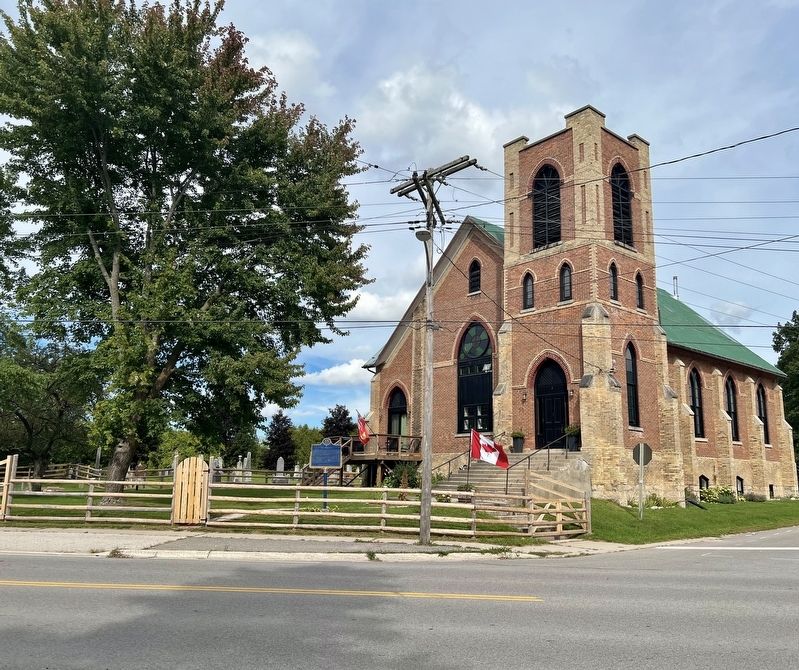
Photographed by Tim Boyd, September 20, 2026
2. Nellie L. McClung Marker
The former Chatsworth United Church is in the background
Also see . . . Nellie McClung, the great woman of Canadian history.
In 1921, now living in Alberta, she ran as a Liberal MLA in Edmonton, won, and acted like an independent, supporting her opponents when she felt they were doing something sensible. She was defeated in 1926 because she had pushed so hard for prohibition.(Submitted on September 21, 2026, by Tim Boyd of Hamilton, Ontario.)
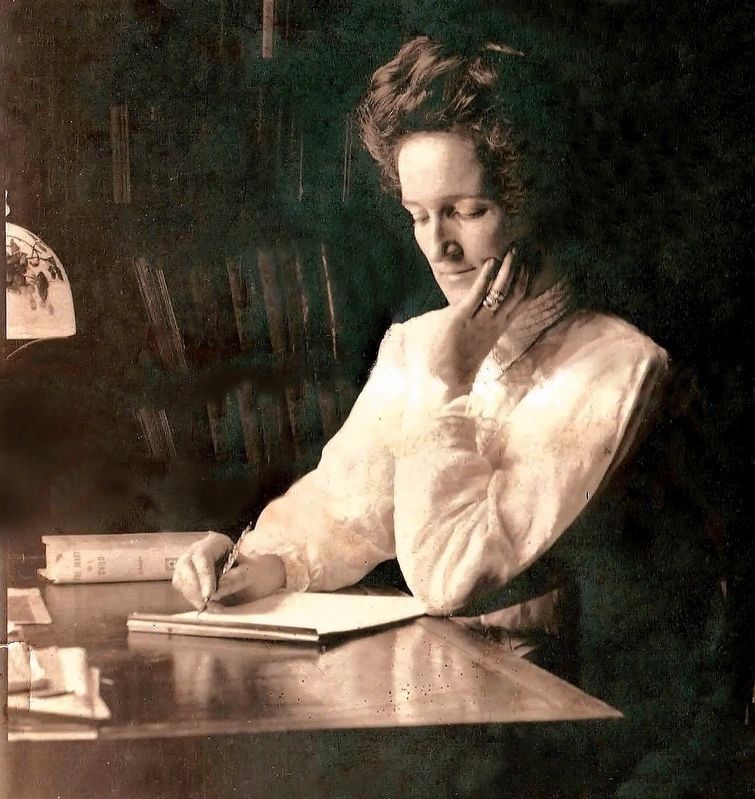
Then there was the Person’s Case, spearheaded by Canada’s and indeed the British Empire’s first female judge, Emily Murphy, joined by three other stellar figures, Henrietta Muir Edwards, Louise McKinney (an Alberta MLA, the first woman elected to a legislature in the British Empire), and Irene Parlby (Alberta MLA). When the Supreme Court of Canada, in all its wisdom, preferred to think it was still 1867, the Famous Five, as they came to be called, used their last resort and appealed, as was their right as British subjects, to Britain’s Judicial Committee of the Privy Council. Those men across the ocean overruled Canada’s Supreme Court, which wasn’t so supreme, on October 18, 1929, and declared that women could and should be deemed “qualified persons” and thus eligible to be admittedto the Senate.19083. Nellie McClung in 1908Source: Pembina Manitou Archive (public domain)
Credits. This page was last revised on September 21, 2026. It was originally submitted on September 21, 2026, by Tim Boyd of Hamilton, Ontario. This page has been viewed 11 times since then. Photos: 1, 2, 3. submitted on September 21, 2026, by Tim Boyd of Hamilton, Ontario. • Andrew Ruppenstein was the editor who published this page.
