Chelmsford in Middlesex County, Massachusetts — The American Northeast (New England)
Chelmsford Forefathers Burying Ground
1655
Photographed by G.W.Bartlett, May 11, 2025
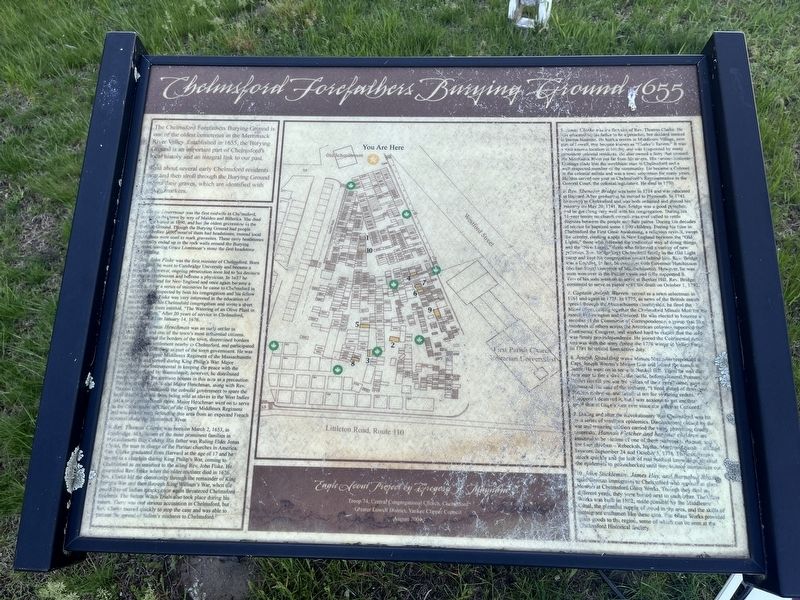
1. Chelmsford Forefathers Burying Ground 1655 Marker
The Chelmsford Forefathers Burying Ground is one of the oldest cemeteries in the Merrimack River Valley. Established in 1655, the Burying Ground is an important part of Chelmsford's local history and an integral link to our past.
Read about several early Chelmsford residents here and then stroll through the Burying Ground amongst their graves, which are identified with granite markers.
1.Grace Livermoar was the first midwife in Chelmsford, coming to this town by way of Malden and Billerica. She died and was buried in 1690, and has the oldest gravestone in the Burying Ground. Though the Burying Ground had people buried before 1690, none of them had headstones; instead local fieldstones were used to mark gravesites. These early headstones eventually ended up in the rock walls around the Burying Ground, leaving Grace Livermoar's stone the first headstone still existing.
2. Rev. John Fiske was the first minister of Chelmsford. Born in England, he went to Cambridge University and became a preacher. However, ongoing persecution soon led to his decision to change professions and become a physician. In 1637 he left Old England
this page online
3. Maj. Thomas Henchman was an early settler in Chelmsford and one of the town's most influential citizens. He helped lay out the borders of the town, determined borders with the Indian settlement nearby to Chelmsford, and participated [?] as part of the town government. He was [?] Upper Middlesex Regiment of the Massachusetts [?] and served during King Philip's War. Major Henchman was instrumental in keeping the peace with the [?] by Wannalancit; however, he distributed [?] the garrison houses in this area as a precaution. [?] 1676 and Major Henchman, along with Rev. [?] positioned the colonial government to spare the [?] from being sold as slaves in the West Indies and a [?] death there.
Photographed by G.W.Bartlett, May 11, 2025
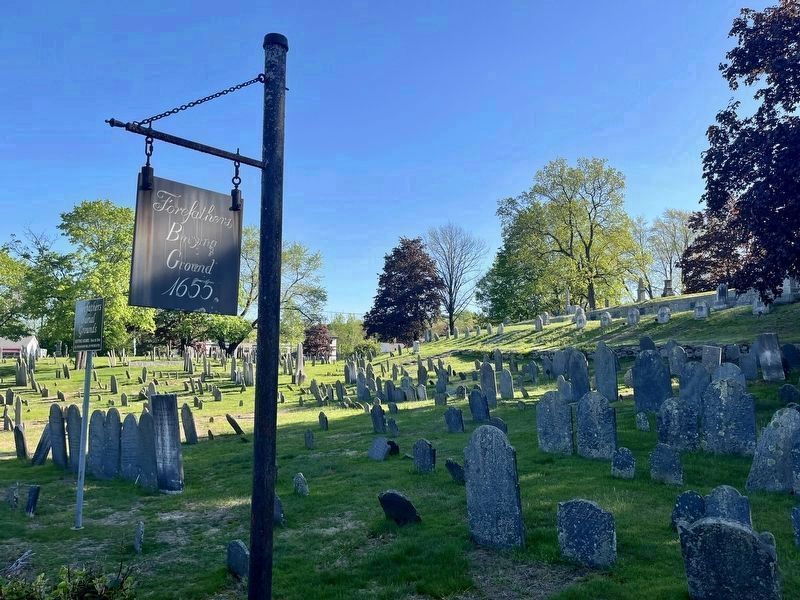
2. Chelmsford Forefathers Burying Ground
4. Rev. Thomas Clarke was born on March 2, 1653, in Cambridge, MA, to one of the most prominent families in the Massachusetts Bay Colony. His father was Ruling Elder Jonas Clarke, the man in charge of the Puritan churches in America. Rev. Clarke graduated from Harvard at the age of 17 and he served as a chaplain during King Philip's War, coming to Chelmsford as an assistant to the ailing Rev. John Fiske. He succeeded Rev. Fiske when the older minister died in 1676. Rev. Clarke led the community through the remainder of King Philip's War and then through King William's War, when the possibility of Indian attacks once again threatened Chelmsford, but Rev Clarke moved quickly to stop the case and was able to prevent the spread of Salem's madness to Chelmsford.
5. Jonas Clarke was the first son of Rev. Thomas Clarke. He was educated by his father to be a preacher, but decided instead to pursue business. He built a tavern in Middlesex Village, now part
Photographed by G.W.Bartlett, May 11, 2025
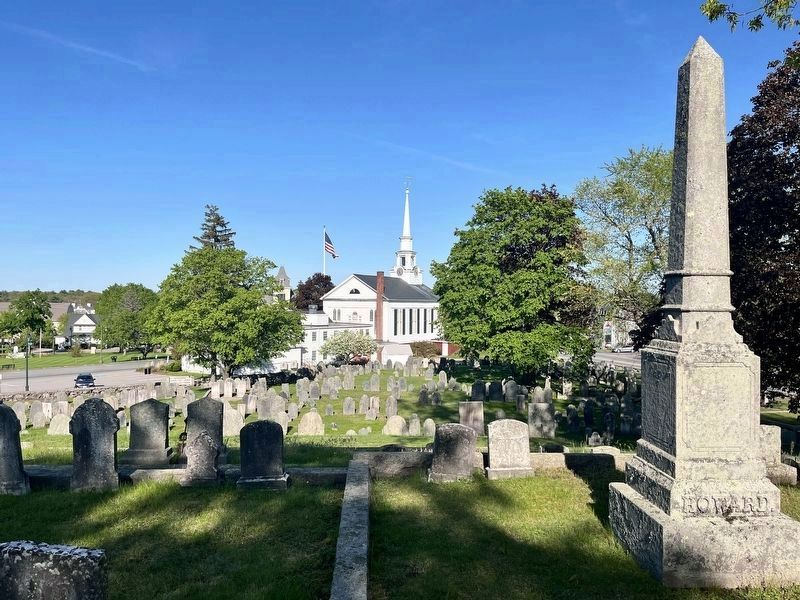
3. Chelmsford Forefathers Burying Ground
The First Parish Chelmsford Church is beyond the burying ground.
6. Rev. Ebenezer Bridge was born in 1714 and was educated at Harvard. After graduation he moved to Plymouth. In 1741 he moved to Chelmsford and was both ordained and started his ministry on May 10, 1741. Rev. Bridge was a good preacher and he got along very well with his congregation. During his 51-year tenure no church council was ever called to settle disputes between the people and their pastor. During his decades of service he baptized som 1,900 children. During his time in Chelmsford the first Great Awakening, a religious revival, swept the country, creating a split in New England between
Photographed by G.W.Bartlett, May 11, 2025
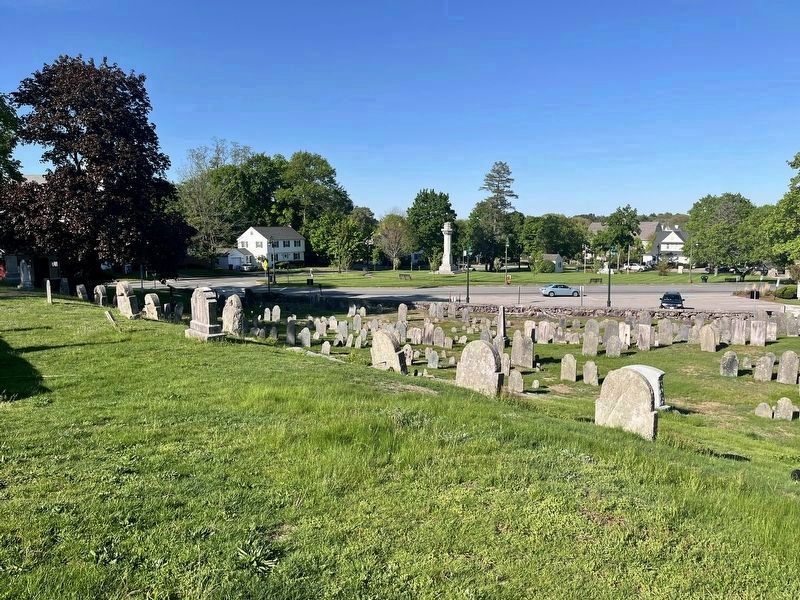
4. Chelmsford Forefathers Burying Ground
7. Captain Joseph Warren served as a town selectman in 1761 and again in 1775. In 1775, as news of the British march spread through the Massachusetts countryside, he fired the Minute Gun calling together the Chelmsford Minute Men for the march to Lexington and Concord. He was elected to become a member of the Committee of Correspondence, a group that like hundreds of others across the American colonies supported the Continental Congress and worked hard to ensure that the area was firmly pro-independence. He joined the Continental Army and was with the army during the 1778 winter at Valley
Photographed by G.W.Bartlett, May 11, 2025
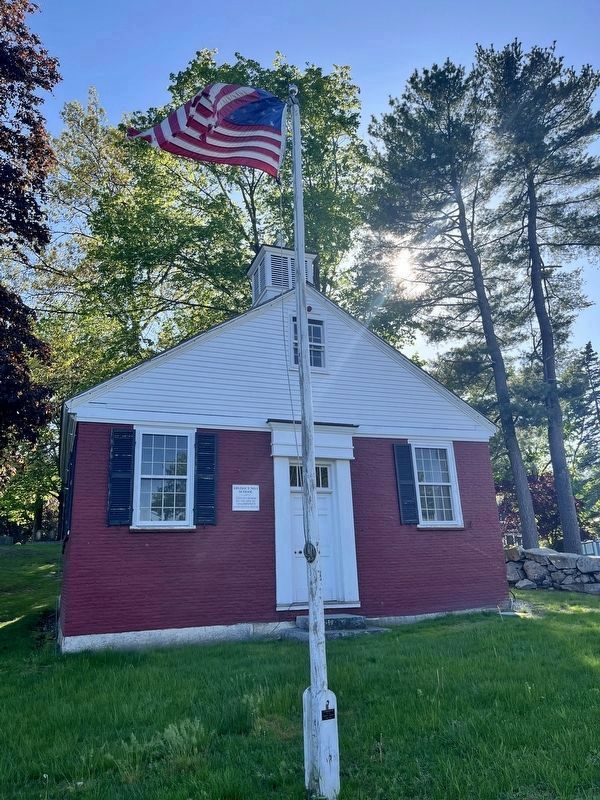
5. No. 1 District School
The marker is in front of the No 1. District School, which is on the grounds of the Forefathers Burying Ground.
8. Joseph Spaulding was a Minute Man who responded to Capt. Joseph Warren's Minute Gun and joined the march to battle. He went on to serve at Bunker Hill. There he was the first man to fire a shot in the battle, before General Putnam, of "don't fire until you see the whites of their eyes" fame, gave the command. He said of the incident, "I fired ahead of time, and Putnam rushed up and struck at me for violating orders. I suppose I deserved it, but I was anxious to get another good shot at Gage's men ever since our affair at Concord."
9. During and after the Revolutionary War Chelmsford was hit by a series of smallpox epidemics. Displacement caused by the war and returning soldiers carried the virus, provoking deadly outbreaks. Hannah Fletcher and her children are assumed to be victims of one of these outbreaks. Hannah and her four children -- Rebeckah, Jeptha, Mary, and Sarah -- all died between September 24 and October 5, 1778. Smallpox struck quickly and the lack of real medical knowledge allowed the epidemic to go unchecked until these epidemics burned themselves out.
10. John Sticklemire, James Hay and Barnabus Bradt,
Photographed by G.W.Bartlett, May 11, 2025
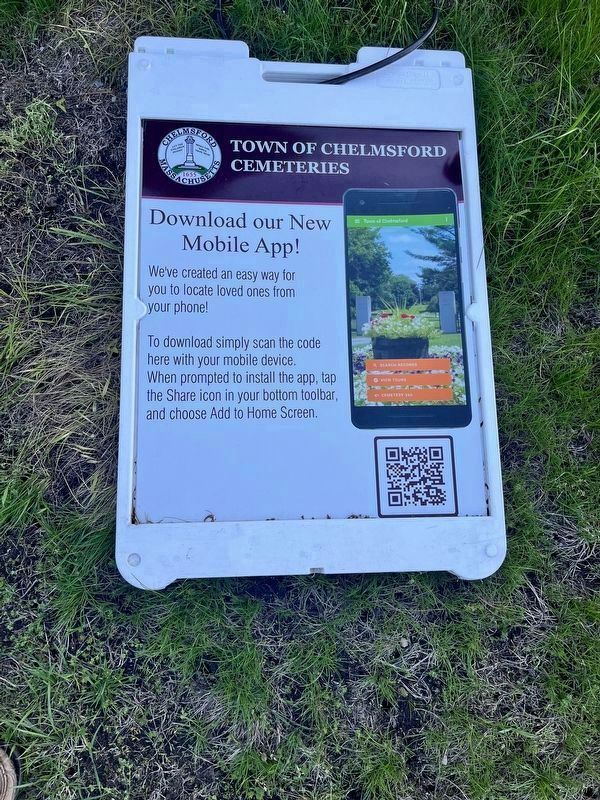
6. Town of Chelmsford Cemeteries
Additional information, including names and locations of individual Chelmsford burials is available at the website by scanning the QR code on the sandwich board.
Troop 74, Central Congregational Church, Chelmsford
Greater Lowell District, Yankee Clipper Council
August 2004
Erected 2004 by Troop 74, Chelmsford, MA; Boy Scouts of America.
Topics. This historical marker is listed in these topic lists: Cemeteries & Burial Sites • Colonial Era • Religion & Religious Structures • Settlements & Settlers. A significant historical year for this entry is 1655.
Location. 42° 35.873′ N, 71° 21.237′ W. Marker is in Chelmsford, Massachusetts, in Middlesex County. It is at the intersection of Westford Street and Academy Street, on the left when traveling west on Westford Street. Touch for map. Marker is at or near this postal address: 2 Westford Street, Chelmsford MA 01824, United States of America. Touch for directions.

Regionally, this marker is in Greater Boston and in the Merrimack Valley. It is also in the American Northeast, in New England, and on the Eastern Seaboard. Globally, it is in the North Atlantic Region, North America, the Western Hemisphere, the Western World, and the Anglosphere. Historically, it finds itself in what was once one of the original Thirteen Colonies.
Other nearby markers. At least 8 other markers are within 3 miles of this marker, measured as the crow flies: District No. 1 School (here, next to this marker); Revolutionary War Monument (within shouting distance of this marker); First School for Lip-Reading (about 300 feet away, measured in a direct line); Oldest Toll House (about 300 feet away); Chelmsford (about 700 feet away); Chelmsford’s “Minuteman Boulder” (about 700 feet away); Soldiers and Sailors Monument (approx. 2.8 miles away); Chief of the Penacooks (approx. 2.9 miles away). Touch for a list and map of all markers in Chelmsford.
Regarding Chelmsford Forefathers Burying Ground.
Find-a-Grave records (spellings may vary from this marker):
1. Grace (Sherman) Livermore [1616-1691] Memorial ID: 18168775
2. Rev John Fiske [1601-1676] Memorial ID: 18168369
3. Major Thomas Hinchman [1629-1703] Memorial ID: 18168613
4. Rev Thomas Clark [1653-1704] Memorial ID: 18168123
5. Col Jonas Clark [1684-1770] Memorial ID: 18168120
6. Reverend Ebenezer Bridge [1714-1792] Memorial ID: 18168001
7. Capt Joseph Warren [1724-1792] Memorial ID 18169599
8. Joseph Spaulding [1756-1820] Memorial ID: 18169475
9. Hannah (Parker) Fletcher [1749-1778] Memorial ID: 18168392
10. John Joseph Stickelmire [1766-1814] Memorial ID: 18169528 · James Hay [1774-1826] Memorial ID: 18168557 · Barnabus Bradt [1772-1828] Memorial ID: 18167996
Also see . . .
1. Town of Chelmsford Cemeteries. For more information about Town of Chelmsford cemeteries, including individual burial searches. (Submitted on September 24, 2026, by G.W.Bartlett of Hingham, Massachusetts.)
2. Forefathers Burial Ground, Chelmsford, MA - Find-a-Grave. Founded in 1655 (Submitted on September 24, 2026, by G.W.Bartlett of Hingham, Massachusetts.)
3. History of Chelmsford, Massachusetts by the Rev. Wilson Waters, pub. 1917. For more about the history of Chelmsford and the lives of some of the forefathers buried in this cemetery. (Submitted on September 26, 2026, by G.W.Bartlett of Hingham, Massachusetts.)
Credits. This page was last revised on October 9, 2026. It was originally submitted on September 24, 2026, by G.W.Bartlett of Hingham, Massachusetts. This page has been viewed 14 times since then. Photos: 1, 2, 3, 4, 5, 6. submitted on September 24, 2026, by G.W.Bartlett of Hingham, Massachusetts. • Michael Herrick was the editor who published this page.
