Near Diamond in Newton County, Missouri — The American Midwest (Upper Plains)
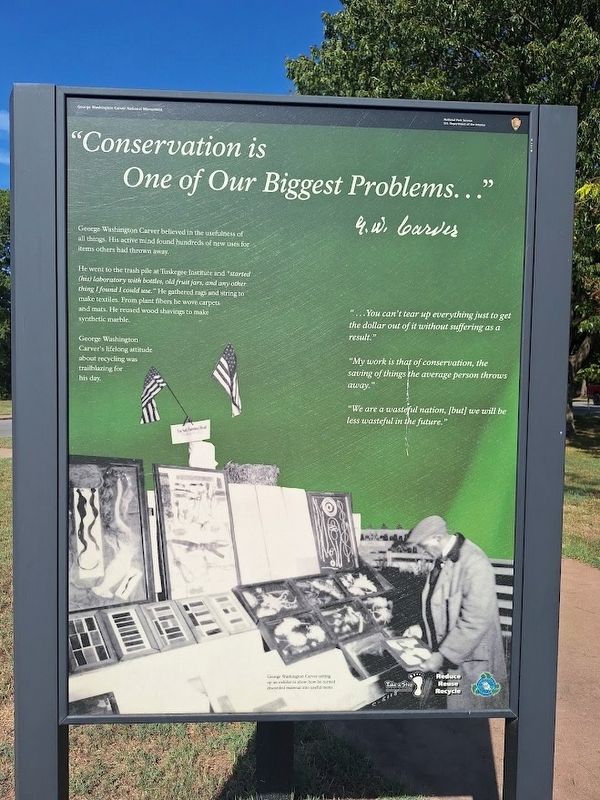
"Conservation is One of Our Biggest Problems" - G.W. Carver
George Washington Carver National Monument
| — | National Park Service, U.S. Department of the Interior | — |
Photographed by Jason Voigt, September 19, 2026
1. "Conservation is One of Our Biggest Problems" Marker
George Washington Carver believed in the usefulness of all things. His active mind found hundreds of new uses for items others had thrown away.
He went to the trash pile at Tuskegee Institute and "started (his) laboratory with bottles, old fruit jars, and any other thing I found could use." He gathered rages and string to make textiles. From plant fibers he wove carpets and mats. He reused wood shavings to make synthetic marble.
George Washington Carver's lifelong attitude about recycling was trailblazing for his day.
"…You can't tear up everything just to get the dollar out of it without suffering as a result."
"My work is that of conservation, the saving of things the average person throws away."
"We are a wasteful nation, [but] we will be less wasteful in the future."
Photo caption:
George Washington Carver setting up an exhibit to show how he turned discarded material into useful items.
Erected by National Park Service.
Topics and series. This historical marker is listed in these topic lists: African Americans • Environment • Science & Medicine. In addition, it is included
this page online
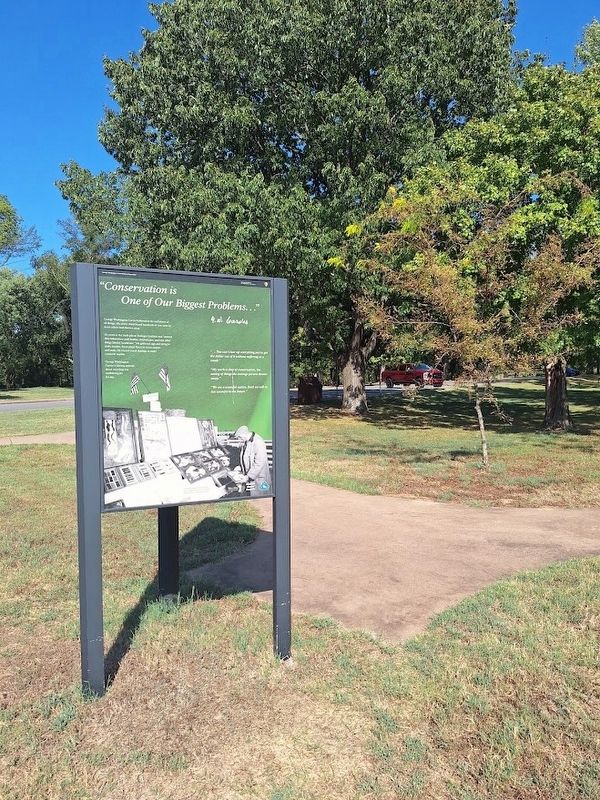
Location. 36° 59.168′ N, 94° 21.258′ W. Marker is near Diamond, Missouri, in Newton County. It can be reached from Carver Road. Marker is in front of the George Washington Carver National Monument Visitors Center. Touch for map. Marker is at or near this postal address: 5646 Carver Rd, Diamond MO 64840, United States of America. Touch for directions.

Regionally, this marker is in Southwest Missouri. It is also in the American Ozarks, in the Lewis & Clark Corridor, and in the Corn Belt. Globally, it is in North America, the Western Hemisphere, the Western World, and the Anglosphere. Historically, it finds itself in what was once the territory of the Mississippian Culture, the Louisiana Purchase, and the Antebellum South.
Other nearby markers. At least 8 other markers are within walking distance of this marker: George Washington Carver's Thoughts (within shouting distance of this marker); Take a Walk in Carver's Woods (within shouting distance of this marker); Why a National Monument? (within shouting distance of this marker); a different
Photographed by Jason Voigt, September 19, 2026
2. "Conservation is One of Our Biggest Problems" - G.W. Carver Marker
Other markers no longer nearby. The Moses Carver Farm (was within shouting distance of this marker but has been replaced with another marker now near it); George Washington Carver National Monument (was within shouting distance of this marker but has been replaced with another marker now near it); George Washington Carver's Birthplace (was within shouting distance of this marker but has been replaced with another marker now near it).
Also see . . .
1. George Washington Carver National Monument (National Park Service). (Submitted on September 25, 2026, by Jason Voigt of Glen Carbon, Illinois.)
2. George Washington Carver National Monument on Wikipedia.
Photographed by Jason Voigt, September 19, 2026
3. Different panel
Photographed by Jason Voigt, September 19, 2026
4. Different panel
Credits. This page was last revised on September 25, 2026. It was originally submitted on September 25, 2026, by Jason Voigt of Glen Carbon, Illinois. This page has been viewed 2 times since then. Photos: 1, 2, 3, 4. submitted on September 25, 2026, by Jason Voigt of Glen Carbon, Illinois.
