Little Compton in Newport County, Rhode Island — The American Northeast (New England)
Native Plants
Plants have been woven into our lives. They are a part of everything.
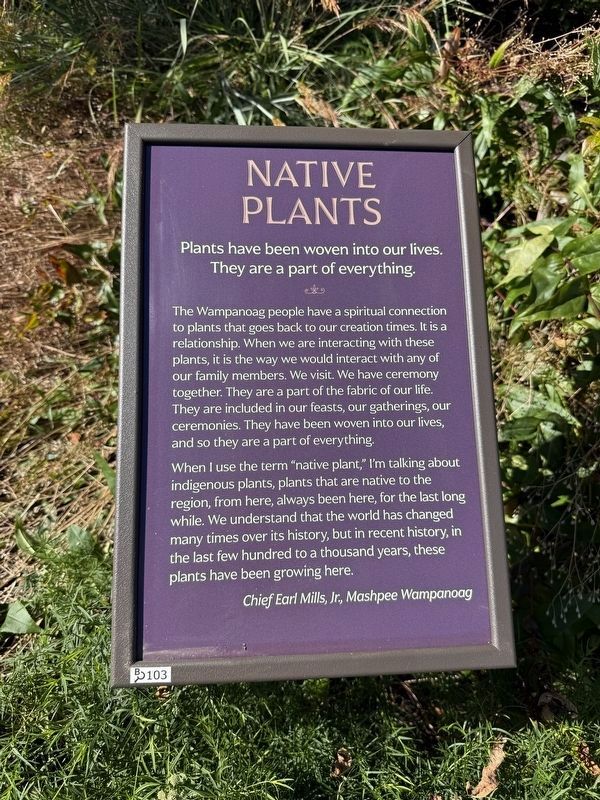
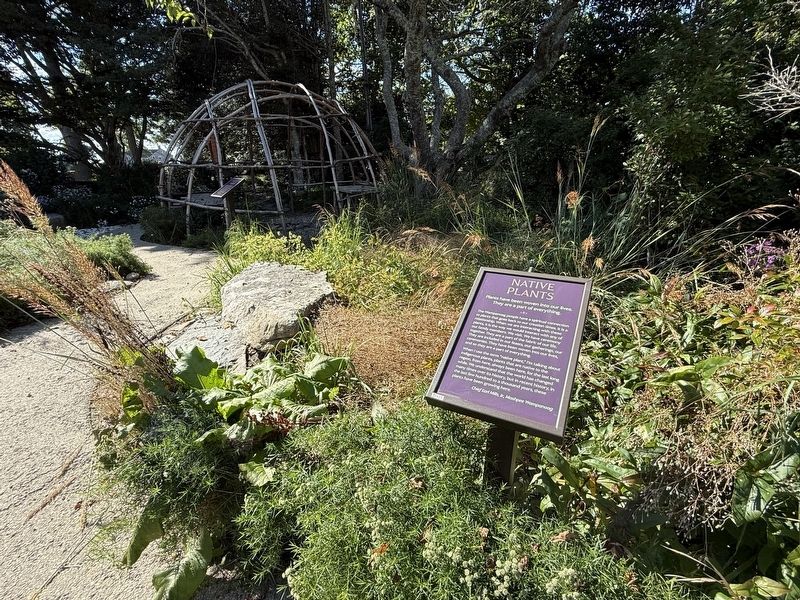
The Wampanoag people have a spiritual connection to plants that goes back to our creation. It is a relationship. When we are interacting with these plants, it is the way we would interact with any of our family members. We visit. We have ceremony together. They are a part of the fabric of our life. They are included in our feasts, our gatherings, our ceremonies. They have been woven into our lives, and so they are a part of everything.
When I use the term "native plant," I'm talking about indigenous plants, and plants that are native to the region, from here, always been here, for the last long while. We understand that the world has changed many times over its history, but in recent history, in the last few hundred to a thousand years, these plants have been growing here.
Chief Earl Mills, Jr., Mashpee Wampanoag
Erected by Little Compton Historical Society. (Marker Number 103.)
Topics and series. This historical marker is listed in these topic lists: Anthropology & Archaeology • Horticulture & Forestry • Indigenous Peoples and Communities • Natural Resources. In addition, it is included
this page online
Location. 41° 29.585′ N, 71° 11.064′ W. Marker is in Little Compton, Rhode Island, in Newport County. It can be reached from West Main Road (Rhode Island Route 77) south of Fairfields Drive, on the right when traveling north. Touch for map. Marker is at or near this postal address: 548 W Main Rd, Little Compton RI 02837, United States of America. Touch for directions.

Regionally, this marker is on Narragansett Bay. It is also in the American Northeast, in New England, and on the Eastern Seaboard. Globally, it is in the North Atlantic Region, North America, the Western Hemisphere, the Western World, and the Anglosphere. Historically, it finds itself in what was once one of the original Thirteen Colonies.
Other nearby markers. At least 8 other markers are within walking distance of this marker: Sakonnet History Project (a few steps from this marker); Welcome to Sakonnet (a few steps from this marker); Honoring Awashonks (a few steps from this marker); Three Sisters: A Symbiotic Garden (a few steps from this marker);
Credits. This page was last revised on September 27, 2026. It was originally submitted on September 27, 2026, by Devry Becker Jones of Washington, District of Columbia. This page has been viewed 5 times since then. Photos: 1, 2. submitted on September 27, 2026, by Devry Becker Jones of Washington, District of Columbia.
