Newport in Newport County, Rhode Island — The American Northeast (New England)
Trinity Church
Walk Newport's History
| — | Newport Historical Society | — |
The Newport Historical Society invites you to Walk Newport's History and discover our city's rich past by exploring its historic buildings and landscape. This self-guided walking tour—with signs scattered throughout Newport's historic neighborhoods—celebrates the many voices and stories that make up our community's history. It is important to acknowledge that Newport is built on the ancestral lands of Native American nations who welcomed the first European settlers to Rhode Island. Furthermore, this State's wealth and development were historically dependent on the unwilling labor of people of African and Native descent, who played an integral role in building this state.
Made possible the Rhode Island Commerce & the Pomeroy Foundation
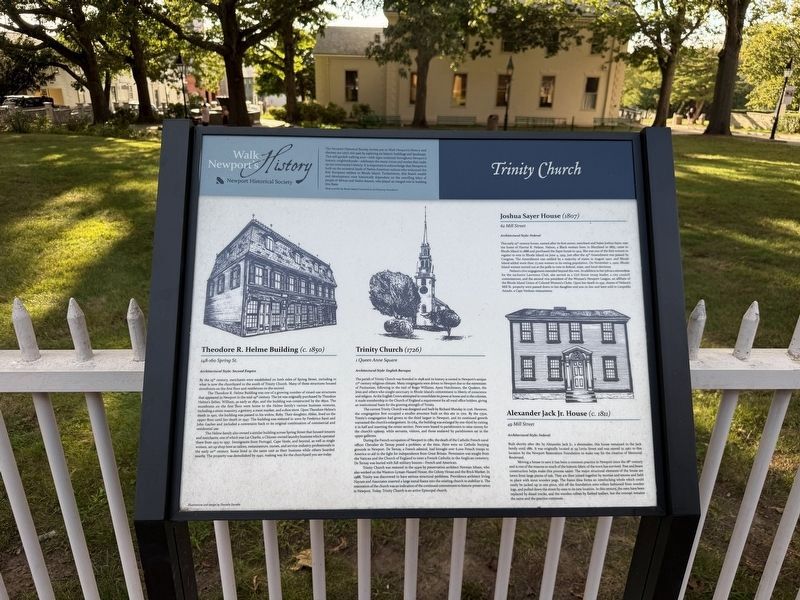
Theodore R. Helme Building (c. 1850)
148-160 Spring St.
Architectural Style: Second Empire
By the 19th century, merchants were established on both sides of Spring Street, including in what is now the churchyard to the south of Trinity Church. Many of these structures housed storefronts on the first floor and residences on the second.
The Theodore R. Helme Building was one of
this page online
The Helme family also owned a similar building across Spring Street that housed tenants and merchants, one of which was Lai Charlie, a Chinese-owned laundry business which operated there from 1913 to 1937. Immigrants from Portugal, Cape Verde, and beyond, as well as single women, set up shop here as tailors, restaurateurs, nurses, and service-industry professionals in the early 20th century. Some lived in the same unit as their business
Trinity Church (1726)
1 Queen Anne Square
Architectural Style: English Baroque
The parish of Trinity Church was founded in 1698 and its history is rooted in Newport's unique 17th century religious climate. Many congregants were driven to Newport due to the extremism of Puritanism, followed in the trail of Roger Williams, Anne Hutchinson, the Quakers, the Jews and others who sought sanctuary in Rhode Island's commitment to liberty of conscience and religion. As the English Crown attempted to consolidate its power at home and in the colonies, it made membership in the Church of England a requirement for all royal office holders, giving an institutional basis for the growing strength of Trinity.
The current Trinity Church was designed and built by Richard Munday in 1726. However, the congregation first occupied a smaller structure built on this spot in 1702. by the 1750s, Trinity's congregation had grown to the third largest in Newport, and its continued growth warranted the church's enlargement. In 1764, the building was enlarged by one-third by cutting it in half and inserting the center section. Pews were leased to parishioners to raise money for the church's upkeep, while servants, visitors, and those enslaved by parishioners sat in the upper galleries.
During the French occupation of Newport in 1780, the death of the Catholic French naval officer Chevalier de Ternay posed a problem: at the time, there were no Catholic burying grounds in Newport. De Ternay, a French admiral, had brought over 6,000 French troops to America to aid in the fight for independence from Great Britain. Permission was sought from the Vatican and the Church of England to inter a French Catholic in the Anglican cemetery. De Ternay was buried with full military honors—French and American.
Trinity Church was restored in the 1930s by preservation architect Norman Isham, who also worked on the Wanton-Lyman-Hazard House, the Colony House and the Brick Market. In 1988, Trinity was discovered to have serious structural problems. Providence architect Irving Haynes and Associates inserted a large metal frame into the existing church to stabilize it. The restoration of the church was an indication of the continued commitment to historic preservation in Newport. Today, Trinity Church is an active Episcopal church.
Joshua Sayer House (1807)
62 Mill Street
Architectural Style: Federal
This early 19th century home, named after its first owner, merchant and baker Joshua Sayer, was the home of Harriet R. Nelson. Nelson, a Black woman born in Maryland in 1865, came to Rhode Island in 1888 and purchased the Sayer house in 1914. She was one of the first women to register to vote in Rhode Island on June 4, 1919, just after the 19th Amendment was passed by Congress. The Amendment was ratified by a majority of states in August 1920, and Rhode Island added more than 77,000 women to its voting population. On November 2, 1920, Rhode Island women turned out at the polls to vote in federal, state, and local elections.
Nelson's civic engagement extended beyond the vote. In addition to her job as a stewardess for the exclusive Lawrence Club, she served as a Girl Scout troop leader, a city council commissioner, and the second vice president of the Woman's Newport League, an affiliate of the Rhode Island Union of Colored Women's Clubs. Upon her death in 1931, shares of Nelson's Mill St. property were passed down to her daughter and son-in-law and later sold to Leopoldo Amado, a Cape Verdean restaurateur.
Alexander Jack Jr. House (c. 1811)
49 Mill Street
Architectural Style: Federal
Built shortly after 1811 by Alexander Jack Jr., a shoemaker, this house remained in the Jack family until 1881. It was originally located at 59 Levin Street and was moved in 1967 to this location by the Newport Restoration Foundation to make way for the creation of Memorial Boulevard.
Moving a house to save it has been a common practice in Newport since the 18th century and is one of the reasons so much of the historic fabric of the town has survived. Post and beam construction helps make this process easier. The major structural elements of the house are hewn from large pieces of oak. They are then joined together by mortise and tenons and held in place with stout wooden pegs. The frame thus forms an interlocking whole which could easily be jacked up in one piece, slid off the foundation onto rollers fashioned from wooden logs, and pulled down the street by oxen to its new location. In this century, the oxen have been replaced by diesel trucks, and the wooden rollers by flatbed trailers, but the concept remains the same and the practice continues.
Erected by Newport Historical Society, ade possible the Rhode Island Commerce & the William G. Pomeroy Foundation.
Topics and series. This historical marker is listed in these topic lists: Architecture • Civil Rights • Colonial Era • Religion & Religious Structures. In addition, it is included in the William G. Pomeroy Foundation series list. A significant historical date for this entry is June 4, 1919.
Location. 41° 29.218′ N, 71° 18.779′ W. Marker is in Newport, Rhode Island, in Newport County. It is on Spring Street north of Mill Street, on the left when traveling north. Touch for map. Marker is at or near this postal address: 152 Spring St, Newport RI 02840, United States of America. Touch for directions.

Regionally, this marker is on Narragansett Bay and in Newport and Aquidneck Island. It is also in the American Northeast, in New England, and on the Eastern Seaboard. Globally, it is in the North Atlantic Region, North America, the Western Hemisphere, the Western World, and the Anglosphere. Historically, it finds itself in what was once one of the original Thirteen Colonies.
Other nearby markers. At least 8 other markers are within walking distance of this marker: Capt. George Mowat House (within shouting distance of this marker); 77 Division Street (within shouting distance of this marker); Billy Bottomore (within shouting distance of this marker); Christopher Ellery House (within shouting distance of this marker); a different marker also named Trinity Church (within shouting distance of this marker); Alexander Jack Jr. House (within shouting distance of this marker); Samuel Bours House (within shouting distance of this marker); Mill Street Inn (within shouting distance of this marker). Touch for a list and map of all markers in Newport.
Another marker is no longer nearby. Trinity Church (has been replaced with this marker).
Credits. This page was last revised on September 27, 2026. It was originally submitted on September 27, 2026, by Devry Becker Jones of Washington, District of Columbia. This page has been viewed 4 times since then. Photos: 1, 2. submitted on September 27, 2026, by Devry Becker Jones of Washington, District of Columbia.
