Jasper, Alberta — Canada’s Prairie Region (North America)
First People
Peaks and People
⎯⎯⎯
Les premiers habitants
Des sommets et des hommes
| — | Jasper Discovery Trail / Sentier de la découverte-de-Jasper | — |
Photographed by Cosmos Mariner, July 5, 2022
1. First People / Les premiers habitants Marker

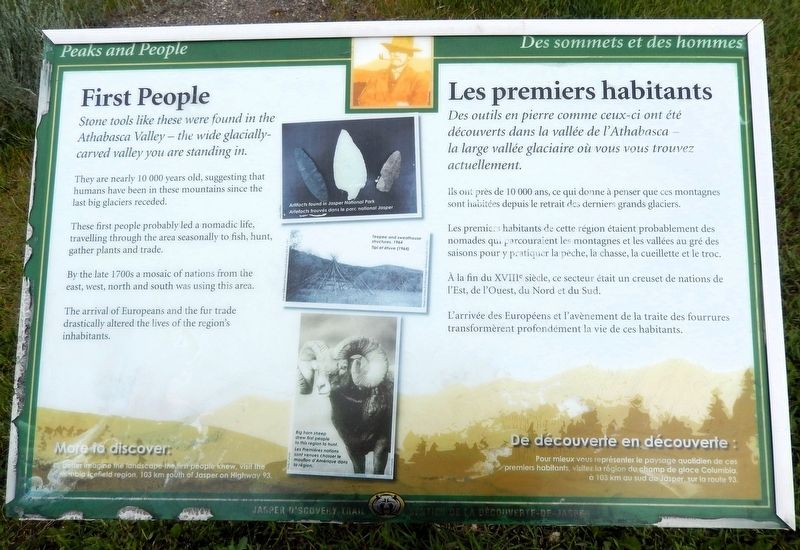
Stone tools like these were found in the Athabasca Valley — the wide glacially-carved valley you are standing in.
They are nearly 10,000 years old, suggesting that humans have been in these mountains since the last big glaciers receded.
These first people probably led a nomadic life, travelling through the area seasonally to fish, hunt, gather plants and trade.
By the late 1700s a mosaic of nations from the east, west, north and south was using this area.
The arrival of Europeans and the fur trade drastically altered the lives of the region's inhabitants.
[image captions]
• Artifacts found in Jasper National Park [Mike Dillon]
• Teepee and sweathouse structures, 1964 [Jasper-Yellowhead Museum and Archives (PA 37-17b)]
• Big horn sheep drew first people to this region to hung [Parks Canada]
More to discover: To better imagine the landscape the first people knew, visit the Columbia icefield region, 103 km south of Jasper on Highway 93.
Des outils en pierre comme ceux-ci ont été découverts dans la vallée de l'Athabasca — la large vallée glaciaire où vous vous trouvez actuellement.
Ils
this page online
Les premiers habitants de cette région étaient probablement des nomades qui parcouraient les montagnes et les vallées au gré des saisons pour y pratiquer la pêche, la chasse, la cueillette et le troc.
À la fin du XVIIIe siècle, ce secteur était un creuset de nations de l'Est, de l'Ouest, du Nord et du Sud.
L'arrivée des Européens et l'avènement de la traite des fourrures transformèrent profondément la vie de ces habitants.
[légendes d'images]
• Artefacts trouves dans le parc national Jasper. [Mike Dillon]
• Tipi et étuve (1964) [Jasper-Yellowhead Museum and Archives (PA 37-17b)]
• Les Premières nations sont venues chasser le mouflon d’Amérique dans la région. [Parcs Canada]
De découverte en découverte : Pour mieux vous représenter le paysage quotidien de ces premiers habitants, visitez la région du champ de glace Columbia, a 103 km au sud de Jasper, sur la route 93.
Erected by Jasper Discovery Trail / Sentier de la découverte-de-Jasper.
Topics. This historical marker is listed in these
Photographed by Cosmos Mariner, July 5, 2022
2. First People / Les premiers habitants Marker
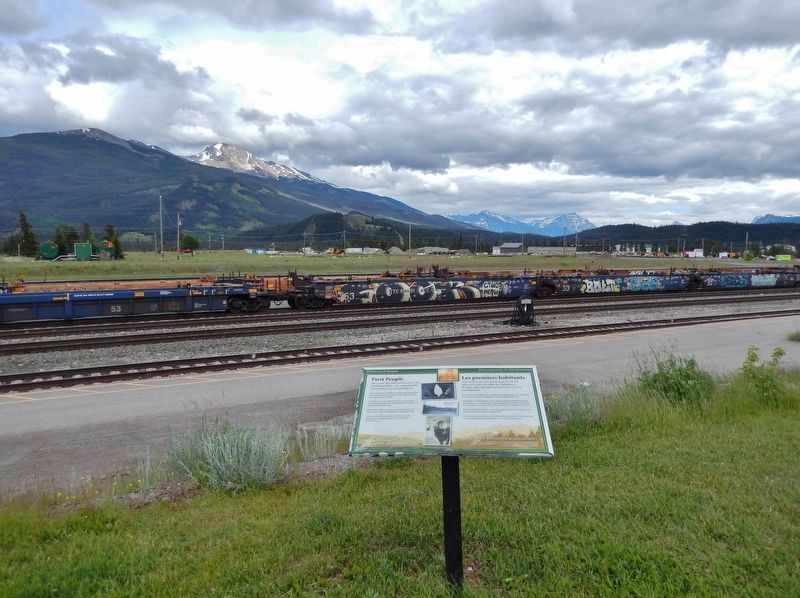
Looking southeast from the recreational trail that parallels Connaught Drive. An active rail yard and the Athabasca River Valley are in the background.
Location. 52° 52.762′ N, 118° 4.722′ W. Marker is in Jasper, Alberta. It can be reached from Connaught Drive just north of Pyramid Lake Road, on the right when traveling north. The marker is on the recreational trail that parallels Connaught Drive, about 10 meters east of the street. Touch for map. Marker is in this post office area: Jasper AB T0E 0A8, Canada. Touch for directions.

Regionally, this marker is in the Canadian Rockies. It is also in the Prairies. Globally, it is in North America, the Rocky Mountains, the Western Hemisphere, the Western World, and the Anglosphere. Historically, it finds itself in what was once a British colony and also Rupert’s Land.
Other nearby markers. At least 8 other markers are within walking distance of this marker: Memories of Home / Souvenirs d'un lieu de résidence / Weekiwawoo isitapatamook (about 180 meters away, measured in a direct line); A Lasting Legacy / Un legs durable / Aniskoonamakewin (about 180 meters away); The First Homesteaders / Les premiers homesteaders / Nistum Oota Ka Ki Weekichik (about 180 meters away); Original Jasper National Park Information Centre (about 210 meters away); In Honoured Memory of Those Who Paid the Supreme Sacrifice (about 240 meters away); Korean War (about 240 meters away); In Memory of the Canoe River Disaster (about 240 meters away); Jasper's Raven Totem Pole 1915-2009 / Mât totémique du Corbeau de Jasper de 1915 à 2009 (approx. 0.2 kilometers away). Touch for a list and map of all markers in Jasper.
Also see . . . Indigenous Connections (Parks Canada).
Excerpt: Since time immemorial, a diversity of Indigenous peoples lived on this land, and utilized and cared for the natural resources. Some groups spent almost all year in the Rocky Mountains, while others came to or through the area on a seasonal basis to access resources and ceremonial sites, to meet with other groups, or to use the mountain passes that permitted travel across the mountains.(Submitted on September 30, 2026, by Cosmos Mariner of Cape Canaveral, Florida.)
When Europeans came to the area in the early 1800s, Indigenous Peoples continued to care for the land and resources in the Jasper area while also beginning to work as trappers, traders, interpreters, and guides. The knowledge and experience of Indigenous Peoples allowed European explorers and fur traders to move through the Northern Rockies into the west through the Athabasca and Yellowhead passes (now national historic sites). Some Indigenous women married European fur traders and provided local knowledge and connections to surrounding Indigenous communities. In the late 1800s, several Indigenous families homesteaded and farmed near what is now the town of Jasper, while also working as outfitters and hunters for the fur trading companies.
Credits. This page was last revised on September 30, 2026. It was originally submitted on September 29, 2026, by Cosmos Mariner of Cape Canaveral, Florida. This page has been viewed 5 times since then. Photos: 1. submitted on September 29, 2026, by Cosmos Mariner of Cape Canaveral, Florida. 2. submitted on September 30, 2026, by Cosmos Mariner of Cape Canaveral, Florida.
