Grachtengordel in Amsterdam, North Holland, Netherlands — Northwestern Europe
Mary Zeldenrust Noordanus
| — | Walk of Pride Amsterdam | — |
Photographed by Andrew Ruppenstein, August 31, 2026
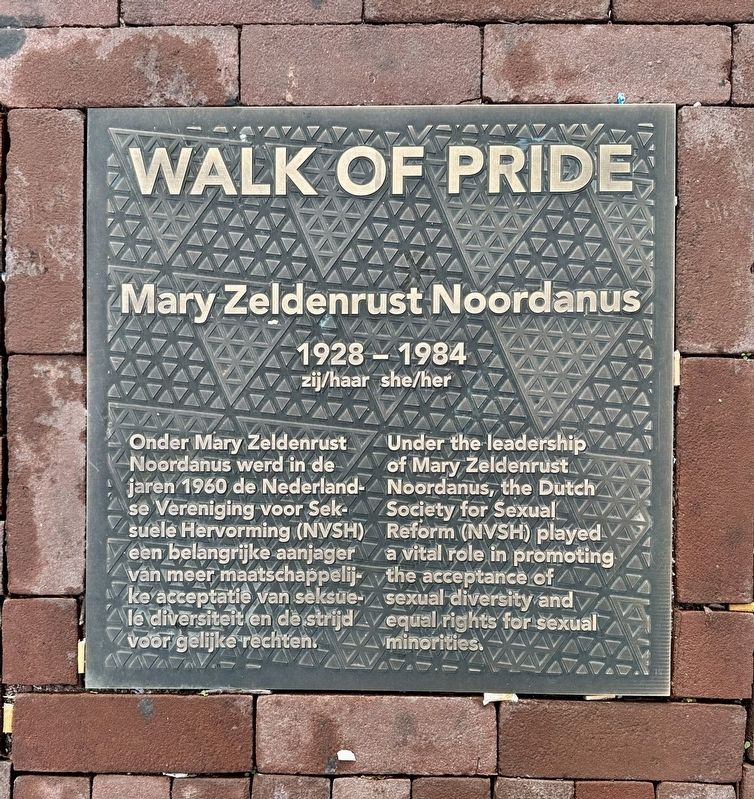
1. Mary Zeldenrust Noordanus Marker

Mary Zeldenrust Noordanus
1928-1984
zij/haar she/her;
Erected 2026 by Walk of Pride Amsterdam. (Marker Number 19.)
Topics and series. This historical marker is listed in these topic lists: Civil Rights • Women. In addition, it is included in the Walk of Pride Amsterdam series list. A significant historical year for this entry is 1960.
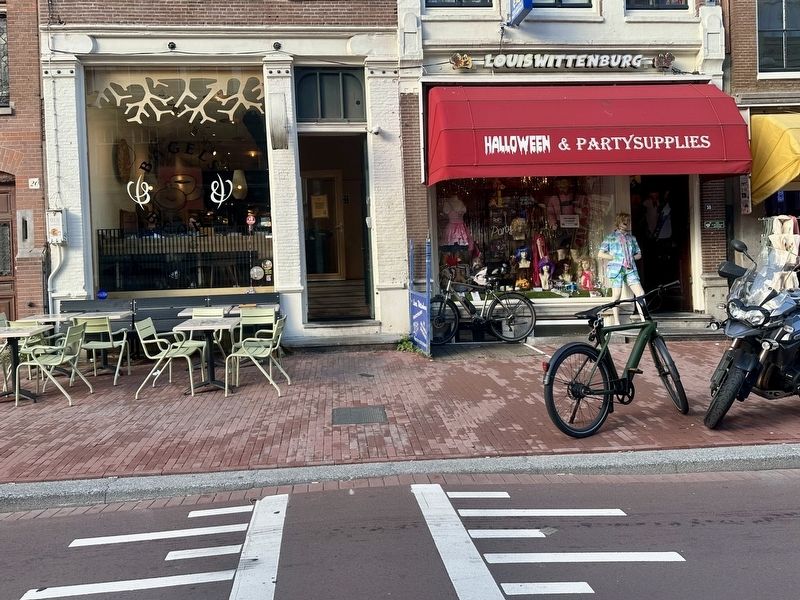
Location. 52° 22.404′ N, 4° 53.28′ E. Marker is in Amsterdam, Noord-Holland (North Holland). It is in Grachtengordel. It is on Raadhuisstraat west of Singel, on the right when traveling west. Touch for map. Marker is at or near this postal address: Raadhuisstraat 18HS, Amsterdam, Noord-Holland 1016 DE, Netherlands.
this page online

Regionally, it is in Europe, the European Union, Atlantic Europe, the Benelux Low Countries, the Schengen Area, Western Europe, and the Western World. Historically, it finds itself in what was once the Holy Roman Empire.
Other nearby markers. At least 8 other markers are within walking distance of this marker: Niek Engelschman (here, next to this marker); Edgar Caïro (here, next to this marker); Max Lievendag (a few steps from this marker); Inge Intven (a few steps from this marker); Aaïcha Bergamin (a few steps from this marker); Dirkje Kuik (a few steps from this marker); Tania Leon (a few steps from this marker); Janine Wegman (within shouting distance of this marker). Touch for a list and map of all markers in Amsterdam.
Also see . . . Mary Zeldenrust-Noordanus. Excerpt:
From the mid-1960s onward, society began to change rapidly. Religious divisions weakened and the influence of religion declined, including in matters of sexuality. The introduction of the contraceptive pill in the Netherlands in 1963—in cooperation with the NVSH—created new possibilities for family planning. Contraceptives(Submitted on October 1, 2026.)were no longer only available through the NVSH. Under her leadership, the organization experienced substantial growth. By 1966, the NVSH had 200,000 members and 60 clinics throughout the country.Photographed by Andrew Ruppenstein, September 5, 20262. Mary Zeldenrust Noordanus Marker - wide view
Through her media appearances, Zeldenrust-Noordanus became a national figure. The national newspaper Algemeen Dagblad even called her “the most talked-about woman in the Netherlands.” Her clear positions and openness provoked strong reactions. She received much praise but also fierce criticism and hate mail. This did not leave her unaffected: “I wasn’t prepared for that. You can easily ignore the first anonymous letter (…), but the number of those that I received—I really found that painful.” She nevertheless continued to speak out in favor of abortion rights, the acceptance of prostitution and homosexuality, and the breaking down of sexual taboos.
In 1967 she made an important appearance at the NVSH congress “SEXtant ’67” in Amsterdam’s RAI convention center, where she pleaded for a genuine acceptance of homosexuality and the abolition of Article 248bis, the stipulation in the Dutch Penal Code that raised the age of consent for same-sex sexual behavior compared to that for heterosexual sex: “Article 248bis is therefore completely unacceptable. The acceptance of homosexuality does not mean that somewhat pitiable acceptance, because it simply cannot be otherwise, but rather the recognition of many—more than just heterosexual and homosexual—ways of being human.” The controversial article of law was ultimately abolished in 1971. In that same decade, the entire system of morality legislation was modernized.
Credits. This page was last revised on October 1, 2026. It was originally submitted on October 1, 2026, by Andrew Ruppenstein of Lamorinda, California. This page has been viewed 4 times since then. Photos: 1, 2. submitted on October 1, 2026, by Andrew Ruppenstein of Lamorinda, California.
